
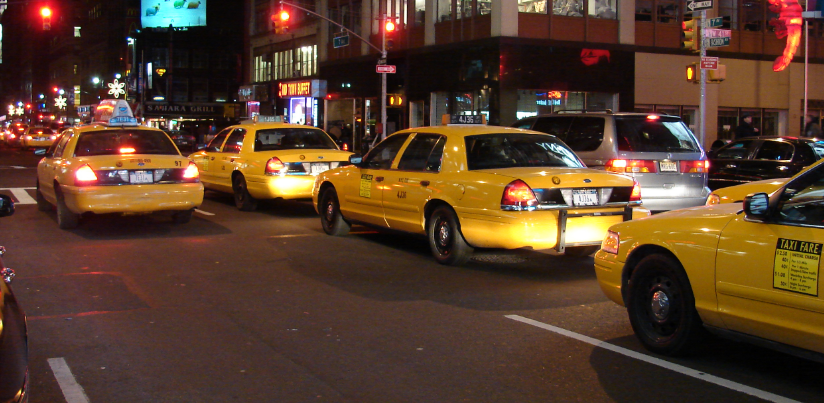
There are over 14,000 taxis that operate in New York City, however, researchers at MIT found that 98 percent of taxi demand in the Big Apple could be served by just 3,000 four-passenger cars.
The findings of the research suggest that ride-sharing services, such as those provided by Uber and Lyft, could help curb traffic congestion, in addition to reducing pollution and energy usage.
Professor Daniela Rus and colleagues developed an algorithm that found it would only require 3,000 four-passenger cars to meet almost all of the city’s taxi demand, with an average waiting time of 2.7 minutes.
They also found that it would only require 2,000 ten-person vehicles to meet 95 percent of taxi demand in the city.
“A system like this could allow drivers to work shorter shifts, while also creating less traffic, cleaner air and shorter, less stressful commutes.”
The team used data from 3 million NYC taxi rides to create an algorithm which works in real time to “reroute cars based on incoming requests” and “proactively send idle cars to areas with high demand.”
“To our knowledge, this is the first time that scientists have been able to experimentally quantify the trade-off between fleet size, capacity, waiting time, travel delay and operational costs for a range of vehicles, from taxis to vans and shuttles,” said Prof Rus.
“What is more, the system is particularly suited to autonomous [self-driving] cars, since it can continuously reroute vehicles based on real-time requests.”
Carpooling is not a new concept, but only a few years ago companies started leveraging smartphone data to make it a more accessible and viable option of transportation for the masses.
The MIT system, which Professor Rus said would be openly available, works by creating a graph of all requests and all vehicles. The system then creates a second graph of all possible trip combinations and uses a method called “integer linear programming” to compute the best assignment of vehicles to trips.
“A key challenge was to develop a real-time solution that considers the thousands of vehicles and requests at once,” says Rus.
“We can do this in our method because that first step enables us to understand and abstract the road network at a fine level of detail.”
Rus calls the final product an “anytime optimal algorithm”.
“Ride-sharing services have enormous potential for positive societal impact with respect to congestion, pollution and energy consumption,” says Rus.
“It’s important that we as researchers do everything we can to explore ways to make these transportation systems as efficient and reliable as possible.”
