

Additional value of 5 to 6 per kilowatt hour could be added by Concentrating Solar Power (CSP) projects to utility-scale solar energy in California, says a news report by the National Renewable Energy Laboratory (NREL), part of the US Energy Department.
The US government has stipulated that at least 33% of California’s energy mix must consist of renewables within six years.
The new NREL report, “Estimating the Value of Utility-Scale Solar Technologies in California Under a 40% Renewable Portfolio Standard (RPS),” found that CSP helps maintain firm capacity after the sun has gone down because of its ability to store energy for several hours.
When compared to variable generation technologies, this means an increase in value of five cents per kilowatt hour under the 2020 mandate’s 33% renewable standard, or 6 cents per kilowatt hour if renewables accounted for 40%.
After 2020, California aims to further reduce greenhouse gasses emissions to 80% of 1990’s level by the year 2050. In order to achieve this goal, governor Jerry brown says a higher 40% RPS might be reachable in the near term.
Earlier this month, The Environmental Protection Agency (EPA) launched its Clean Power Plan – guidelines to reduce carbon emissions from existing power plants. If existing power plants comply with the proposal, the EPA says Americans will enjoy a cleaner environment as well as reliable and affordable power.
Concentrated Solar Power could reduce costs
During peak demand CPS could help reduce electricity bills, the NREL says.
Co-author NREL CSP Group Manager Mark Mehos, and study-colleagues Jennie Jorgenson and Paul Denholm said:
“CSP adds significant additional value when compared to less flexible generation sources. As the penetration of renewables rises, so does the relative value of CSP.”
“CSP could also allow greater penetration of PV by making the grid more flexible and reducing curtailment of PV by generating energy after the sun sets. We intend to investigate this in more detail for the remainder of this year.”
Unlike photovoltaic modules which capture sunlight and turns it into useable electricity, CSP technologies concentrate the sun’s light and capture that energy in the form of heat, which then powers a turbine or engine to produce electricity.
CSP energy can be held back
However, CSP generates thermal energy that can be held back for many hours via storage systems, such as molten salts. The stored energy can then be released when demand after sunset is still strong, for say, lighting, television or air conditioning.
Funding for the new report came from the SunShot Initiative, which was paid for by the Energy Department’s Office of Energy Efficiency and Renewable Energy. The report compared the total operating costs of a system with or without an incremental amount of Concentrated Solar Power with thermal energy storage or solar PV. Capacity value is also analyzed.
This latest report is the second in a series that analyzes the value of CSP with thermal energy storage. The previous report was titled, “Estimating the Performance and Economic Value of Multiple Concentrating Solar Power Technologies in a Production Cost Model.”
Concentrated Solar Power
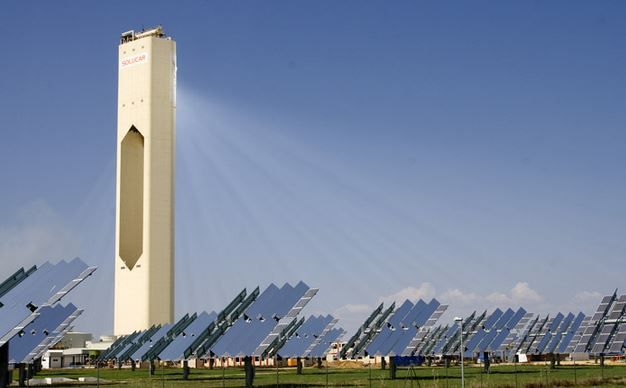
Concentrated Solar Power, also known as Concentrating Solar Power or Concentrated Solar Thermal, is a system that uses lenses or mirrors to concentrate a large area of solar thermal energy (sunlight) onto a small area.
Electricity is produced when the concentrated light is turned into heat, which then drives a steam turbine or some other kind of heat engine that is connected to electrical power generators; it may also power a thermochemical reaction.
In February 2014, the $2.2 billion Ivanpah Solar Thermal Power Plant, the largest of its kind in the world, started operating in the Mojave desert, California. It covers 3,500 acres and has more than 300,000 mirrors.
The largest producers of CSP are the United States, Spain and China.
