
A national index of customer satisfaction in the United Kingdom puts Amazon at the top of the list for the second year running.
The UK Customer Satisfaction Index (UKCSI) measures customer satisfaction across 13 sectors of the economy. It has been going since 2008 and draws its data from a nationally representative, 6-monthly survey of 10,000 consumers.
 This is the second year running that Amazon ranks as the organization with the highest customer satisfaction in the UK.
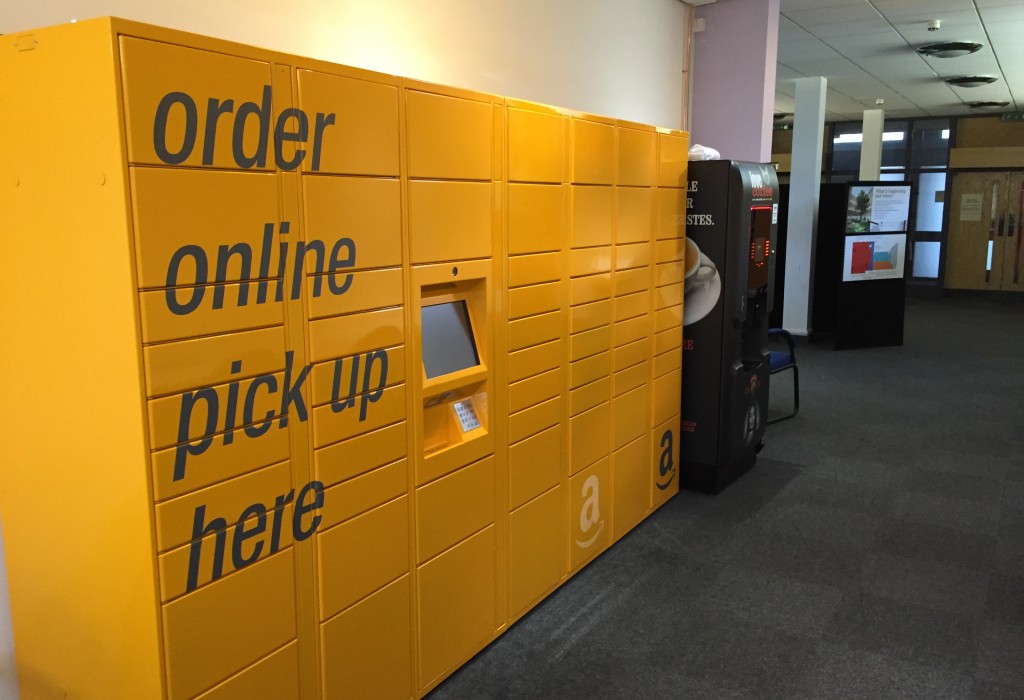
Image: Amazon locker Savana is used by students at Lancaster University.
The index – expressed as a score out of 100 – measures customer satisfaction at the national, sector, and organizational level.
It takes into account 30 different factors, including: staff professionalism, quality and efficiency, ease of doing business, problem solving, timeliness, and complaint handling. It also assesses attitudes towards trust and reputation.
The January 2017 figures – the first to include survey responses collected since the Brexit referendum – show the organization that UK customers are most satisfied with is Amazon.
The other organizations in the top 10 that customers are most satisfied with are: ASOS.com, John Lewis, M&S, Waitrose, Nationwide, first direct, Greggs, giffgaff, and Iceland.
This is the second year running that Amazon ranks as the organization with the highest levels of customer satisfaction in the UK, says the Institute of Customer Service – a professional membership body that administers the UKCSI.
To thank its customers, Amazon.co.uk offered them £10 off selected orders over £50 placed on the day the UKCSI report came out.
Non-food retail is the strongest sector for customer satisfaction
The 13 sectors covered by the UKCSI are: Automotive, Banks/Building societies, Insurance, Leisure, Public services (local), Public services (national), Retail (food), Retail (non-food), Services, Telecomms/media, Tourism, Transport, and Utilities.
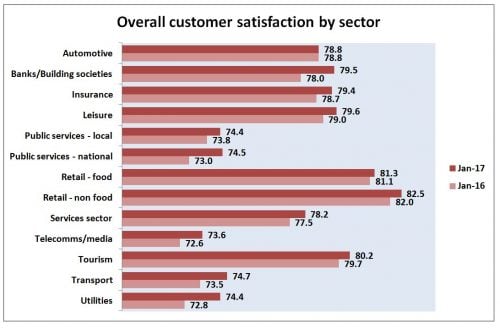 Data from: Institute of Customer Service, UKCSI January 2017
Of the 13 sectors, non-food retailers come out the strongest in the latest report, scoring a UKCSI average of 82.5, with Amazon and ASOS scoring 87.3 and 85.8 respectively at the top of the sector.
The next strongest performing sector is food retail, with an average score of 81.3. M&S scored the highest in customer satisfaction in this sector (85.0), while Tesco was the most improved supermarket chain.
The report notes that all sectors have improved since the same time last year – except for automotive, which scored 78.8 for the second year running.
However, while the year-on-year customer satisfaction profile for the automotive sector looks static, it masks some brisk activity, with five organizations going up two points, and six coming down by at least that.
Getting better at the basics but more work to be done
Across the board the January 2017 UKCSI score for customer satisfaction is 77.8 – up 0.8 from a year ago. It has grown every year for the last 4 years and is at its highest point since 2013.
The report also shows that this coincides with an increase in the number of customers experiencing a problem with an organization – which has risen to 13.1 percent from 12.6 percent in the previous January.
This is unusual, as increases in customer satisfaction are normally accompanied by a drop – not a rise – in the number of problems that customers experience.
The report also notes that satisfaction with complaint handling has gone up, as has trust in UK organizations.
But what makes the top 50 organizations stand out from the rest, is that they are better at handling complaints (for instance staff doing as promised, resolving problems speedily) and over-the-phone experiences.
Shift in the way customers interact
Perhaps a trend to watch is the finding that over the past year there has been a significant shift in the way customers interact with organizations.
Interaction via website, webchat, apps, text, and email have nearly doubled, rising to 9 percent of customer interactions from 4.9 percent a year earlier.
The most noticeable rise has been in interaction via email, which customers are increasingly using as a means to deal with potentially difficult interactions, such as making enquiries, reporting problems, or raising complaints.
The report notes that: “The skill with which email experiences are managed will be a growing influence on customer satisfaction for many organizations.”
Jo Causon, Chief Executive of the Institute of Customer Service highlights the fact interacting with customers via email, website, apps, webchat, and text, makes it very difficult for service staff to show empathy. She, says:
“Organizations therefore need to make sure that their staff are highly engaged and highly skilled, as every customer interaction – regardless of the channel it’s on – counts towards business performance.”
Video – Summary of UKCSI for January 2017
