

The majority of American wages remain unchanged, says a new study by the Economic Policy Institute. Workers have hardly seen any real wage growth in the last thirty-five years, the author informs.
The study is titled Why America’s Workers Need Faster Wage Growth – And What Can We Do About It?, which was written by economist Elise Gould, who found that inflation-adjusted hourly wages for most US workers declined in the first six months of this year, compared to H1 2013.
Ms. Gould gathered and analyzed six months’ worth of wage data from the Census Bureau’s Current Population Survey Outgoing Rotation Group, and found:
- For high-wage earners and individuals with a university degree wages have fallen. These groups have the lowest unemployment levels. The author says this is evidence that the economy has a long way to go before reaching full employment, and shows that the Federal Reserve System should postpone considering raising interest rates.
- Over the last 12 months, pay for the broad middle class has fallen, a trend that has persisted for the past 4 decades. “Dismal wage growth” has brought about income stagnation and a widening wealth gap.
- Wage earners in the bottom 10th percentile (10 percent lowest earners) did not experience falling wages over the last 12 months – the only group to suffer no decline. This is thanks to legislated minimum wage increases in H1 2014 where 40% of the country’s workers live.
Ms. Gould said:
“Despite a recovering economy and growing productivity, employers are not putting anything more in their employees’ paychecks. Over the past forty years, corporations, and their CEOs and lobbyists, have used public policy to stack the deck in their favor.”
“The only way to strengthen the middle class is to grow wages, and for that we need policies that deal workers a stronger hand.”
Ms. Gould puts forward the following policy changes that could strengthen employees’ leverage and lead to increased wages:
- raise the minimum wage,
- make it easier for workers to form unions,
- take firm action to stop wage theft,
- expand provisions for overtime,
- stop the misclassification of employees as independent contractors.
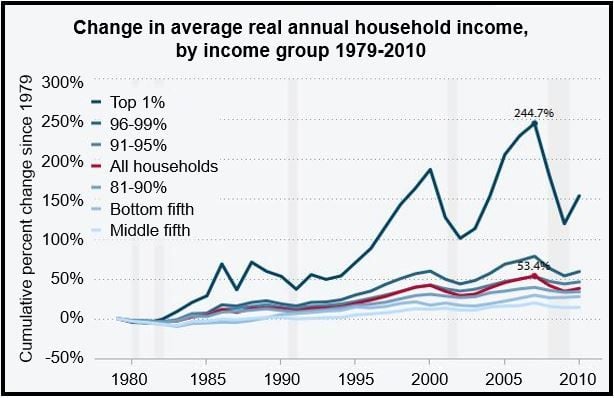
(Data Source: Economic Policy Institute)
In a separate study published last week, the Census Bureau informed that from 2000 to 2001, inequality in the United States increased.
