
An Apple IBM global partnership has been announced by the two companies, which they claim will transform enterprise mobility. In other words, the multinational giants have got together to develop iPhone and iPad apps aimed at big businesses or enterprises.
The partnership has its risks because corporate clients say tablets and smartphones are not as good as PCs for their employees’ broad range of tasks.
According to Tim Cook, Apple’s CEO, eighty percent of his work is done using an iPad. He cannot see why everybody else shouldn’t be like that. He said the aim of the partnership is to make corporate apps as simple as consumer ones.
Apple says the partnership will bring IBM’s big data and analytics capabilities to iPad and iPhone and redefine how work gets done.
The two companies plan to launch:
- a new class of over 100 sector-specific enterprise solutions, including native apps developed exclusively for iPads and iPhones,
- IBM cloud services optimized uniquely for iOS, including mobile integration, analytics, security, and device management,
- a new AppleCare service and support offering tailored to the enterprise’s requirements, and
- new packaged IBM offerings for device activation, supply and management.
IBM MobileFirst for iOS
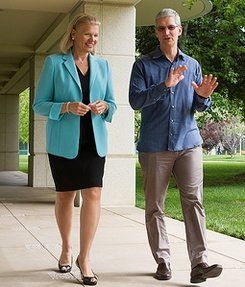
The two companies say that together they can create apps that will change how firms and their employees work using iPads and iPhones. They believe the result will be superior efficiency and effectiveness, and better customer satisfaction.
The “IBM MobileFirst for iOS” agreement means that IBM will also sell iPads and iPhones with the industry-specific solutions to business customers globally.
Mr. Cook said:
“iPhone and iPad are the best mobile devices in the world and have transformed the way people work with over 98 percent of the Fortune 500 and over 92 percent of the Global 500 using iOS devices in their business today.”
“For the first time ever we’re putting IBM’s renowned big data analytics at iOS users’ fingertips, which opens up a large market opportunity for Apple. This is a radical step for enterprise and something that only Apple and IBM can deliver.”
Ginni Rometty, IBM Chairman, President and CEO, says mobility, data and cloud are transforming businesses in historic ways.
Ms. Rometty said:
“This alliance with Apple will build on our momentum in bringing these innovations to our clients globally, and leverages IBM’s leadership in analytics, cloud, software and services. We are delighted to be teaming with Apple, whose innovations have transformed our lives in ways we take for granted, but can’t imagine living without.”
“Our alliance will bring the same kind of transformation to the way people work, industries operate and companies perform.”
Old enemies come together
Such an alliance would have been virtually impossible during the 1980s. Apple and IBM used to be arch-enemies that fought fiercely for market share during the early days of personal computing.
Daisuke Wakabayashi at the Wall Street Journal wrote “A partnership between the two companies would have been unthinkable 30 years ago when Apple famously attacked IBM in an iconic commercial entitled ’1984,’ painting IBM as a big-brother-like figure protecting the status quo while Apple’s Macintosh provided a pathway to freedom.”
Ten years after the advertisement, when Microsoft had captured most of global market share, Apple and IBM got together to produce an operating system called Taligent. It was commercially unsuccessful and that partnership only lasted three years. Within days of dissolving the partnership, Apple acquired Next bringing back Steve Jobs, an Apple co-founder.
The two companies got together again twice, but neither venture got anywhere.
IBM (International Business Machines), based in Armonk, New York, has generated more patents for 20 successive years than any other company.
Companies prefer PCs
Analysts wonder how risky Mr. Cook’s ambition might be. Intel’s Q2 financial results posted a rebound in sales of PCs to corporate customers. A recent survey carried out by Bob O’Donnel at TECHnalysis Research found that most corporate customers prefer PCs to tablets or smartphones.
Perhaps the partnership aims to address this corporate preference.
Bad news for BlackBerry
Soon after IBM and Apple announced their partnership, BlackBerry shares fell more than 9% in one day. BlackBerry CEO John Chen is in the middle of a company turnaround which involves targeting exactly the same customers.
Reuters quotes John Jackson, an IDC analyst, who said “It is not a crushing blow at this early stage, but it is a negative for BlackBerry. There can be little question that it is unwelcome, if not entirely unexpected news.”
Brian Colello, an analyst at Morningstar wrote in a note to clients “The partnership’s software around data security and device management pose immediate threats to mobile device management (MDM) software solutions deployed by firms such as BlackBerry and MobileIron. Even if Apple-IBM’s security ‘mousetrap’ isn’t as good as ones offered by BlackBerry and others, these MDM vendors will have to overcome the extremely high hurdle of displacing IBM’s mobile device software preloaded on iPhones and iPads.”
