
Canadian real GDP (gross domestic product) shrank by 0.6% in May, the steepest monthly decline in more than seven years (since March 2009). The contraction was mainly due to lower non-conventional oil extraction, which was a consequence of the Fort McMurray wildfire and evacuation.
The 2016 Fort McMurray Wildfire, also called the Horse River Fire, is a huge wildfire burning in the provinces of Saskatchewan and Alberta. It started on May 3rd southwest of Fort McMurray in Alberta, and swept through the community, destroying more than 2,400 homes and buildings.
The fire forced the largest evacuation in the history of Alberta. It continued spreading across northern Alberta into Saskatchewan, destroying massive forested areas and severely halting Athabasca oil sands operations.
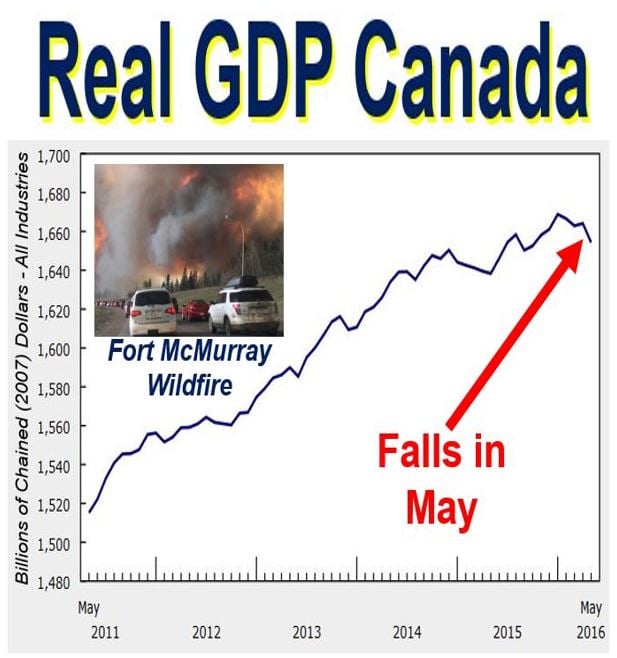 According to Statistics Canada: “Disasters—such as wildfires, floods, ice storms or other major catastrophes—have an impact on economic activity because 1) current production is affected, 2) structures, equipment, and other assets are damaged or destroyed and must later be repaired or replaced, and 3) transactions, such as payments of insurance benefits or government disaster relief, take place as a result of the damages incurred.” (Image: statcan.gc.ca)
Canada’s costliest disaster
The fire was declared ‘under control’ on July 5th, after it had spread across more than 1,500,000 acres (590,000 hectares). The Canadian government says it is by far the costliest disaster in the country’s history.
The Fort McMurray wildfire was the main reason for the 2.8% fall in the output of goods-producing industries. The mining, quarrying and oil & gas extraction sector reported a 6.4% decline in activity, while the output of the non-conventional oil extraction industry posted a 22% fall.
During April there were extensive maintenance shutdowns at upgrader facilities, which meant that that month also reported a decline of 8.1%. May’s output level for this industry was the lowest since the same month in 2011.
Real GDP shrank by 0.1% in May after excluding the decline in the non-conventional oil extraction industry.
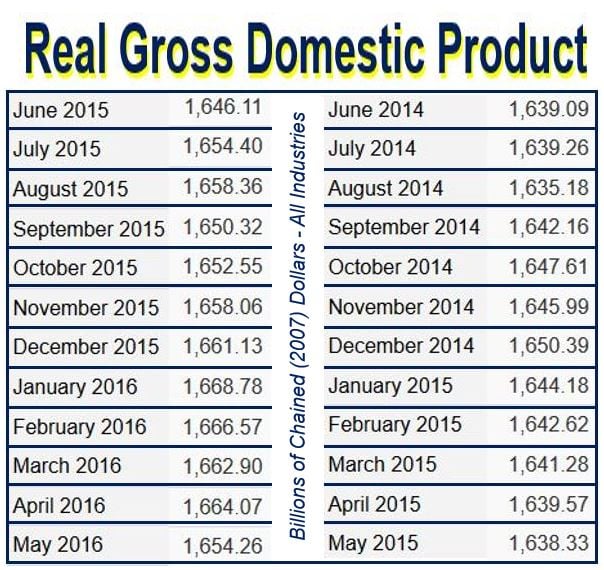 Canadian real GDP fell in May 2016, due to a colossal fire. Will activity now increase significantly – especially construction – because the thousands of homes and buildings that were destroyed need to be rebuilt? (Image: Statistics Canada)
According to Statistics Canada:
“There was little evidence that the Fort McMurray wildfire significantly affected other industries at the national level. Therefore, the difference between the overall 0.6% decline in GDP and the 0.1% decrease in GDP excluding the non-conventional oil and gas industry is an approximation of the direct impact that the Fort McMurray wildfire had on overall growth in May.”
Service-producing industries reported a 0.3% expansion in May. The arts, entertainment and recreation sector; the public sector; wholesale and retail trade; and the finance and insurance sector were all up.
Administrative services and transportation & warehousing services, however, were down. The Fort McMurray wildfire and evacuation had a negligible impact on most of the service-producing industries across the country.
Mining, quarrying, and oil & gas extraction sector
The mining, quarrying and oil & gas extraction sector posted decreases in mining except oil & gas extraction (-0.4%) and support activities for mining, and oil & gas extraction (-3.3%).
The drop in mining excluding oil & gas extraction was principally due to lower output at metal ore mines, such as nickel and copper, which offset growth in potash mining. Ore refers to naturally-occurring rock with metal or metal compounds in it.
For the fourth successive month, support activities for mining and oil & gas extraction posted declines, mainly due to a fall in support activities for mining.
Conventional oil & gas extraction, on the other hand, increased 0.6% in May. The majority of Canada’s crude petroleum extraction facilities are located far from the areas that were affected by the wildfire.
Manufacturing output
Manufacturing output fell 2.4% in May, the largest fall since January 2009. Both non-durable and durable goods manufacturing were down significantly.
Output at petroleum refineries was 15% down in May, which drove non-durable goods manufacturing to report a 2.8% contraction for the month.
According to Statistics Canada:
“The decrease at petroleum refineries reflected a loss in availability of crude oil for refining—due to the Fort McMurray wildfire – combined with maintenance and turnaround work at some facilities. Chemical manufacturing (-3.9%) also posted a notable decline.”
Durable-goods manufacturing fell by 2.1% in May. Most industry subgroups posted declines.
Utilities: fell by 1.8% in May. Natural gas distribution as well as electric power generation, transmission and generation were down. May’s decline offset much of April’s surge, which was caused by Central Canada having a colder-than-average month.
The public Sector: which includes public administration, health and education, increased by 0.3% in May – the sector’s ninth successive month of growth.
Wholesale and Retail Trade: the wholesale trade posted a 1% increase in May, with food, beverage, tobacco, motor vehicles & parts, and personal household goods wholesalers reporting strong growth.
Farm product wholesales reported a decline, as did miscellaneous wholesalers.
The retail trade saw business grow by 0.4% in May, mainly due to strong sales from food & beverage stores, clothing & clothing accessories stores, and filling stations.
Retailers of motor vehicles & parts, furniture & home furnishing stores, as well as general merchandise stores (including department stores) posted declines.
Construction: after a flat April, the sector decreased by 0.7% in May. Residential building construction shrank by 1.2% – fewer single-family homes were built.
Finance and Insurance: saw business grow by 0.6% in May – the third successive monthly gain. Insurance carriers reported strong growth, reflecting an increase in claims as a result of the Fort McMurray wildfire.
Financial investment services also grew in May, as did (to a lesser extent) banking services.
Other industries
– Transportation & warehousing services: down
– Rail transportation: down
– Pipeline transportation: down
– Arts, entertainment & recreation: up
Video – The fight to save Fort McMurray
This CBC News video contains an in-depth look at the battle to save Fort McMurray by Marion Warnica.
