

Developers have started pilot testing the world’s first carbon removal solution that captures carbon dioxide from the atmosphere, mineralizes it, and sends it more than 700 metres underground.
The pilot plant at Hellisheidi in Iceland, next to one of the world’s largest geothermal power stations, is part of an EU-backed “negative emissions” scheme called CarbFix2.
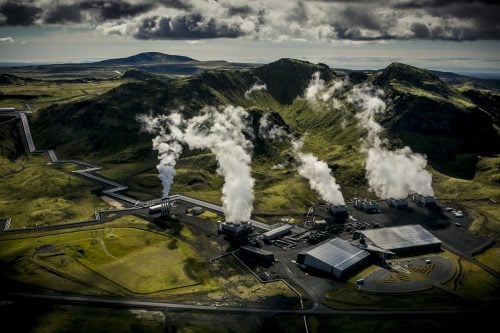 Iceland’s Hellisheidi geothermal power plant already removes CO2 from geothermal steam and stores it in underground rock in mineral from. The new carbon removal project will test capture of CO2 from the air. Image: Árni Sæberg
Carbon removal
Carbon removal started at Hellisheidi in 2007. That was when teams of scientists, technicians, and industrialists came together to work on a project led by Reykjavik Energy, called CarbFix.
Hellisheidi’s geothermal power plant generates electricity and hot water from geothermal steam, which contains variable amounts of geothermal gases, including the greenhouse gas carbon dioxide (CO2).
Using CarbFix technology, the power plant removes the CO2 from the geothermal steam and fixes it as minerals in the basalt bedrock that lies hundreds of meters under the ground.
CO2 turned into rock in under 2 years
A study reported in Science in 2016 found that “over 95 percent of the CO2 injected into the CarbFix site in Iceland was mineralized to carbonate minerals in less than 2 years.”
It was previously thought that “immobilizing” CO2 in this way would take “several hundreds to thousands of years.”
The study results showed that the CarbFix site in Iceland can safely store manmade CO2 emissions as minerals and can be much faster than previously thought.
CarbFix2 is similar to Carbfix in that it captures CO2 and mineralizes it in basalt bedrock.
CO2 from air into rock
However, unlike Carbfix, instead of capturing CO2 from the geothermal steam, CarbFix2 captures it from the atmosphere, where rising levels of manmade CO2 and other greenhouse gases are contributing to global warming.
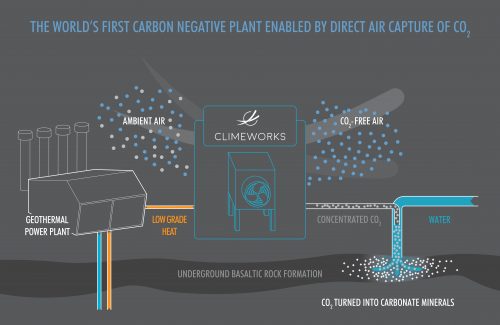 The new carbon removal project will use direct air capture technology to remove CO2 from the air.
Credit: Climeworks
Such a technology, if proved to work on a large, commercial scale, could be invaluable in helping to achieve the climate change mitigation goals set out in the 2016 Paris Agreement, which aims to keep the “global temperature rise this century well below 2 degrees Celsius above pre-industrial levels.”
Climeworks, the Swiss company that developed the direct air capture (DAC) technology behind CarbFix2, say that research shows that the 2-degree target is “not achievable without carbon removal solutions.”
“The potential of scaling-up our technology in combination with CO2 storage, is enormous,” says Christoph Gebald, Climeworks’ founder and CEO.
“By integrating the Climeworks and CarbFix technologies we create a solution that is deployable where we have basalt but independent of the location of emissions,” says Edda Sif Aradóttir, leader of the CarbFix project at Reykjavik Energy. “This is important to scale up the CarbFix approach on a global level.”
In addition to Reykjavik Energy and Climeworks, the other partners in the CarbFix2 carbon removal project are: the University of Iceland; the National Centre for Scientific Research (CNRS) in France; and the Spanish environmental consultancy Amphos 21.
The EU project started in August 2017 and runs until the end of January 2021.
