
A team of cardiologists used the Google Glass device to help control the blood flow of a blocked right coronary artery in a 49-year-old male patient.
The team of doctors from the Institute of Cardiology, Warsaw, were able to restore the flow of blood in the blocked artery with help from the the eye-wearable gadget.
Their report is published in the Canadian Journal of Cardiology.
Google Glass played a key role in the construction and digital presentation of tomographic images i.e. images in a section-wise manner. The doctors were able to control the device with voice commands – allowing both hands to be free to operate.
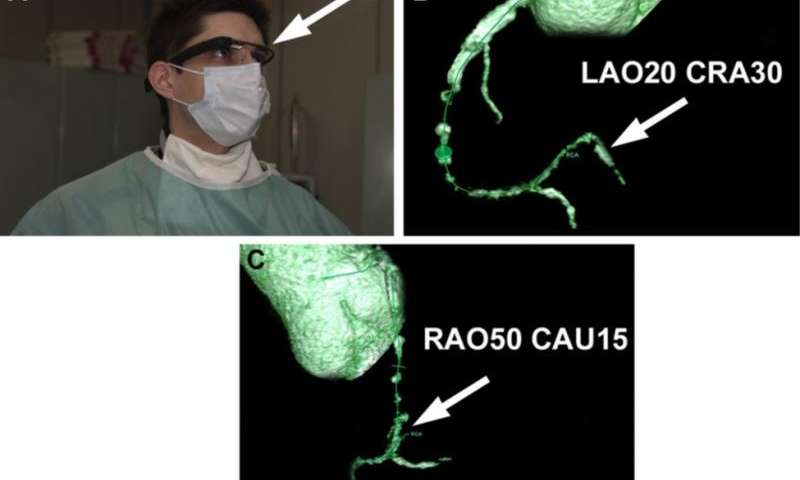 A cardiologist views computed tomography angiography images in the upper right visual field on Google Glass.
Using the images provided by Google Glass the physicians were able to clearly visualise the distal coronary vessel and determine the direction of the guide wire relative to the course of the blocked vessel segment, clear the blockage, and implant two drug-releasing stents.
“This case exhibits the novel use of wearable gadgets for showcase of informations in the catheterisation lab that can be utilized for better arranging and direction of interventional methodology,” said lead examiner Maksymilian P Opolski from the Institute of Cardiology.
“Mobile technology is easily accessible and offers an incremental opportunity to expand the existing open platform for mobile applications, which might in turn overcome the economic and capacity limitations of advanced angiography systems with dedicated monitors for projection of CTA data sets,” added Dr. Opolski.
“Furthermore, wearable devices might be potentially equipped with filter lenses that provide protection against X-radiation. We believe wearable computers have a great potential to optimize percutaneous revascularization, and thus favorably affect interventional cardiologists in their daily clinical activities.”
The Google Glass head-mounted display can display and capture images and videos while interacting with the surrounding environment.

Comments are closed.