
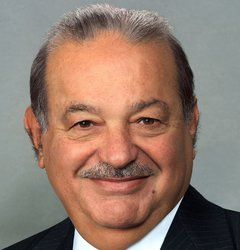
Carlos Slim slims América Móvil’s presence after new Mexican legislation stipulates that no company is allowed to have a 50%+ share of the national market. The world’s second richest man says he will bring his empire’s market share below the new ceiling.
América Móvil, owned by Slim, controls:
- 70% of the mobile market through Telcel, and
- 80% of the fixed line market through Telmex.
Under the new legislation, which is expected to sail through Congress this week, Slim’s company will have to share infrastructure with Madrid-based Telefonica and other rivals.
In March, 2014, the Mexican telecom regulator declared América Móvil dominant in fixed-line and mobile telecom and imposed measures including slashing interconnection rates that Telcel charges rivals to complete calls, as well as making the monopoly share its network.
When the new legislation is passed in Congress, mobile interconnection rates will be reduced to zero and domestic long-distance charges will be phased out.
Telmex is now no longer allowed to add TV to its telephone and broadband offerings, while other cable operators can offer TV, phone and broadband as one package.
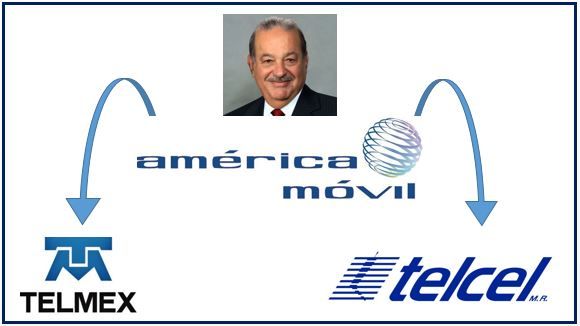
Carlos Slim, through América Móvil and its subsidiaries Telcel and Telmex, dominates Mexico’s telecoms market.
Peña Nieto’s more competition pledge
The new law was introduced by President Enrique Peña Nieto, who took office in December 2012. He pledged to bolster competition in the Mexican economy.
In a move to avoid breaking the new law, América Móvil says it will present its restructuring plan to the Instituto Federal de Telecomunicaciones (IFT), the new telecoms watchdog.
América Móvil is likely to split its infrastructure business and cellphone towers into separate entities.
There is some good news for América Móvil. As soon as its market share falls below 50%, it will then be allowed to compete in other markets, such as pay-TV, something it is not currently allowed to do.
Televisa must reduce market share
Televisa, the largest provider of Spanish-language content worldwide, will also be affected. It has over 60% of the Mexican free-to-air TV market.
Mexico’s Ministry of Telecommunications and Transportation (Secretaría de Comunicaciones y Transportes) announced today that América Móvil informed the Mexican Stock Exchange of its decision to sell off certain assets to a new independent operator in order to reduce its market share to below 50%.
The Ministry of Telecommunications and Transportation wrote:
“The Ministry believes its new legislation may transform the conditions for competition in the telecoms sector, resulting in superior quality and better prices for end users.”
“The Federal Telecommunications Institute will evaluate América Móvil plan.”
América Móvil confirms divestment plans
América Móvil wrote in a press release:
“América Móvil informs that its Board of Directors, at its ordinary meeting held today, after having analyzed several alternatives and recommendations presented by the Strategic Committee, resolved to authorize measures to reduce its national market share in the Mexican telecommunications market under fifty percent in order to cease being a ‘preponderant economic agent,’ under the terms of the Constitution of the United Mexican States and its implementing legislation.”
“The Board of Directors of América Móvil decided upon the sale of certain assets to a new and solid carrier independent of América Móvil, with experience in the telecommunications sector, with sound economic and technical resources, being a real option to participate in this capital-intensive sector, to overcome the obstacle of the insufficient investment made by our Mexican competitors.”
Regarding the planned sales, the company gave no time frame.
According to Mr. Slim’s company, rival firms have had difficulties in competing effectively because of their lack of investment. América Móvil has the most advanced technology because it has invested heavily in Mexico and Latin America, the company claims. “These investments have resulted in important and continuous productivity increases which have been passed on to our clients,” it added.
In June, Carlos Slim agreed to acquire AT&T’s América Móvil’s stake as the US giant moved to avoid a conflict of interest after acquiring DIRECTV, a competitor of América Móvil in Latin America.
