
China

China’s banking system is now the world’s largest by assets

Written by Joseph Nordqvist

Published: 08:54, March 7, 2017

The Chinese banking system is now the world’s largest by assets.

Chinese bank assets rose to $33 trillion at the end of 2016, surpassing $31 trillion for the Eurozone and $16 trillion for the US, according to a report by The Financial Times. 

The Chinese banking system is more than triple (3.1 times) the size of the nation’s annual economic output, largely due to a surge in lending following the 2008 global financial crisis.

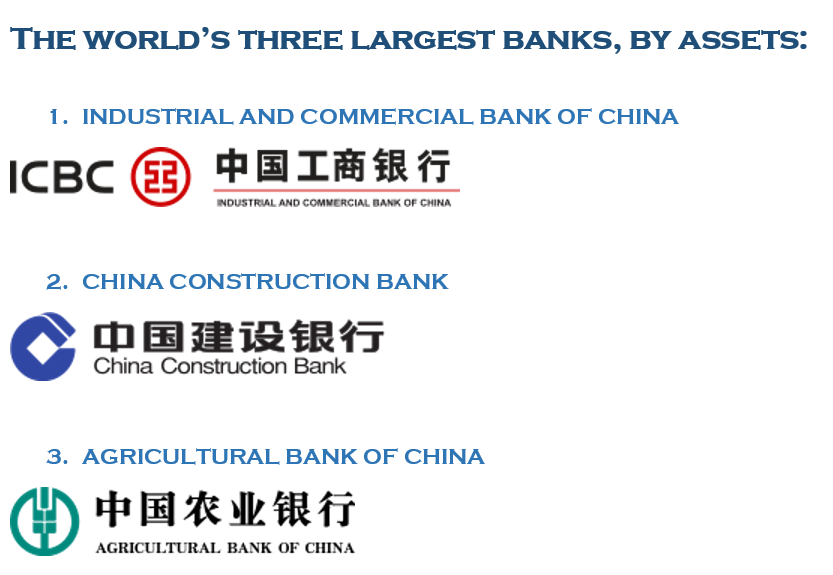
The world’s three largest banks are now Chinese.

The largest bank in the world, by assets, is the Industrial and Commercial Bank of China, followed by China Construction Bank and the Agricultural Bank of China.
Largest_Banks_Chinese
The three largest banks in the world (in terms of assets) are now Chinese.

There is concern that Beijing’s fiscal stimulus programme to boost the economy has created a dangerous debt bubble, with overcapacity in certain industries, unsustainable debt levels, and wasteful investments.

Eswar Prasad, economist at Cornell University and former China head of the International Monetary Fund, told the FT:

“The massive size of China’s banking system is less a cause for celebration than a sign of an economy overly dependent on bank-financed investment, beset by inefficient resource allocation, and subject to enormous credit risks.”

Local governments across China have used debt to finance large infrastructure projects over recent years, with large state-owned policy banks, such as China Development Bank, playing an important role in financing such projects, as well as commercial banks.

Hou Wei, China banks analyst at Sanford C Bernstein in Hong Kong, was quoted by the FT as saying:

“There’s a lot of hidden sovereign credit within the corporate loans on bank balance sheets, which can distort the picture when you do a cross-country comparison.

“In most other markets, governments just borrow directly from capital markets. In China, it’s a unique situation.”


Source:

“China overtakes eurozone as world’s biggest bank system”, published March 5, 2017 by Gabriel Wildau, The Financial Times. Retrieved March 7, 2017.


Joseph Nordqvist Avatar

Other News

SOCAR and Comstock set a $1.65 billion framework for Haynesville gas investment

Sep 28, 2026

HCLSoftware plans Robotiq.ai deal to connect AI agents with older business systems

Sep 28, 2026

ONS research says payroll records could sharpen the UK labor market picture

Sep 28, 2026

Select Water agrees $700 million deal for Pilot Water’s oilfield network

Sep 27, 2026

US firms are pulling back investment in China, Federal Reserve analysis finds

Sep 26, 2026

NetApp plans PEAK:AIO acquisition to scale storage for larger AI clusters

Sep 26, 2026

Bank AI use was linked to a smaller share of small-business lending, Fed study finds

Sep 26, 2026

Iridium shareholders approve Rocket Lab takeover: what still has to happen

Sep 25, 2026

Akamai’s 11.6 billion dollar Anthropic deal ties cloud revenue to a 5.5 billion dollar buildout

Sep 25, 2026

Bentley completes 350 million pound Crewe investment as it unveils its first electric vehicle

Sep 25, 2026

Falling birth rates did not reduce total output in historical data, NBER study finds

Sep 25, 2026

Cheaper renewable power does not solve the capital problem for poorer countries

Sep 25, 2026

Facial payments may feel novel, but money worries can curb repeat use

Sep 24, 2026

Precision farming cuts water use while raising crop yields, study finds

Sep 24, 2026

EU allocates €505m to Lebanon for recovery, reforms and basic services

Sep 23, 2026

Alcoa raises $2.6bn in notes to fund South32 aluminium-assets deal

Sep 23, 2026

UK workplace health plan targets preventable exits from employment

Sep 23, 2026

IMF says Sri Lanka’s recovery is holding, but the next review is still unresolved

Sep 23, 2026

OECD sees global growth holding up after energy shock, but forecasts higher inflation

Sep 23, 2026

QAD and Redzone plan NVIDIA-powered AI for factory data and production planning

Sep 22, 2026