

Why does a latte spill less than a black coffee when you carry a drink full to the brim from your kitchen to the living room? Researchers at the New York University Polytechnic School of Engineering have found out why and say their findings have possible applications for industry.
Professor Emilie Dressaire and colleagues found that the sloshing motion of coffee is significantly dampened with just a few layers of bubbles.
They have reported their findings in the academic journal Physics of Fluids (citation below). They say their research could be of interest to several industry sectors, including companies seeking safer transport of liquefied gas in trucks and propellants in rocket engines.
Prof. Dressaire says she remembers first thinking about foam as a sloshing dampener when she picked up a latte at Starbucks and was told a stopper would not be needed to keep it from spilling.
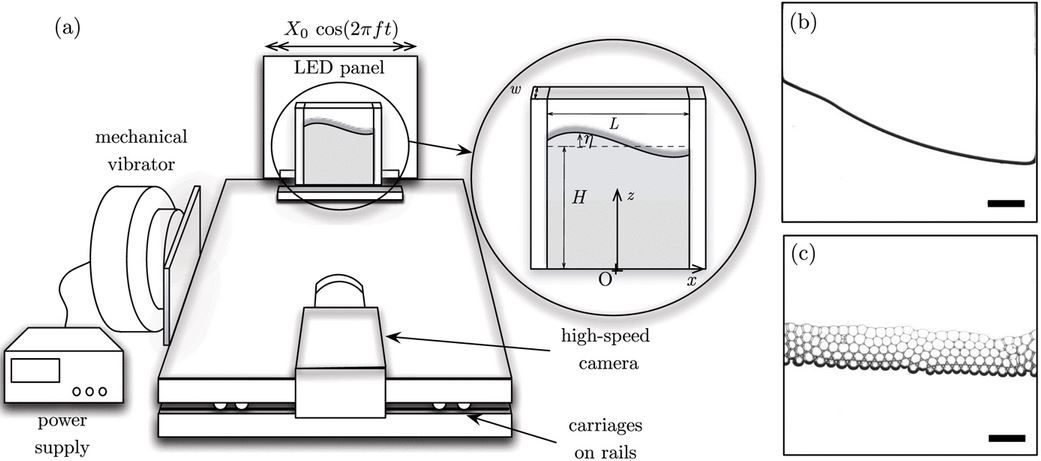
Drawing of the experiment. One can see in (b) that the waves were much bigger without foam than in (c) with foam. (Image: http://scitation.aip.org/)
When she started working in the complex fluids group at Princeton University, colleagues mentioned the same thing with foamy beer.
Alban Sauret, a researcher at the French National Center for Scientific Research (CNRS), said:
“While I was studying for my Ph.D. in the south of France, we were in a pub, and we noticed that when we were carrying a pint of Guinness, which is a very foamy beer, the sloshing almost didn’t happen at all.”
The researchers took their observations from the pub and the cafe to the lab, and built a device to test foam’s dampening power more scientifically.
They built a narrow, glass, rectangular container, which they filled with a solution of water, glycerol (to make the solution more viscous), and Dawn (a commercial dishwashing detergent).
They created foam by injecting air at a constant flow through a needle placed at the bottom of the rectangular cell. They were able to create flat layers of 3mm-diameter bubbles.
Team member François Boulogne said:
“The dishwashing foam is very stable, which allowed us to conduct the experiments without the bubbles disappearing.”
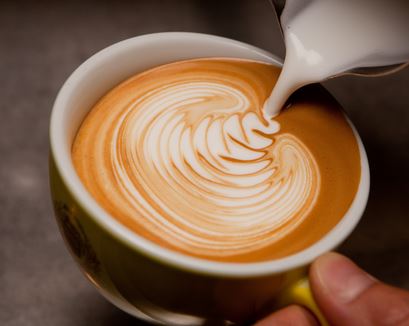
The bubbles touching the side of the cup are the ones that dampen the sloshing motion when a latte is being carried.
The scientists tried out two types of movements: 1. Jolting the device with rapid, side-to-side motions. 2. Rocking it steadily back and forth.
Waves one-tenth in size with foam on top
They used a high-speed camera to record the resulting waves, and found that with just five layers of foam, the height of the waves were reduced by a factor of ten.
The researchers suggest that the foam dissipates the energy of the sloshing solution through friction with the sides of the container.
Five layers of bubbles appear to be enough – additional layers did not add much extra dampening, they wrote. This is because the top layers of foam did not really move.
Only the bubbles that made contact with the walls of the container appeared to contribute to the dampening effect, they added.
Energetic sloshing of liquids and the problems they can cause go far beyond the annoyance of spilled drinks in bars and cafes, and can affect the safety of hazardous liquids, such as liquefied gas and oils, when they are being transported in large tankers.
Sloshing can exert significant pressure forces on the walls of tankers, which can open ruptures or disrupt the motion of the vehicle, the authors say.
Mr. Boulogne said:
“The potential applications are much bigger than just beer.”
Citation: “Damping of liquid sloshing by foams,” A. Sauret, F. Boulogne, J. Cappello, E. Dressaire and H. A. Stone. Physics of Fluids. Published February 24, 2015. DOI: 10.1063/1.4907048.
