

Construction output in the UK dropped by 0.9% in June, slightly lower than economists had expected, following the 2.1% fall in May.
Construction in June was 2.2% lower compared to the same month in 2015. The decline was driven by a 0.8% drop in all new work.
According to the Office for National Statistics (ONS), construction output in the second quarter fell by 0.7% after a 0.3% decline in the first quarter.
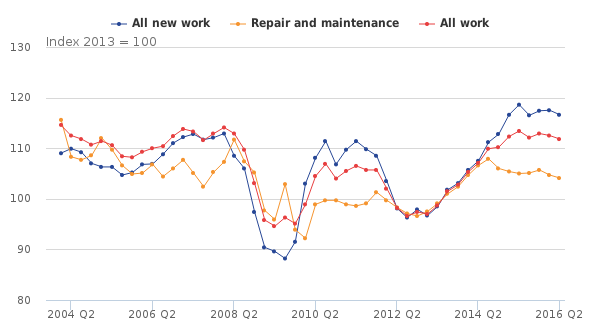
The release covers the second quarter of 2016 plus the calendar month of June 2016, including data for only a short period after the EU referendum.
However, the ONS said in its report that “there is very little anecdotal evidence at present to suggest that the referendum has had an impact on output.”
| Chained volume measures, seasonally adjusted, percentage change | |||||
| Great Britain | |||||
| Most recent 3 months on a year earlier | Most recent 3 months on 3 months earlier | Most recent month on the same month a year ago | Most recent month on the previous month | ||
| Total all work | -1.4 | -0.7 | -2.2 | -0.9 | |
| Total all new work | -1.7 | -0.8 | -1.9 | -0.6 | |
| Total repair and maintenance | -0.8 | -0.5 | -2.6 | -1.4 | |
| New housing | |||||
| Public | -21.7 | -6.5 | -17.0 | 1.3 | |
| Private | 6.6 | -0.2 | 7.6 | -0.6 | |
| Other new work | |||||
| Infrastructure | -10.1 | -3.7 | -7.5 | -1.8 | |
| Excl infrastructure | |||||
| Public | 0.0 | 2.3 | -4.2 | -1.7 | |
| Private industrial | -8.3 | 7.3 | -8.8 | 1.7 | |
| Private commercial | 1.1 | -0.7 | -2.0 | 0.0 | |
| Repair and maintenance | |||||
| Public housing | -4.8 | -2.6 | -7.7 | -1.4 | |
| Private housing | -0.9 | -1.4 | -4.1 | -1.5 | |
| Non-housing R&M | 0.5 | 0.9 | 0.2 | -1.3 | |
| Source: Construction: Output and Employment – Office for National Statistics | |||||
Last week’s Markit/CIPS construction purchasing managers’ index (PMI) showed that activity in the construction industry also fell in July, with a reading of 45.9, confirming “a clear loss of momentum since the second quarter of 2016”.
Chris Hare, economist at Investec, told Reuters that that the construction sector was expected to be affected by the Brexit vote.
He said: “It’s quite an investment-heavy sector and it’s one of the sectors we would expect to be held back by Brexit-type uncertainty. We think that uncertainty intensified rapidly after the Brexit vote so I think the outlook for construction sector is not looking too rosy for upcoming quarters.”
Samuel Tombs, chief UK economist of Pantheon Macroeconomics, believes that “the slump in construction activity will play a key role in pushing the overall economy into recession.”
Tombs said: “The downturn looks set to deepen in the third quarter; July’s construction PMI broadly is consistent with output falling by about 3.5% quarter-on-quarter.”
“Meanwhile, Brexit negotiations will be protracted, so businesses will hold off committing to major capital expenditure for a long time to come,” he added.
“In addition, the public investment plans won’t be reviewed until the Autumn Statement at the end of the year and few construction projects are genuinely ‘shovel ready’.”
