
Nearly half of all Brits (48%) said they would be unwilling to travel as a passenger in a driverless car, i.e. an autonomous vehicle with no human steering it, according to new research from price comparison and switching service firm uSwitch.com.
Later this month, driverless car trials will begin on public roads in Coventry, Milton Keynes, Bristol and Greenwich.
uSwitch said British consumers were worried about road safety if driverless cars were let loose. Forty-three percent said in a survey involving 953 adults that they would not trust an autonomous car to drive safely, believing they would undermine the welfare of drivers, pedestrians and cyclists.
Even though trials are underway in Sweden, Japan and the US, sixteen percent of Brits said they were “Horrified” at the thought of driverless cars being allowed to travel around on British roads.
Ninety-two percent of respondents said they had no idea the UK Government was spending £19 million on the introduction of driverless cars.
Who’s liable if there’s an accident?
The survey also revealed that many people wondered who would pay in the event of a crash involving a car with no human driver.
Thirty percent of respondents thought that in the event of a crash the responsibility should lie jointly between the “driver” of the autonomous car and the third party involved in the accident. Twenty-six percent said the maker of the autonomous car should be solely responsible, while 18% said the owner or traveler in the autonomous car should be liable.
Thirty-five percent of those in the survey believed that driverless cars would push up insurance premiums, while just 8% thought they would become cheaper, despite the Government saying that autonomous cars will make British roads safer.
Nineteen percent of the survey participants believed that driverless cars would help reduce traffic congestion. Eighteen percent said they were excited at the prospect of autonomous vehicles transporting passengers on British roads.
Head of Car Insurance at uSwitch.com, Rod Jones, said:
“We may be years away from driverless cars outnumbering traditional vehicles on British roads, but it’s clear motorists are already questioning the impact they will have on their lives. With human error accounting for around 90% of road accidents, the potential safety benefits of driverless cars are significant and they should have a positive impact on car insurance premiums.”
“However, confusion is still widespread and it will be vital for the Government and the insurance industry to clarify the issue of liability over the coming months if driverless technology is to receive the widespread public support it deserves.”
German carmaker Daimler AG presented its experimental Mercedes-Benz F 015 Luxury in Motion self-driving car at the International Consumer Electronics Show 2015 in Las Vegas, Nevada. The new vehicle is an example of how the car is changing from simply being a means of transportation to a private retreating space.
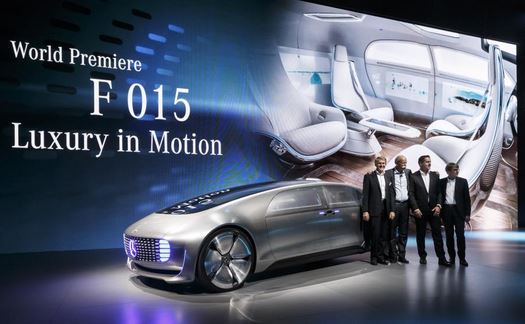
Image: “World premiere Mercedes-Benz F 015: Luxury in Motion,” Daimler AG.
In December, Google unveiled its fully-functioning self-driving car prototype. The search engine giant said it would be testing the car on its own test tracks before driving it on San Francisco Bay Area roads in 2015.
Google is convinced that driverless cars will make roads safer, with fewer drunk and distracted driving collisions. Car collisions are the main cause of death for Americans aged between 10 and 24 years – 30,000 deaths each year.
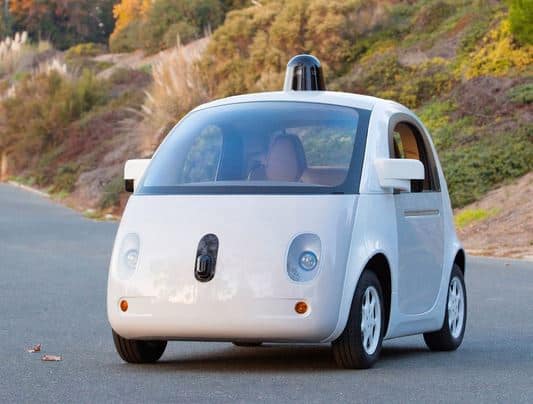
Google’s first real build self-driving vehicle prototype. Photo credit: Google.
Google said:
“We’ve been functioning on distinctive prototypes-of-prototypes, each and every created to test distinctive systems of a self-driving vehicle … like steering and braking, as well as the self-driving parts like the personal computer and sensors. We’ve now placed all these systems together in this totally functional car.”
