
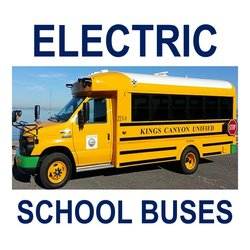
Millions of dollars could be saved by school districts in the US if they utilized electric school buses, plus children’s exposure to diesel fumes would be considerably reduced, say researchers from the College of Earth, Ocean and Environment (CEOE), part of the University of Delaware.
The team examined the cost-effectiveness of electric school buses that when not in use, discharge their batteries into the electrical grid, and get money for it. The technology, known as V2G (vehicle-to-grid), was pioneered at the University of Delaware, where a pilot project is being carried out on electric cars.
The researchers, whose study has been published in Applied Energy and is titled “A Cost Benefit Analysis of a V2G-Capable Electric School Bus”, say that a logical application is adapting the system for school bus fleets.
The majority of school buses travel distances which are within the range of the vehicle batteries, while for much of the day they are not in use. Electric school buses do not emit polluting contaminants that cause heart disease, lung cancer and respiratory problems.
Electric school buses good for kids
Jeremy Firestone, CEOE professor of marine policy and director of the Center for Carbon-free Power Integration, said:
“I see neighborhood kids waiting for and riding school buses out my window or when walking my dog. Electric buses have the benefit of kids not standing around or having their windows open while diesel fumes are being released.”
The researchers gathered and analyzed data on existing diesel school bus routes in a mid-sized Delaware suburban school district. They calculated the costs and benefits of V2G-capable electric bus replacements.
They calculated that a V2G electric bus fleet could save a school district approximately $38 million over a 14-year period, which is the typical lifespan of a school bus.
Massive savings
Lead author Lance Noel said he was surprised with the findings. “The savings go through the roof,” he added.
The researchers said their study factored in costs associated with fuel, electricity and batteries, as well as health care expenses related to diesel-fume emissions, plus some other factors.
An electric school bus with a V2G-capable 70-kilowatt on-board charger costs more than twice as much as a diesel one – $260,000 and $100,000 respectively. Diesel buses consume a gallon of fuel for every six miles traveled, and they emit nitrous oxide, sulfur dioxide, ozone and soot, as well as a number of other pollutants. Their emissions can be disproportionately higher inside the cabin of a bus compared to pollution levels in the surrounding areas.
The authors say that if you add up the diesel gas cost and then include the medical expenses to society, over time the diesel bus looks much less cost-effective.
Electric buses save money and pollute less
The researchers wrote:
“Electric buses providing V2G services, meanwhile, cover the battery charging and additional capital investment costs, and in addition generate profits while releasing no tailpipe pollution.”
Over a 14-year lifespan, a V2G-capable electric school bus would save the school district approximately $6,070 per bus seat or $230,000 per vehicle. Even if you do not include the health care savings and climate change costs linked to diesel pollution, the electric vehicles would still save school districts about $5,700 per seat.
The researchers say:

“They could save a large amount of money while also shifting away from the consumption of diesel and enhancing school children’s health.”
We are still a long way off from having mass-produced V2G-capable school buses throughout the US. Electric school buses are extremely rare. The first Trans Tech all-electric school bus was tested in California earlier this year.
Study co-author Regina McCormak said “The V2G capability is what changes the economics of the school bus.”
There were no details in the study regarding the extra pollution emitted by power stations to supply the electric school buses with electricity.
In a separate study, IHS Automotive forecast global production of electric vehicles will increase by 67% in 2014, while traditional vehicle production is expected to grow by 3.6%. Approximately 403,000 all-electric or hybrid vehicles will be produced in 2014, the study forecast.
