
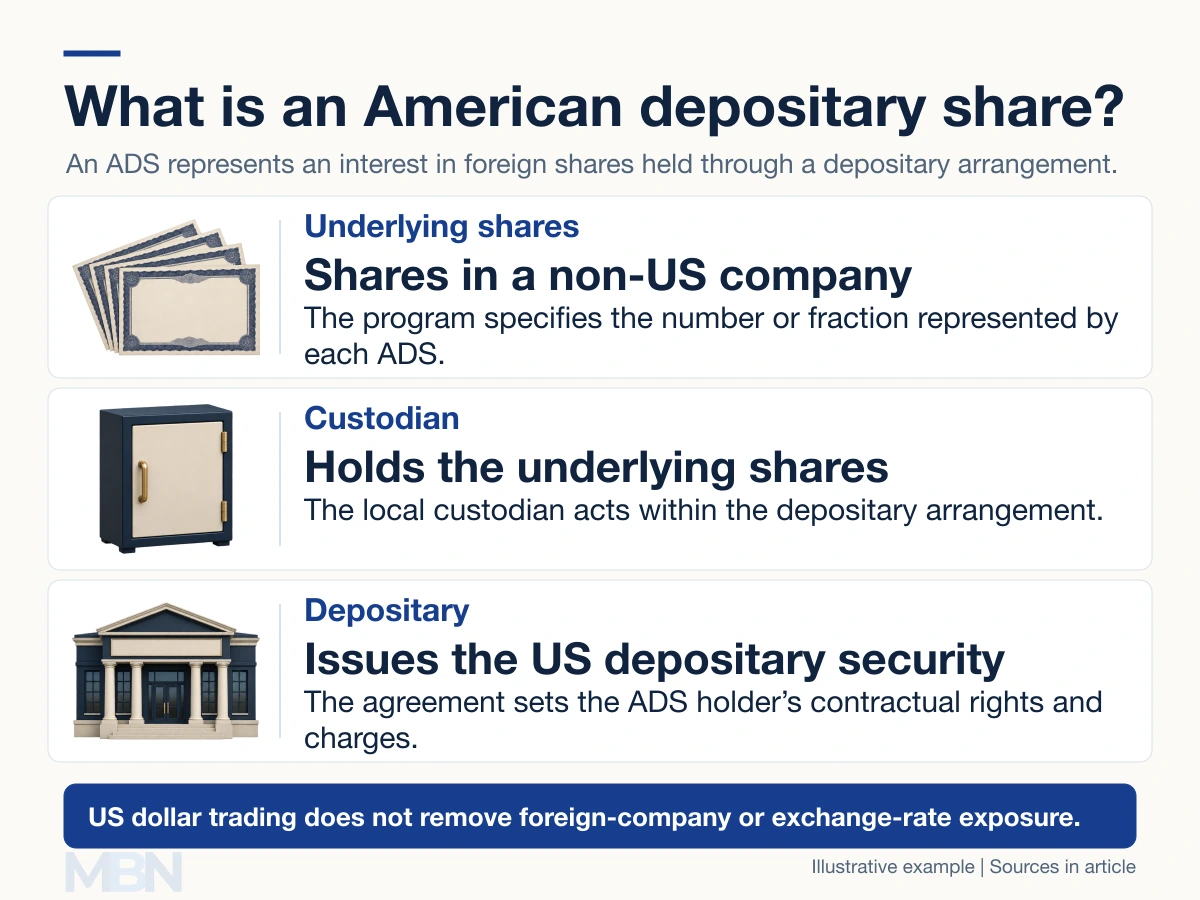
An American depositary share, or ADS, represents an interest in shares of a non-US company held through a depositary arrangement. It allows investors to gain that foreign-share exposure through a US dollar security, subject to the program’s terms.
The underlying ordinary shares are generally held with a custodian in the company’s home market. The US depositary bank and the local custodian have different roles; they should not simply be described as the same bank.
ADS and ADR mean different things
An American depositary receipt, or ADR, evidences ownership of ADSs. It is not the name for the company’s entire share issue. The SEC’s investor bulletin explains that market participants often use ADR and ADS interchangeably.
A program specifies its ratio to the underlying shares. One ADS can represent one ordinary share, several shares or a fraction. For a real example, Vodafone’s shareholder FAQ says each of its ADSs represents 10 ordinary shares.
That ratio matters when comparing share prices or dividends across markets. Comparing one ADS with one ordinary share without adjusting for the ratio can produce a misleading result.
Trading and reporting arrangements vary
Depositary securities can trade on a US exchange or over the counter. Sponsored programs involve an agreement with the foreign company; unsponsored programs can be established without its cooperation.
The SEC distinguishes programs that establish an OTC trading presence from exchange-listed programs and registered capital-raising programs. Having a US trading presence does not necessarily mean the foreign company raised new capital through that program.
Foreign-private-issuer reporting is not identical to domestic US company reporting. The IFRS Foundation’s US jurisdiction profile confirms that foreign private issuers may use IFRS Accounting Standards as issued by the International Accounting Standards Board, without reconciling those statements to US generally accepted accounting principles, or US GAAP. US GAAP is not compulsory for every foreign issuer.
Dollar trading does not eliminate currency risk
The SEC’s international-investing bulletin explains that exchange-rate changes affect dollar returns. An ADS’s dollar price can change even when the underlying shares’ local-currency price does not.
Suppose a fictional ADS represents two shares priced at €10 each. At $1.10 per euro, that €20 holding has an indicative dollar value of $22. If a euro falls to $1.00, the same local share value converts to $20, a decline of about 9.1%.
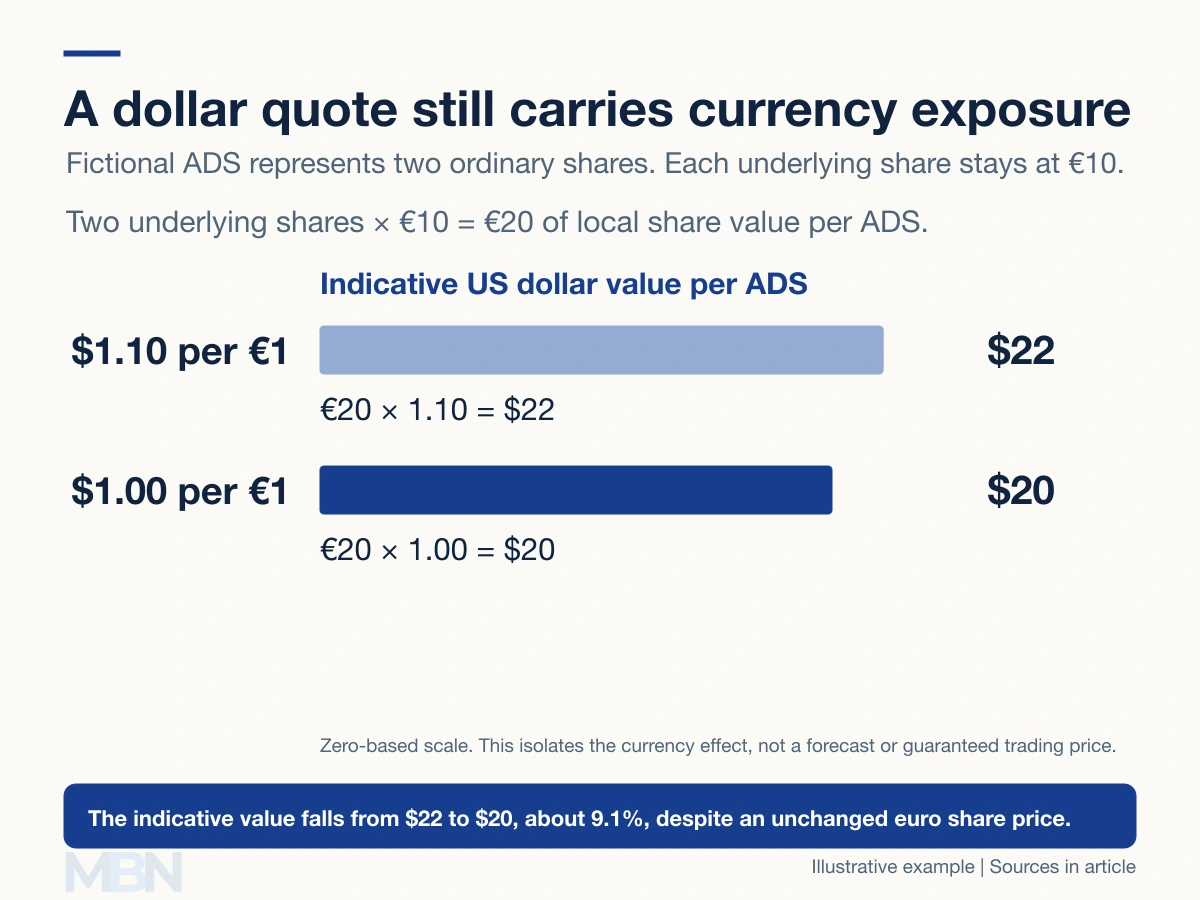
This isolates the currency effect. Actual ADS prices can also reflect trading hours, liquidity, costs and market conditions. Dollar settlement is not itself a currency hedge.
Rights, dividends and costs depend on the agreement
ADS holders’ voting and distribution rights operate through the depositary agreement. Their position should not be assumed identical to direct ownership on the company’s home share register.
For example, Ascentage Pharma’s SEC-filed ADS description sets out depositary fees, taxes, currency-conversion arrangements and voting procedures. Such terms can affect the net cash received and how instructions are exercised; the amounts and conditions are program-specific.
An ADS still carries the underlying company’s business risks and relevant foreign-market risks. Its convenient US trading format does not guarantee returns or protection from political or market disruption.
Last checked and updated on November 4, 2026 by the MBN editorial team.