
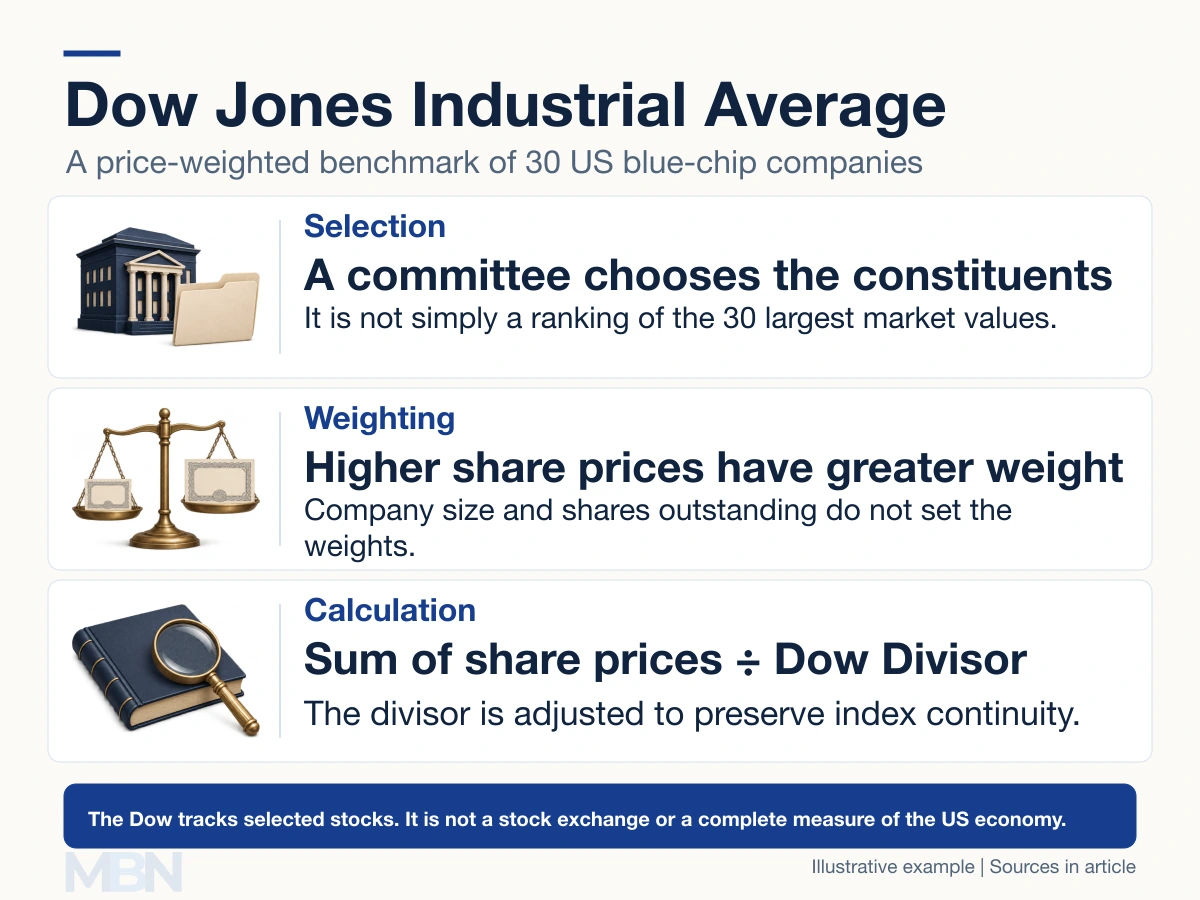
The Dow Jones Industrial Average, or DJIA, is a price-weighted stock index of 30 US blue-chip companies. Commonly called the Dow, it summarizes changes in the share prices of a selected group of established businesses. S&P Dow Jones Indices maintains it.
“Blue-chip” describes a large, established company with a substantial business record. Membership does not guarantee financial strength, investment gains or continued inclusion.
Which companies does the Dow include?
The Dow Jones Averages methodology sets the eligibility and selection framework. A committee chooses companies with the aim of representing major parts of the US market. It does not simply take the 30 companies with the largest market capitalizations.
Despite “Industrial” in its name, the index spans several sectors. Transportation and utilities are excluded because separate Dow averages cover them. Companies can trade on different eligible US exchanges; the index is not itself a trading venue.
Constituents change through committee decisions and corporate events. The provider’s index page contains current composition information; an undated historical company list should not be used as the present membership.
How the Dow is calculated
The basic formula is the sum of the constituent share prices divided by the Dow Divisor. The divisor is a scaling number, not the number of companies. It changes when specified corporate events would otherwise create an artificial jump or drop.
For example, a stock split reduces a company’s price per share while increasing its share count. That alone does not destroy shareholders’ value. Divisor adjustments preserve continuity in the index level. The provider’s index-mathematics methodology explains this treatment.
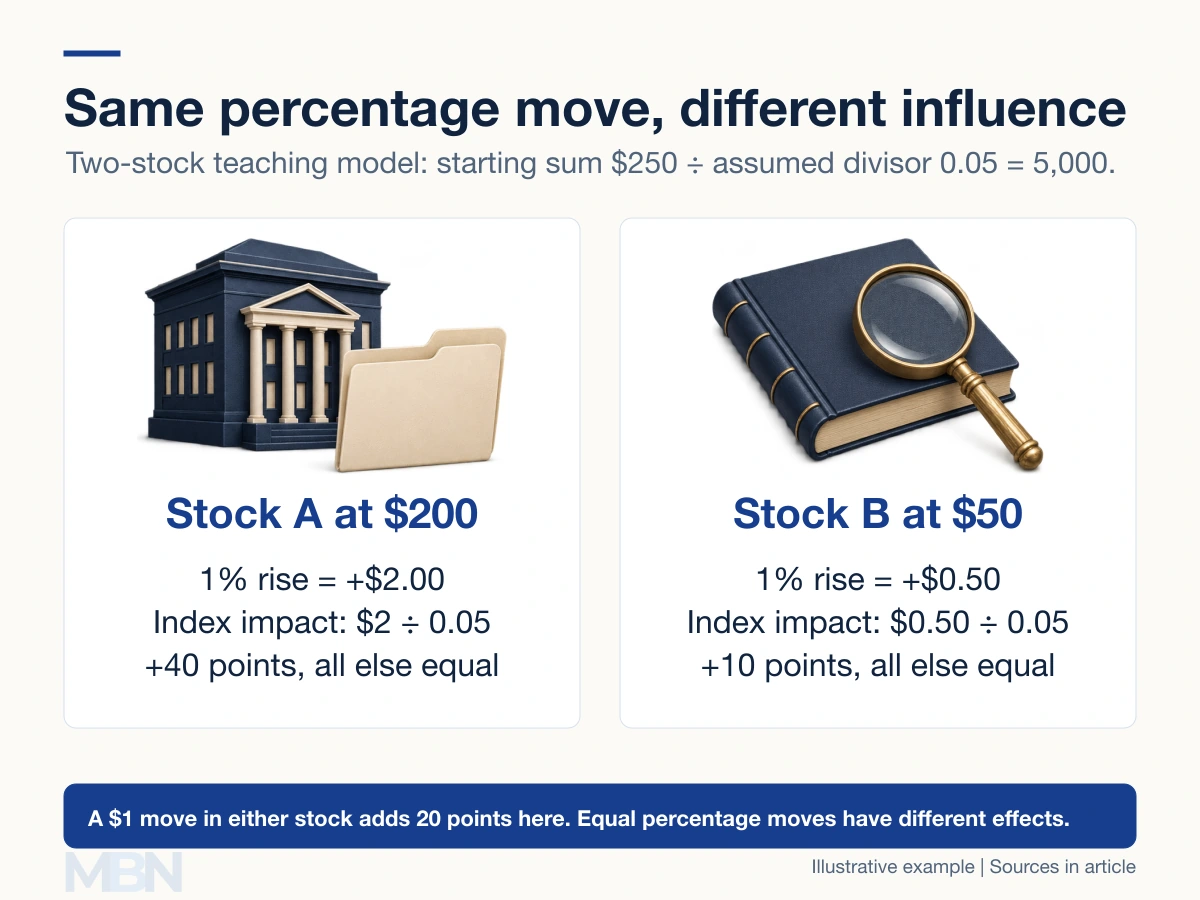
Because the Dow is price weighted, a $1 movement in any constituent has the same immediate point effect, assuming the divisor and other prices are unchanged. But a 1% move in a high-priced share has a larger effect than a 1% move in a low-priced share.
A simple numerical example
Imagine a two-stock index, with prices of $200 and $50 and an assumed divisor of 0.05. Its starting level is 250 ÷ 0.05 = 5,000 points.
A 1% rise in the $200 stock adds $2, increasing the index by 40 points. A 1% rise in the $50 stock adds $0.50, increasing it by 10 points. A $1 rise in either adds 20 points. This is a teaching model, not the actual 30-stock index or its current divisor.
What the index can tell readers
The Dow launched in 1896 with 12 stocks and reached 30 in 1928. Its long history makes it a familiar market indicator, but its small membership and price weighting differ from broader, market-value-weighted benchmarks.
A point change needs context: 500 points is 1% of a 50,000 starting level, but 2% of 25,000. The commonly quoted price-return index also differs from a total-return version that accounts for dividend reinvestment. Neither directly measures households’ living standards or every listed company’s performance.
Last checked and updated on November 11, 2026 by the MBN editorial team.