
A Trade Area is a geographical area or international region in which a commercial enterprise transacts business. Also known as market area, it is a company’s ‘commercial territory’. A business’ trade area represents a location where all or most of its sales volume occurs.
This concept is crucial for businesses in planning their marketing strategies and store placements, as it directly influences customer footfall and sales trends.
The term may also refer to the commercial reach or trading area of a shopping center, department store, or a groceries wholesaler – it is the geographical area where sales are made. The term ‘trade area’ is often interchangeable with ‘trading area’.
A trade area is the furthest distance that consumers are willing to travel to buy goods and services. How big a retail trade area is, for example, depends on the range of goods and services offered in the community and how close they are to competing retail markets.
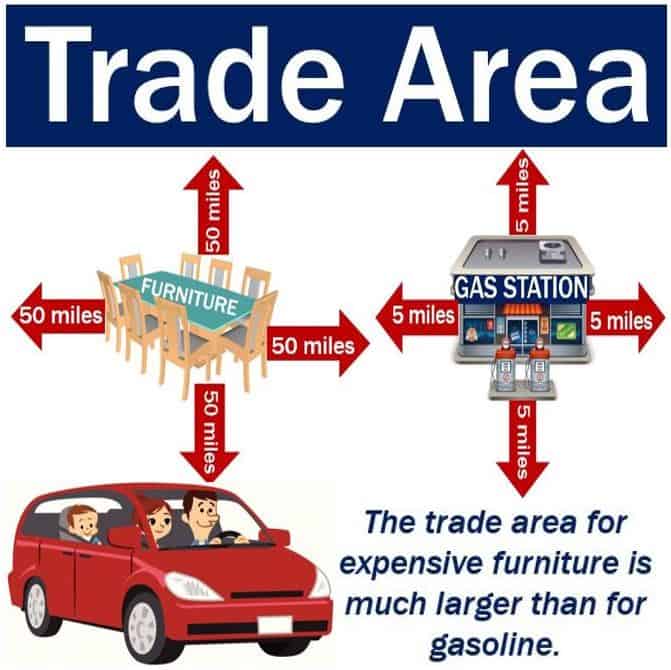
How big or small a trade area is depends on the product and where competitors are located. People are not willing to travel very far to fill their car with gas, but will drive much further when deciding on which nice dining room furniture to buy.
Type of trade area
In the retail sector, there are two main types of trade areas:
– Local Convenience Trade Areas: these are based on ease of access. People will purchase such products as groceries or gasoline (UK: petrol) based on how far or how long they have to travel.
– Comparison Trade Areas: these are based on quality, selection, style and price. People are more likely to compare more expensive goods such as furniture, appliances, etc., and are usually willing to travel further for their purchases.
A trade area generally grows or shrinks depending on the products being sold.
What is trade area analysis?
A trade area analysis shows where a company’s customers live in relation to its existing business sites, or sites that are planned for the future.
The analysis compares the number of customers by distance from a business’ site to the total number of households in the study area.
What is a free trade area?
The OECD (Organization for Economic Development and Co-operation) defines a Free Trade Area as a grouping of nations within which trade barriers have been abolished – export/import tariffs and quotas have been eliminated.
The European Union (EU) is an example of a free trade area.
In a rapidly-globalizing economy, it is surprising that nations increasingly trade with other countries that are nearest to them. One reason could be geography – neighboring countries typically belong to a regional free trade area, and take advantage of the non-tariff and non-quota benefits.
Many economists say that growing trade with countries’ nearest neighbors may not be in the best interests of many of them.
Several nations may be trading with each other when it could be significantly more efficient for them to trade with markets further away.
In a perfect global market, comparative advantage should determine trade patterns. For example, if Sweden imports Greek televisions just because they are tariff-free, even if China has a comparative advantage in TV manufacturing, the principal benefit of trade will be lost.
According to Jagdish Bhagwati, an economist at Columbia University, regional trade areas are not building blocks in the freeing of global trade – they are actually stumbling blocks.
Furthermore, advancements in digital marketing and e-commerce have begun to redefine traditional trade area boundaries, allowing businesses to extend their reach beyond conventional geographic limitations.