
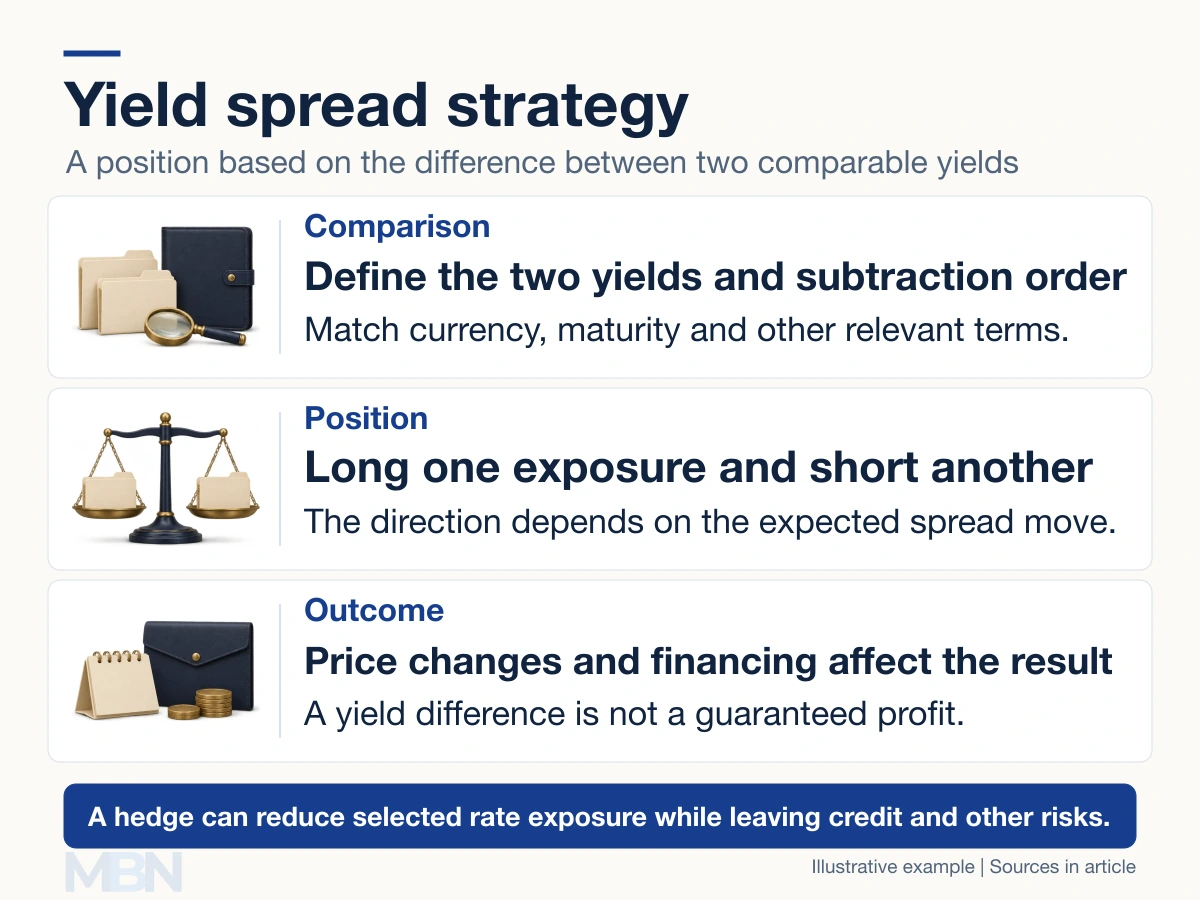
A yield spread strategy is an investment or trading approach based on the difference between two yields. A common version buys one bond exposure and sells another short to express a view about how their relative pricing will change.
It does not simply collect the difference between a high yield and a low yield. Bond prices, interest payments, borrowing arrangements and changes in the spread determine the outcome.
What spread is being compared?
A credit spread commonly compares a corporate bond’s yield with a government benchmark of similar maturity. The Cleveland Fed explains that embedded options and other differences also affect that comparison. A callable bond, which the issuer can repay early under its terms, cannot always be compared directly with a non-callable benchmark.
A yield spread can instead compare maturities, currencies or issuers. The calculation must identify both instruments, the yield convention and the subtraction order. One basis point is 0.01 percentage point, so a 3-percentage-point difference is 300 basis points.
How does the long-and-short position work?
A trader expecting a corporate credit spread to narrow might buy the corporate bond and short a suitable government bond. Buying creates a long position. A short position in a cash bond generally involves borrowing it, selling it and later buying it back for return to the lender.
The trade seeks a favorable relative price movement. If the credit spread widens instead, the corporate bond can underperform the hedge. A strategy expecting widening may reverse the exposures. Neither direction is inherently profitable.
A narrowing-spread example
Suppose a corporate bond yields 6% and a comparable benchmark yields 3%. The spread is 300 basis points. Later, the corporate yield is 5.5% while the benchmark remains at 3%, giving a 250-basis-point spread.
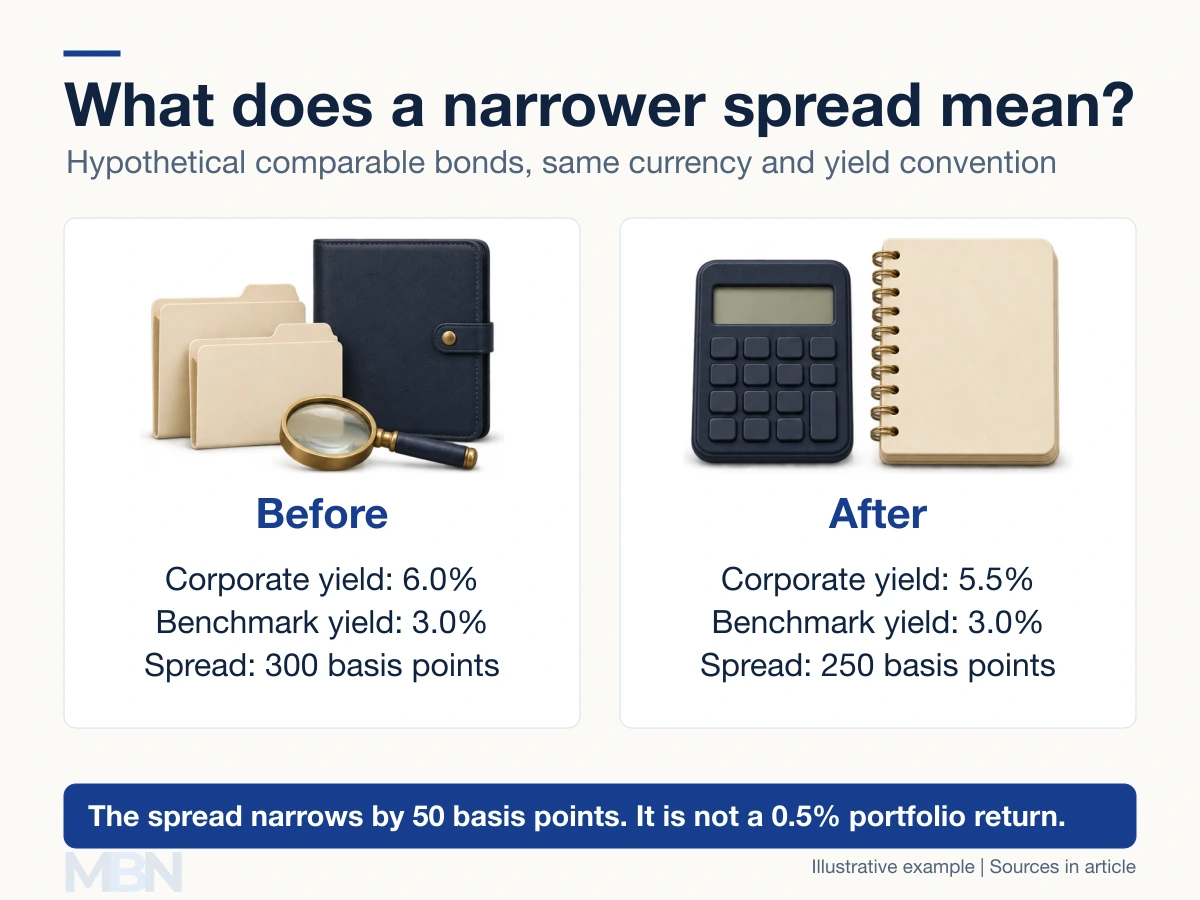
The spread has narrowed by 50 basis points. With unchanged promised cash flows, the corporate bond’s falling yield corresponds to a rising price. The long bond can gain while the benchmark short has little price change. Coupon-related payments, financing and trading costs still affect the net result.
The same 50-basis-point spread move does not produce the same dollar gain on every bond. Duration measures sensitivity to yield changes. Traders may compare dollar sensitivity per basis point, often called DV01, when sizing a hedge.
What risks remain after hedging?
Equal face amounts do not necessarily have equal interest-rate sensitivity. Different maturities, coupons and options can leave residual rate or yield-curve exposure. The Federal Reserve’s trading manual discusses corporate-bond hedging and assumptions about spread and rate relationships.
Credit deterioration, default, poor liquidity, changes in borrowing costs and demands for additional collateral can cause losses. Borrowed securities may also have to be returned. A higher yield can compensate for those risks rather than represent an overlooked bargain.
How is this different from a yield-curve strategy?
A yield curve relates yields to different maturities on a given date. A curve strategy focuses on that shape, such as a steepening or flattening. Credit-spread strategies focus on relative credit pricing. Both can use multiple positions, but their intended exposures and remaining risks differ.
Last checked and updated on November 10, 2026 by the MBN editorial team.