
If you add graphene to thin rubber films they become more rubbery, stretchier and stronger, say scientists from the University of Manchester. Graphene – a form of carbon consisting of planar sheets – is the thinnest and strongest material we know of on Earth. It is over 100 times stronger than steel.
Dr. Maria Iliut and Dr. Aravind Vijayaraghavan explained in the academic journal Carbon that by adding just a tiny amount of graphene to rubber films, both their elasticity and strength can be increased by up to 50%.
Thin rubber films are used for hundreds of everyday products, from condoms to gloves.
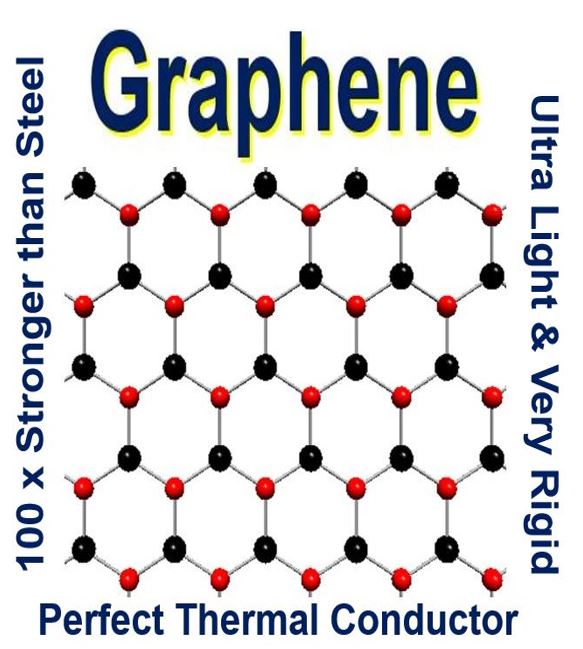 Graphene is ultra-light, immensely tough, over 100 times stronger than steel but incredibly flexible. It is the thinnest material we know of. It is transparent, a superb conductor, and can act as the ultimate barrier – not even helium can get through it.
Natural and artificial rubber films tested
In their experiments, the authors tested two different types of rubbery materials – an artificial rubber called polyurethane and a natural rubber made of polyisoprene. To both rubbers they added varying amounts and kinds of graphene.
In nearly all cases, they found that the resulting composite material could be stretched much further and with greater force before breaking. In fact, in order to make the rubber 50% stronger, all that had to be added was 0.1% graphene.
Dr. Vijayaraghavan, head of the Nano-functional Materials Group at The University of Manchester, explained:
“A composite is a material which contains two parts, a matrix which is soft and light and a filler which is strong. Taken together, you get something which is both light and strong. This is the principle behind carbon fibre composites used in sports cars, or Kevlar composites used in body armour.
“In this case, we have made a composite of rubber, which is soft and stretchy but fragile, with graphene and the resulting material is both stronger and stretcher.”
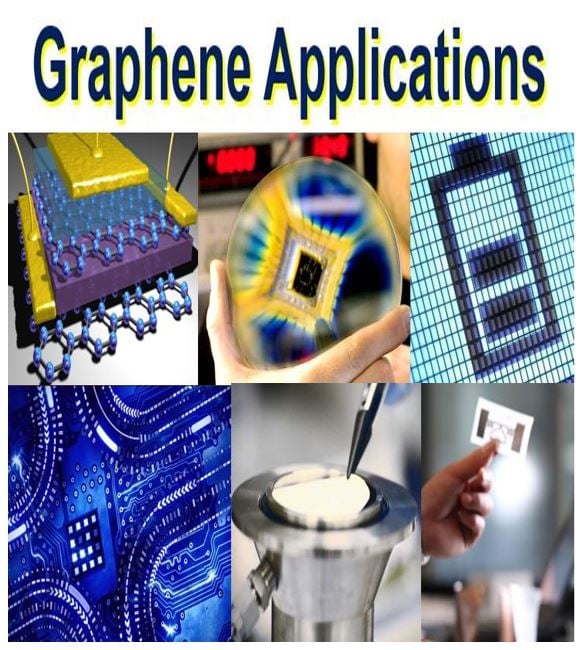 Graphene has so many different potential applications from (start top left and go clockwise) a tunnelling transistor, a quantum dot on a chip, improving the life and efficiency of batteries, a graphene RFID antenna which ould improve wireless devices and sensors, as a membrane for filtering our pollutants from drinking water, to electronics. (Images: graphene.manchester.ac.uk)
Graphene oxide added to rubber
Dr. Maria Iliut, a research associate who joined Dr. Vijayaraghavan’s group in February 2014, said regarding the production of this material:
“We use a form of graphene called graphene oxide, which unlike graphene is stable as a dispersion in water. The rubber materials are also in a form that is stable in water, allowing us to combine them before forming thin films with a process called dip moulding.”
“The important thing here is that because these films are so thin, we need a strengthening filler which is also very thin. Fortunately, graphene is both the thinnest and strongest material we know of.”
Part of quest to make better condoms
This project emerged from a call to create a more desirable condom by the Bill & Melinda Gates Foundation.
The authors say that their composite material has tremendous implications in daily life.
 (Left) Dr. Aravind Vijayaraghavan and Dr. Maria Iliut. (Images: Left – manchestersciencefestival.com. Right – aravind.weebly.com)
Regarding using this new material for making condoms and other products, Dr Vijayaraghavan said:
“Our thinking was that if we could make the rubber used in condoms stronger and stretchier, then you could use that to make even thinner condoms which would feel better without breaking.”
“Similar arguments can be made for using this material to make better gloves, sportswear, medical devices and so on. We are seeing considerable industrial interest in this area and we hope more companies will want to get involved in the commercial opportunities this research could create.”
In an Abstract in the journal, the scientists wrote:
“We demonstrate composites with both graphene oxide and reduced graphene oxide, the reduction being undertaken in-situ or ex-situ using a biocompatible reducing agent in ascorbic acid.”
“The ultrathin films were cast by dip moulding. The transparency of the elastomer films allows us to use optical microscopy image and confirm the uniform distribution as well as the conformation of the graphene flakes within the composite.”
Citation: “Graphene and water-based elastomers thin-film composites by dip-moulding,” Maria Iliut, Claudio Silva, Scott Herrick, Mark McGlothlin, and Aravind Vijayaraghavan. Carbon. 20 May 2016. DOI: 10.1016/j.carbon.2016.05.032.
