
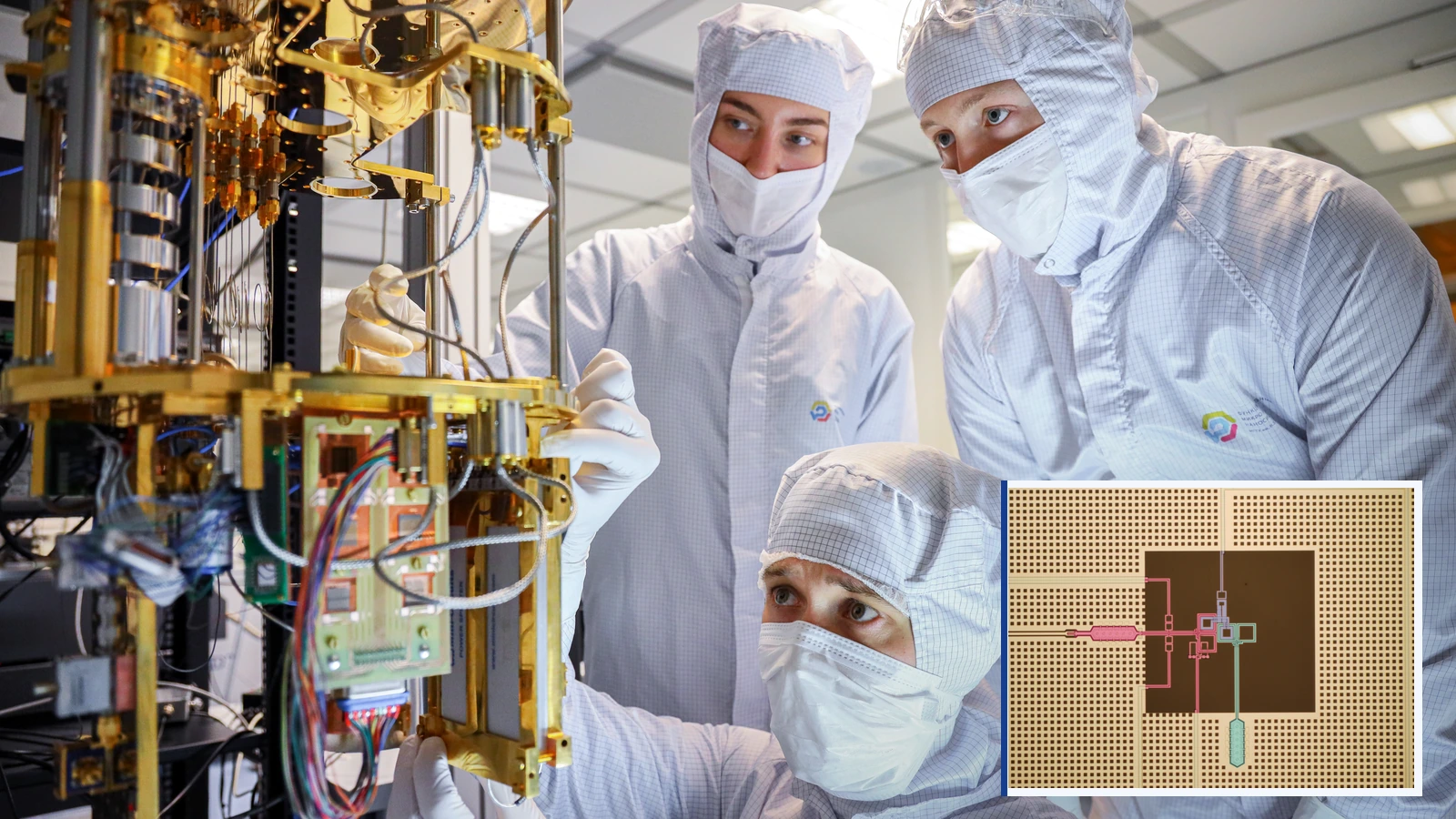
Researchers from Rutgers University, IBM and collaborating institutions have demonstrated repeated measurement and feedback on a quantum processor using up to 100 quantum bits, or qubits. The experiment tests control operations needed for more reliable machines, although it did not demonstrate a computer correcting errors in a protected calculation.
The study, published in Nature Physics on October 9, investigated whether measurements and resets could overcome deliberately programmed scrambling of quantum information.
According to Rutgers’ announcement, the team used a 156-qubit IBM Quantum Heron processor, selecting connected chains of up to 100 qubits. These were physical hardware qubits, not 100 error-protected logical qubits.
At the balance point between scrambling and control, the largest circuits combined approximately 5,000 operations linking pairs of qubits with approximately 5,000 measurement-conditioned resets.
“The challenge was not simply to measure a qubit, but to do it repeatedly while the rest of the processor continued to operate,” said Maika Takita, an IBM principal research scientist and senior author.
What is quantum error correction?
Quantum error correction protects information against disturbances and imperfect operations. A qubit can occupy a superposition of the states associated with 0 and 1, and multiple qubits can share entangled states. Those properties enable quantum algorithms, but interference from the surroundings can corrupt the information.
An arbitrary unknown quantum state cannot simply be copied as a backup. Direct measurement can also disturb it, so repeatedly reading the information is not a safe way to check a calculation.
Instead, error-correction schemes encode a logical qubit, the information being protected, across multiple physical qubits. Selected measurements reveal evidence of errors without directly reading the logical state. Control systems then use that evidence to decide how to respond.
As IBM’s explanation of fault tolerance describes, the objective is a machine that computes correctly despite errors in its components. The measurements and corrective operations must themselves work reliably throughout a computation.
Feedback competed with scrambling
The researchers programmed two competing processes. One mixed information between neighboring qubits. The other measured selected qubits and reset them toward a chosen orderly state. They varied how frequently each process occurred.
When scrambling dominated, the system remained chaotic. More frequent control operations steered it toward the target state. The transition occurred around an equal probability of choosing either process in this particular model.
Physicists call this a phase transition, a change in the system’s collective behavior as a parameter crosses a threshold. Here the parameter was the frequency of control operations, rather than a temperature at which a material melts or freezes.
The authors’ publicly available manuscript compares the hardware measurements with numerical and theoretical models. It examines both the transition and fluctuations that help distinguish quantum behavior from an incoherent noise model.
Resetting qubits toward a selected state serves a different purpose from preserving the information in an ongoing calculation. This protocol demonstrated feedback control of quantum dynamics. A full error-correction system must retain the encoded information while detecting and handling unwanted disturbances.
Reliability will determine commercial use
For companies assessing quantum computing, processor size is an incomplete measure of capability. A machine also needs accurate operations and a way to prevent errors from overwhelming longer calculations.
The US National Institute of Standards and Technology identifies molecular and materials simulation among the fields that could benefit from more capable quantum computers. These calculations interest drug developers, chemical manufacturers and researchers working on batteries.
The Rutgers and IBM experiment tested a physics model, not an industrial application. It provides no measured reduction in drug-development costs, battery-research time or the price of a commercial computing service.
Our earlier coverage of business spending on quantum computing examined investment in skills, applications and integration while returns remain uncertain. For those programs, a hardware advance needs to be assessed alongside the performance and cost of the complete task.
Repeated feedback is part of the engineering required for longer, dependable computations. Connecting it to error-correction codes that preserve information through an entire algorithm remains work for researchers and hardware developers. The study gives no commercial deployment date.
