
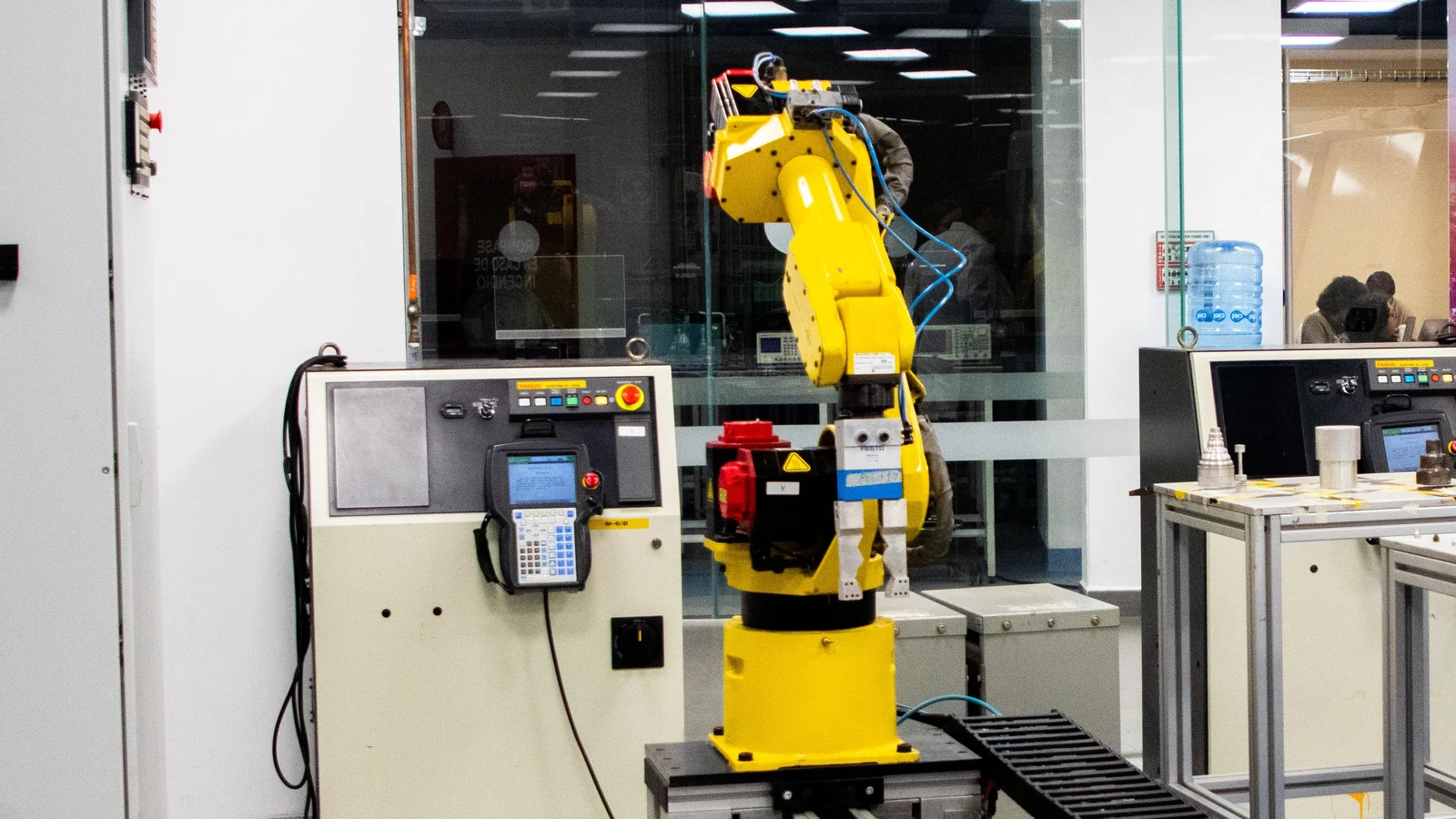
A study of Chinese manufacturers found that productivity gains associated with industrial robots were concentrated in companies with stronger management practices. Firms with lower management scores showed no statistically significant gains.
Dezhuang Hu and Tang Li’s research in Technovation’s September 2026 issue examines why similar technology produces different results across businesses.
The researchers used the China Employer-Employee Survey, which combines information about robot investment, employees and management. Their baseline model estimated a 6.2% increase in total factor productivity associated with robot adoption.
Total factor productivity measures how efficiently a company combines inputs such as labor and machinery. It goes beyond output per employee, which can rise when a business replaces manual work with additional equipment. The study’s estimate is a productivity measure, not a profit margin or a guaranteed financial return.
What are industrial robots?
Industrial robots are automatically controlled, reprogrammable machines that perform physical tasks. The International Federation of Robotics uses a definition covering multipurpose manipulators programmable in at least three axes, meaning different directions of movement.
Manufacturers use them for welding, assembly, painting and materials handling. Some operate behind protective barriers. Collaborative robots are designed for applications involving people, although safe deployment still depends on the task and surrounding equipment.
Reprogramming allows a robot to move between jobs, but each application needs suitable tooling, controls and production arrangements. Installing a machine that works quickly does not establish that the rest of the line can keep pace.
Management practices change the results
Productivity improvements were statistically significant among firms above the sample’s median management score, but not among those below it. The median is the midpoint of the scores. Statistical significance describes how strongly the results differ from what the model would expect if there were no effect.
Monitoring, target-setting and managerial incentives complemented robot adoption. Incentives for non-managers showed no significant moderating effect. Smaller firms generally gained less, but the size gap disappeared in the high-management-score group.
These comparisons concern the surveyed businesses. A small manufacturer still has to finance equipment, obtain technical support and match an installation to its production volumes. Strong management cannot make an unsuitable application economical.
The researchers tested alternative productivity measures and methods addressing whether already-productive firms were more likely to buy robots. These included policy-based comparisons and changes over time. They support a causal interpretation, but the estimates depend on the method and Chinese survey setting.
For a factory manager, the operational question is where automation removes a constraint. In an illustrative assembly line, a faster robot could spend time waiting if the preceding station cannot supply parts quickly enough. If inspection cannot handle the additional output, unfinished goods could accumulate elsewhere.
A bottleneck is a stage that limits the output of the whole process. Automating one operation may move that bottleneck without resolving it. Monitoring waiting time, defects and stoppages gives managers a better basis for deciding where to intervene than counting robot cycles alone.
The investment extends beyond the machine
Programming is a substantial part of adoption costs, the IFR explains in its analysis of robot programming. Adapting an application to another machine or task can require additional work, especially in factories producing small batches of different products.
As we reported in our coverage of FANUC and Palladyne, suppliers are developing ways to reduce that deployment burden. Easier setup addresses one expense; a factory still needs reliable operation, maintenance and acceptable product quality.
Earlier research on German manufacturers linked management practices with productivity and the recruitment and retention of more skilled workers. Published as an NBER working paper in 2016 and in the Journal of Labor Economics in 2018, it provides background on how staffing and management interact.
When calculating an automation budget, manufacturers need to include installation, programming, safety measures, training and servicing alongside the purchase price. Targets should cover quality and delivery as well as output, so faster production does not conceal more rejected goods or longer queues.
The scale of these decisions is growing. In its World Robotics 2026 release, the IFR reported five million industrial robots operating worldwide in 2025, up 9%. Annual installations rose 11% to more than 600,000, with China accounting for 59% of deployments.
For an individual buyer, those totals say little about whether a proposed installation will pay for itself. The business case has to show how the equipment will increase saleable output, reduce defects or save operating time after its continuing costs are included.
