

Shoppers can respond differently to a multi-item promotion depending on whether its rate is expressed as a price per item or a quantity per dollar, according to research in the Journal of Marketing.
Both calculations can describe the same offer. A pack of five items for $40 costs $8 per item, or 0.125 items per dollar. The first expression makes the price of a single item easier to see.
Daniel Villanova and Rajesh Bagchi examined how consumers calculate and respond to those rates in research included in the journal’s November 2026 issue. The paper first appeared online in 2025.
Two ways to describe one rate
To calculate a price per item, divide the total price by the number of items. For five items at $40, the calculation is $40 divided by five, or $8 each.
To calculate items per dollar, reverse the division: five divided by $40 equals 0.125 items per dollar. Neither number changes what the customer actually pays.
The researchers found that dollar-per-unit rates made consumers more sensitive to promotions than unit-per-dollar rates in the situations studied. Their proposed explanation is that a price per unit makes the price more noticeable.
The results concern responses in the research settings. They do not establish that a particular label will always increase sales or that one rate presentation makes every offer a good deal.
How to compare offers
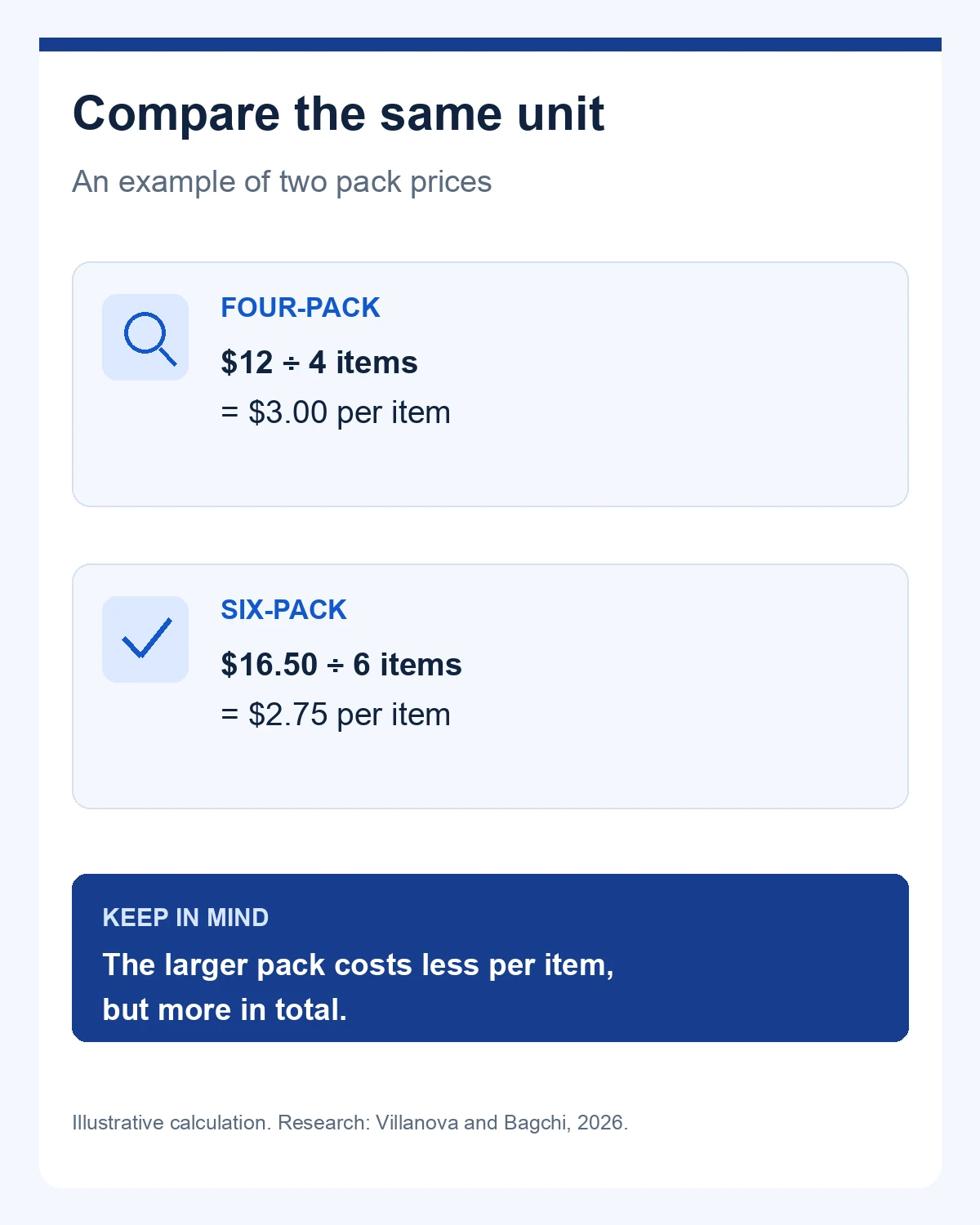
Compare the same unit and the same currency. If a four-pack costs $12, its unit price is $3. If a six-pack costs $16.50, its unit price is $2.75. The larger pack is cheaper per item, but the customer spends more in total.
Quantity only helps if the product will be used. Storage, expiration dates, quality and delivery charges can change the value of an offer. A lower unit price is not necessarily a saving if part of the purchase goes unused.
What retailers can do
Clear unit prices make products easier to compare. A retailer can show the total amount and a consistent price per item, weight or volume, while ensuring that promotions and mandatory charges are accurately described.
Presentation is also a measurement question. Businesses testing a new label can examine comprehension and completed purchases, not only clicks or initial attention. Where an offer uses different package sizes, customers should be able to see which quantities are being compared.
Our report on coupons and direct discounts examines a different way the presentation of an offer can influence shopper behavior.
The research highlights why a mathematically equivalent rate can feel different. For shoppers, converting competing offers to the same unit is a practical way to compare them before deciding how much to buy.
