

People exposed to an advertisement before adopting a Dutch retail app subsequently opened it more often in a study, but the researchers could not measure whether the additional activity produced more sales.
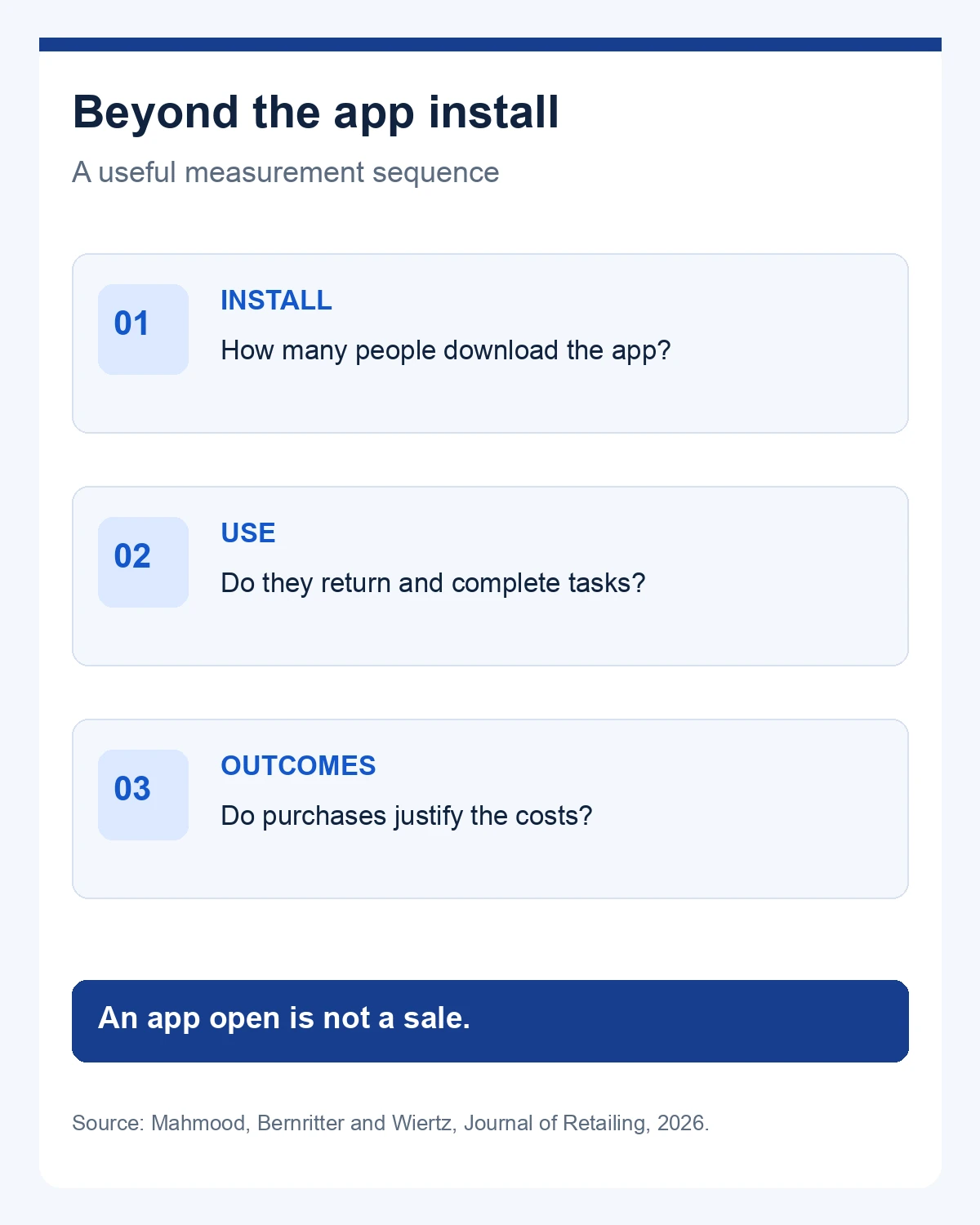
The finding suggests that the effectiveness of an app-install campaign deserves attention beyond the number of downloads it generates. It also shows why an app open is not the same as a purchase or a profitable customer relationship.
Ammara Mahmood, Stefan Bernritter and Caroline Wiertz examined the question across 11 studies involving 11,272 participants. Their Journal of Retailing paper was published online in September 2026.
What the field study found
The researchers analyzed behavior from 7,811 adopters of a Dutch marketplace app. In their main model, prior exposure to the app’s advertising was associated with roughly 6% more weekly app-opening events than in the comparison group.
That is a relative difference in app opens in this analysis, not a six-percentage-point increase in purchases. The data did not include transactions or revenue, so the study could not directly calculate the financial return on the advertising.
Although users were assigned to exposure and control groups, the authors identified imbalances and said actual exposure timing and frequency were partly influenced by users’ activity. They could not rule out all pre-existing differences. The field result is therefore best read as an association.
Why the message may matter
The wider research included controlled experiments and other measures of app use. The authors propose that advertising before installation can reduce doubts about the decision to adopt an app, particularly when the message explains useful functions.
For a retailer, a practical message might show how a customer can check availability, compare items or manage an order. Those examples illustrate possible approaches; the study does not establish that each feature will improve retention in every business.
The researchers found that advertising content, consumers’ desire for control and market competition influenced results in their tests. They should not be treated as a universal formula for app promotion.
Measure the journey after the download
A retailer can follow a group of new users over time and examine whether they complete meaningful tasks, return and, where relevant, make purchases. Comparing the cost of acquisition with later revenue and service costs offers a fuller picture than installation count alone.
Teams should also check that advertising accurately represents what the app actually does. A message may attract downloads, but a confusing sign-in process or unavailable feature can make the first experience frustrating.
Where possible, a properly designed comparison can separate advertising effects from differences between the people who saw an ad and those who did not. Customers’ privacy preferences and applicable data rules also matter when measuring behavior.
Our coverage of a mattress seller’s ad experiment explores another reason to measure incremental outcomes rather than rely solely on the audience most likely to respond.
The retail app research points to a broader question for marketers: whether the promise made before installation helps people use the service afterward. The answer has to be tested alongside the quality of the app itself.
