

Fingerprint recognition dominates the biometrics market, but changes appear to be on the way, says a new report.
Biometric technologies include recognition of finger, hand, eye, face, voice, and even veins for applications in traditional sectors such as industry and homeland security.
However, in recent years – thanks to massive growth in smartphone use – consumer applications have emerged and now dominate the biometrics market.
 Analysts predict that by 2021, over two-thirds of smartphones will have one or more biometric solutions, such as fingerprint recognition. Image: pixabay-586268
Today, consumer applications represent 66 percent of the total hardware biometrics market, compared with only 2 percent in 2010.
The consumer sector will continue its strong growth at 10.4 percent compound annual growth rate (CAGR) over 2016-2021, outpacing industrial (8.1 percent) and homeland (6.9 percent) over the same period.
So suggests a new report from Yole Développement (Yole) that estimates the consumer market for biometrics to be $2.9 billion in 2016.
Consumer sector growth will be underpinned by a growth in use of smartphones of 6.4 percent CAGR during 2015-2021, say Yole.
Fingerprint sensing dominates
The biggest demand will be for fingerprint sensors. In 2015, the number of fingerprint units sold were 525 million. Guillaume Girardin, technology and market analyst at Yole, expects this to surge to 1,500 million by 2021. However, he notes:
“By 2021, fingerprint sensing won’t be the unique biometric solution embedded in a smartphone, the advent of multimodal recognition is on the verge to conquer the consumer market.”
Fingerprint sensing, such as for device unlocking and mobile payment, is the most common biometric technology in today’s smartphones.
Currently, around a quarter of cellphones have one or more biometric solutions. By 2021, this proportion will be over two-thirds.
Yole analysts say the total hardware value of the global biometrics market is currently over $4 billion, of which – at 91 percent – fingerprint recognition has the highest share.
At present, fingerprint sensing is the closest fit to a perfect biometric recognition system. However, other technologies that use eyes and face are catching up – especially in homeland security. Yole say there is increasing demand for multimodal technology – that is using more than one biometric – for airport security and flow control.
Industrial applications – such as time and attendance systems – are also increasingly looking to single and multimodal biometric solutions, driven by strong Asian market demand.
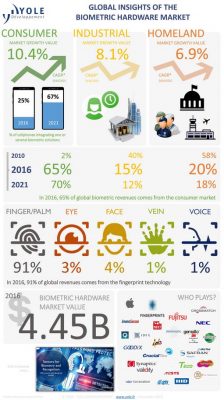 Biometrics market analysis. Infogram: Yole
Emerging applications
In the consumer market, things are changing. The Internet of Things is creating a demand for fingerprint recognition and voice recognition – for instance to authorize access to secure places or information.
Voice assistant technology – such as developed and made popular by Amazon and Google – are also spurring demand for voice recognition technologies to confine system access to registered users. Girardin explains:
“Current performances are not sufficient to perform a good recognition of the owner but future sensors, especially with high SNR [signal-to-noise ratio], beam-forming and always-on behavior will drive the market in a near future.”
Yole predict other emerging applications will include: flexible fingerprint sensors that can wrap around doorknobs or steering wheels for access to buildings and cars.
The growing biometrics market for homeland security will be in China, Africa, India, and South America, while the consumer sector will continue to dominate in terms of volume of devices sold, they conclude.
