
The French economy stalled again, posting zero growth in the second quarter, according to statistical agency INSEE. The country has now registered two consecutive quarters of no growth. Two quarters of contraction signify a recession, while 6-months of no growth suggest the country is likely on the verge of a severe downturn.
There is growing concern in the Eurozone, which posted zero growth in Q2, that the fragile economic rebound is dying. With Italy now officially back in recession and Germany posting GDP contraction in the second quarter, it is looking increasingly probable that the currency bloc’s three largest economies will pull the whole region down with them.
France scraps deficit target
Michel Sapin, France’s Finance Minister, believes his government will be unable to meet its 2014 deficit target.
Mr. Sapin wrote in Le Monde:
“The truth is that, as a direct consequence of sluggish growth and insufficient inflation, France will not meet its public deficit target this year despite a complete control of spending.”
Mr. Sapin’s comments have increased the risk of a head-on clash with the European member states that are trying to meet their own fiscal targets. He says the Eurozone’s policies are partly to blame for the current economic woes of his country.
Mr. Sapin said there are “European causes…and French causes for lack of growth.”
There is a wide division in the Eurozone between the northern countries led by Germany, which want reforms and prudent spending, and the southern (peripheral) nations led by Italy, that would like to see more budgetary leeway.
So far, the European Commission has relented twice with France, allowing it to delay its deficit targets.
Mr. Hollande’s administration now forecasts 0.5% GDP growth for 2014, rather than the previously announced 1%. Economists across Europe doubt either prediction will be achieved.
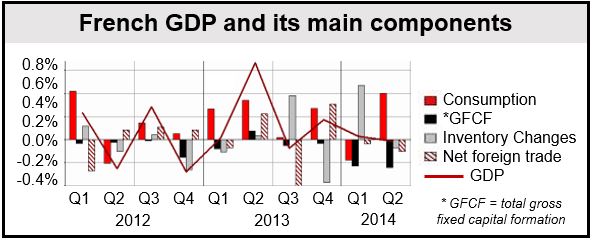
(Data source: INSEE)
Household spending and domestic demand rose
Private consumer spending increased by 0.5% in Q2 after falling by -0.5% in Q1, while total gross fixed capital formation declined by -1.1% (-1.0% in Q1). Capital formation refers to the creation of new capital goods, which increase the production of products and provision of services.
Domestic demand, however, (excl. changes in inventories) rose marginally by 0.2 of a point after falling -0.4 of a point in Q1.
Exports held steady at 0.0% (+0.5% in Q1) while imports grew by 0.4% (0.6% in Q1), resulting in a negative contribution to the economy from its foreign trade balance. When the trade balance surplus grows, it contributes positively to GDP growth, and negatively if it falls.
Goods & services production declined by -0.1% in Q2 compared to +0.2% in Q1, while manufactured goods output fell -0.1% (+0.8% in Q1).
INSEE put the drop down to the high number of potential extra off-work days in Q2 due to midweek public holidays.
Russian sanctions
With the tightening of Russian sanctions after the downing of flight MH370 over Ukraine, European countries will face dwindling exports, fewer investment opportunities, and a growing risk of fuel shortages this winter.
The European Union is dependent on Russia for about one third of its natural gas supplies. If things come to a head and supplies are switched off, the economic consequences could be devastating for the region.
France has called on the European Commission to take “appropriate” measures to deal with the fallout from Russia’s move to impose sanctions on food imports from Europe.
After Russia announced it was banning certain food imports from the United States and its major allies, French President Francois Hollande met with domestic food producers concerned about the impact.
Mr. Hollande asked for the European Commission today to take “appropriate” measures to deal with the fallout from Russia’s tit-for-tat move.
In a statement issued today, the French government said:
“(Talks have started with the European Commission so that the) consequences of the embargo are accurately assessed and measures appropriate to the situation are taken. Special attention will be paid to producers of fruits and vegetables, and farmers who are already facing difficulties in the market.”
