

German factory orders recovered slightly in September, increasing by 0.8% after a sharp -4.2% (revised) decline in August. Economists had expected factory orders to be 2% up in September.
It now looks more likely that Europe’s biggest economy contracted in the third quarter, which would mean it is in recession. If a country’s GDP shrinks for two successive quarters, it is technically in recession.
In the second quarter of this year, German GDP shrank by 0.2%. The country had started the year well.
According to the Federal Statistical Office Destatis, domestic factory orders in September fell by -2.8% while orders from abroad grew by 3.7%.
New orders in September from the Eurozone were 2.5% up on August, while orders from elsewhere increased by 4.4%.
Intermediate goods manufacturers reported a 0.8% increase in orders, while those of capital goods saw orders rise by 1.3%.
Consumer goods makers recorded a -1.4% fall in orders in September.
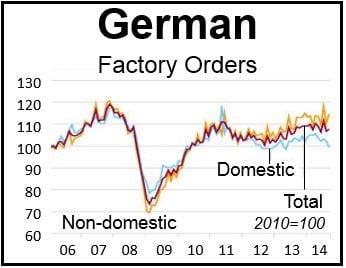
(Source: Destatis)
The European Commission downgraded its GDP growth forecasts for Eurozone members this week, including its outlook for Italy, France and Germany. The Bundesbank says there is unlikely to be any growth in the rest of the year, partly due to economic sanctions against Russia.
The Commission predicts Eurozone GDP will grow by 0.8% in 2014 and by 1.1% in 2014. In May it had forecast 1.2% and 1.7% growth respectively. It expects German GDP to increase by 1.3% this year and by 1.1% in 2015, compared to May’s prediction of 1.8% and 2% respectively.
European Central Bank officials meet today in Frankfurt to decide on their next monetary policy actions. Most analysts believe they will leave interest rates where they are.
Economists believe these sluggish figures will be short-lived, given that German wages are rising and unemployment is low. Most predict accelerating growth in 2015.
