
A new OECD study predicts a global economic slowdown plus growing income inequality for the next thirty to fifty years. The authors, who looked beyond the financial crisis at what the world might look like by 2060, say global economic growth will gradually lose its current pace.
As life expectancy gets longer and the emerging economies’ GDP start experiencing slower GDP (gross domestic product) expansion, the authors forecast that their 2010 to 2020 average growth rate of 3.6% will have declined to 2.4% from 2050 to 2060.
The main drivers of growth in the middle of this century will be innovation and investment in skills.
In a separate report in May, the OECD informed that inequality has persisted for the last three decades in most member nations. The top 1% richest people continue to capture a progressively more disproportionate share of overall income growth.
Pollution and inequality will cut economic growth
The study – Policy challenges for the next 50 Years – believes that CO2 emissions will probably reduce GDP by 1.5% by 2060, and by almost 6% in South and South-East Asia, unless something is done about it.
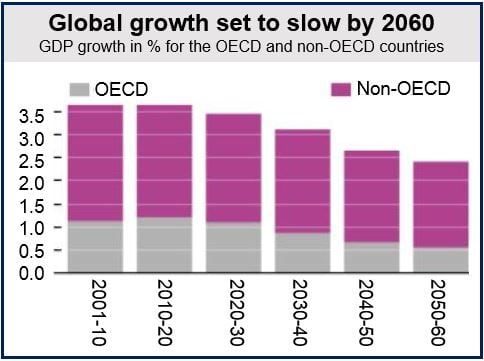
(Source: OECD Economic Outlook 95 long-term database)
The advances in science & technology will push up demand for highly-skilled workers. If current policies are not changed, OECD member nations will face a further increase in earnings inequality by 2060, bringing them in line with the current levels in the United States.
Growing inequalities undermine growth, “most notably by blocking economic opportunities,” the authors wrote.
Workforce will shrink in advanced economies
Economic migration from emerging into advanced economies will be much less as the gaps between them shrink. As immigration into the advanced economies declines, the pressures caused by aging populations will grow. The result will be a smaller workforce “with the baseline of the current trends by 20% in the US and by 15% in the Euro area by 2060,” the report predicts.
Emerging economies’ share of trade will rise considerably. Technological catch-up and improved skills will help them develop high value-added manufacturing and services activities.
Governments and their policymakers will have to inject dynamism into the workforce and product markets and sustain innovation, productivity and employment.
Redistributive policies to address widening inequalities will be required, with a strong focus on equal opportunities and a review of the tax structures and funding systems of public services.
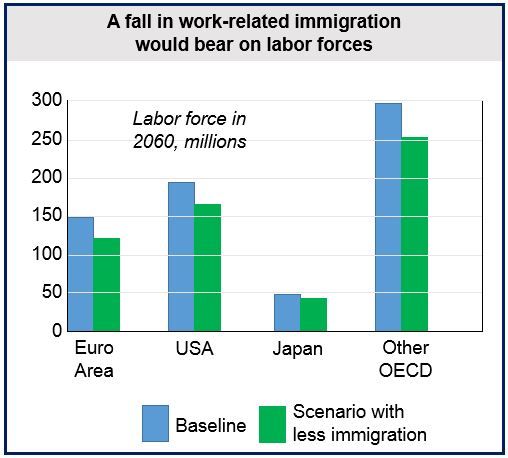
(Source: OECD “Shifting Gear Policy”)
More interdependence between countries
Nations will become increasingly interdependent economically, making international cooperation in areas such as climate change mitigation, competition policy, intellectual property rights and basic research a top priority.
The authors added “Cooperation will also be crucial in the area of taxation, particularly to combat corporate tax avoidance.”
OECD Deputy-Secretary General and Acting Chief Economist, Rintaro Tamaki, said when presenting the report in Tokyo that the report highlights three areas:
- sustaining strong growth,
- addressing rising income inequality, and
- reducing climate change costs.
“The study shows we face a globalization paradox – countries will be more integrated than ever before, but it may become increasingly difficult to organize the required international cooperation in a more complex multipolar system,” Mr. Tamaki said.
