
Scientists in Australia have created a graphene filter that promises to be a fast and affordable way to make polluted water drinkable.
In a study paper published in Nature Communications, they describe how water from Sydney Harbour was safe to drink after it passed through their “anti-fouling” graphene filter.
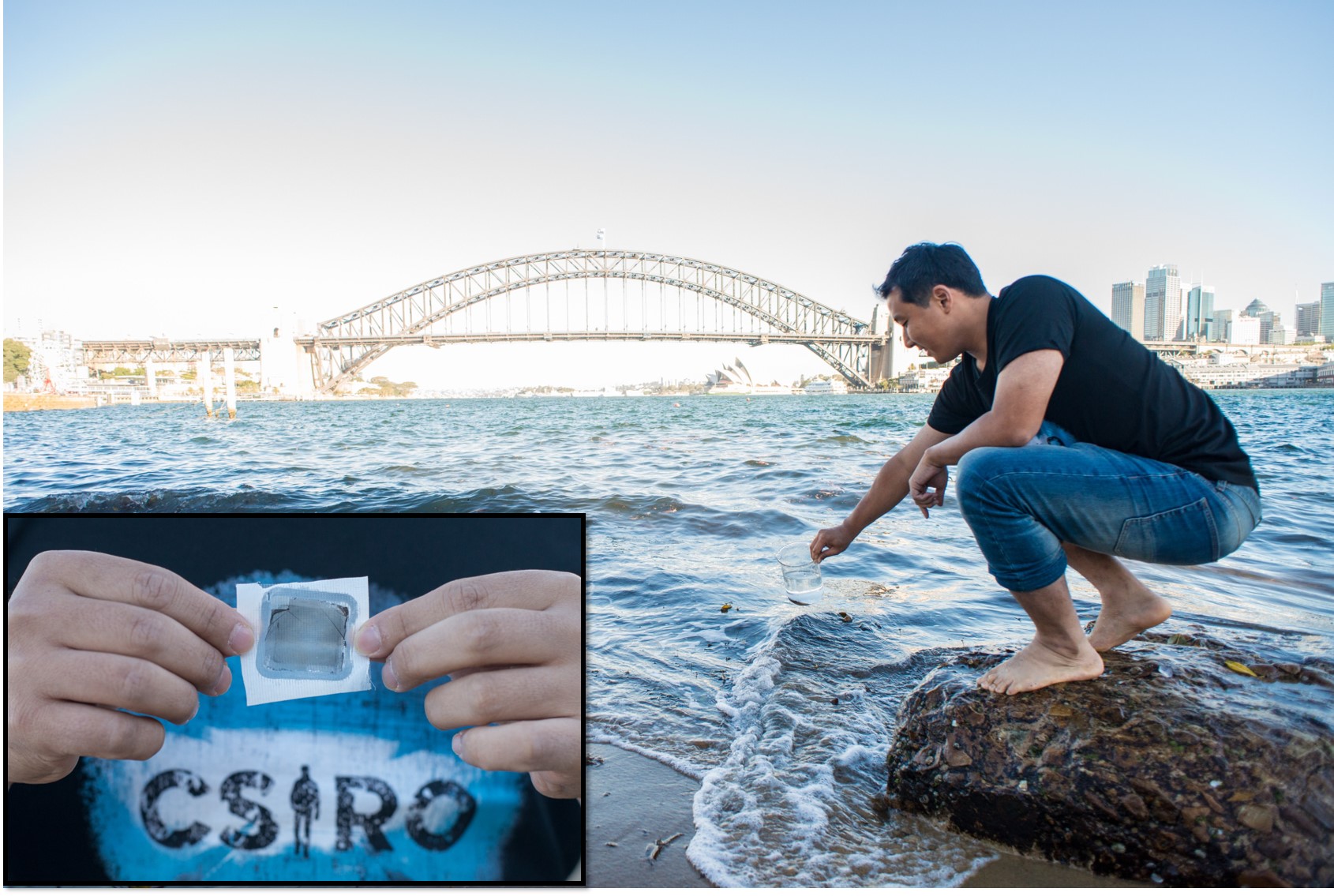
 Dr. Seo and his colleagues tested their anti-fouling graphene filter (see inset) on water taken from Sydney Harbour. Image: composite of CSIRO photos.
Lead author Dr. Dong Han Seo, a scientist at the Commonwealth Scientific and Industrial Research Organisation (CSIRO) in Lindfield, near Sydney, says that their invention – which uses a special form of graphene that they call “Graphair” – is perfect for water purification.
“It can replace the complex, time-consuming and multi-stage processes currently needed with a single step,” he adds.
‘Safe water is a basic human right’
Nearly a third of the world’s population – some 2.1 billion people – do not have access to safe water in the home.
Every year, tens of millions people around the world become seriously ill because of dirty water, and some 1.8 million are killed by cholera and other diarrheal diseases.
The United Nations regard universal access to clean, safe water as a basic human right and essential to improving living conditions for all.
Graphene – ideal material for water purification
Graphene is a form of carbon made of sheets that are one atom thick and in which the atoms are arranged in a two-dimensional hexagonal lattice – like extremely thin honeycombs.
Hailed as the “world’s first 2D material,” it has some remarkable properties that have fascinated scientists and technologists all over the world since it was first isolated in 2004.
Its unique structure makes graphene both extremely thin – it is the world’s thinnest material – and transparent. It is also, despite being very flexible, about 200 times stronger than steel.
But the property that is perhaps of most interest to the scientists at CSIRO – and others working on water purification systems – is the fact that graphene has tiny “nanopores with diameters approaching those of hydrated ions.”
This makes it an ideal material for the “design of membranes capable of ultrafast and selective water transport,” note the authors.
Nanochannels for water transport
The graphene filter that the team has invented has tiny nanochannels that allow water to pass through but stop pollutants.
Dr. Seo explains that the way that they make their so-called Graphair is a unique, environmentally friendly process that can make the graphene filter cheaply from renewable materials such as soybean oil.
The team tested the new graphene filter on water samples from Sydney Harbour. They ran the samples through a commercially available filter that they had coated it with Graphair.
“Our graphene membrane enables 100 percent salt rejection as well as 100 percent rejection of household contaminants such as detergents and oil without fouling which was tested for over many days,” says Dr. Seo.
Anti-fouling
Fouling – where pollutants gradually coat the filters and block flow – is a common problem with conventional water filtration systems. The process is further slowed down by the fact that the contaminants have to be removed.
Without the Graphair coating, within 3 days, the filtration rate was reduced to half the speed it had at the start.
But when it was Graphair-coated, the filter continued to work effectively even when it became coated with pollutants. It also worked faster and removed more pollutants.
The graphene filter can produce clean drinking water – no matter how dirty it is, “in a single step,” says Dr. Seo.
“All that’s needed,” he explains, “is heat, our graphene, a membrane filter and a small water pump. We’re hoping to commence field trials in a developing world community next year.”
Video – anti-fouling graphene filter
In the following short video Dr. Dong Han Seo sums up the work they have done so far on developing their anti-fouling graphene filter.
