

There is widespread homophobia in UK sport, says a new study ‘Out on the Fields’, the world’s first international study on homophobia in sport. Study researchers, from the UK, Canada, US, Ireland, New Zealand and Australia call for a zero-tolerance approach towards discrimination and improved training for teachers, coaches and officials.
The study found that homophobia in sports is common throughout the native-English-speaking world.
The study, on behalf of the Bingham Cup (a non-professional, gay rugby union tournament) and affiliated sports groups, was carried out by the global sports market research firm Repucom, and monitored by a panel of seven academics from six universities.
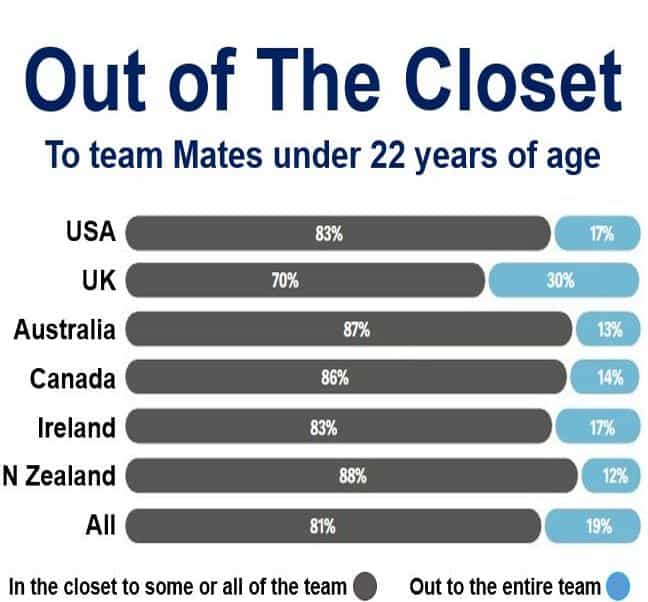
This result refers to gay males under 22 at the time. (Source: ‘Out on the Fields’)
Record numbers ‘coming out of the closet’
In spite of the prevalence of homophobia, the study showed that a growing number of young gay and lesbian sports people are coming ‘out of the closet’.
Thirty percent of British gay men under 22 years of age are likely to be out of the closet to their entire team, which is nearly twice the rate compared to the rest of the native-English-speaking nations.
Major areas of concern in the UK are spectator stands and reports of homophobic violence.
Gareth Thomas, a retired Welsh rugby player, who represented Wales in both rugby union and and rugby league, the most capped Welsh rugby union player, and who came out in 2009, said:
“This study has cast a very bright and much needed light on the extent of homophobia in sport in the UK and around the world.”
Mr. Thomas, who also wrote a Foreword for ‘Out on the Fields’ added:
“I’m very encouraged to see that more gays and lesbians are finding the courage to come out of the closet, certainly much younger than I did while playing sport.”
“It’s even more impressive that they are choosing to be open about their sexuality despite the widespread homophobia that continues to be reported around sporting fields, especially among fans”
Being unsafe at a sporting event is ‘unacceptable’
Football (US: soccer) player Robbie Rogers, who came out when leaving Leeds United, becoming the first openly gay male professional sports person to join any of the five major US sports leagues when he signed with the LA Galaxy soccer team, said:
“It’s very disappointing to see that the overwhelming majority of people who took part in the study, including the many straight people, thought an openly gay, lesbian or bisexual person would not be very safe as a spectator.”
“This is not acceptable. Everyone should be able to enjoy sports. It’s time that all sports enforce a zero tolerance of hateful language on and off the fields.”
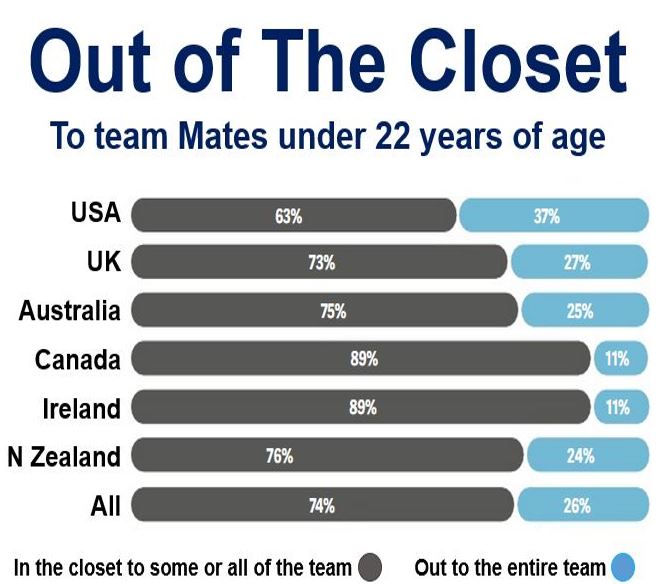
This result refers to lesbians under 22 at the time. (Source: ‘Out on the Fields’)
Mr. Rogers said he strongly supported “immediate venue bans for anyone using homophobic, racist or any other form of discriminatory language.” He also believes players should be penalised for using this language.
Professor of Human Development, Ian Rivers, from Brunel University London, said:
“In the UK we have recently invested significant resources to address discrimination in sport but it’s very clear from this study that much more needs to be done, particularly around homophobia.”
“This form of discrimination is not only affecting lesbian, gay and bisexual people, but the study shows many straight men are also being targeted.”
“I strongly hope that sport governing bodies, organisers of major sporting events, coaches, referees and even athletes take this report away and consider what we each can do to ensure lesbian, gay and bisexual people feel safe and welcome.”
Data were gathered through an anonymous ten-to-fifteen minute online survey promoted through traditional and social media, as well as sporting organisations, corporations, government, and professional athletes.
The organisers say the survey is the largest ever of its kind, and comprised 9,500 participants, including 1,796 from the UK. Approximately one third of respondents described themselves as heterosexual.
Below are some highlighted data from the survey:
– 60% of gay men, 54% of lesbians, and 24% of heterosexual men said they have personally been at the receiving end of homophobia.
– 30% of gay under 22 years of age (youth) and 27% of lesbian youth said they were out of the closet to their whole team.
– 85% of British participants thought that an openly gay, lesbian or bisexual individual would not be very safe as a spectator at a sporting event.
– 48% of gay men who were not involved in team sports had been put off by homophobic experiences in PE classes at school.
– Gay and lesbian under 22s in the UK are much more likely today to report being personally targetted than previous generations.
– Among those who had personally experienced homophobia, 81% of gay males and 80% of lesbians had received verbal slurs including ‘faggot’ or ‘dyke’.
– 21% of gay males and 14% of lesbians reported being assaulted physically. Twenty-six percent of gay men and 18% of lesbians said they had received threats of harm.
According to the report “Americans were also the most likely to report witnessing or experiencing homophobia in sports, which contributed to the USA being ranked the lowest of the 6 major English speaking countries for inclusion of LGB people in sports.”
Citation: “Out on the Fields.” The first international study on homophobia in sports.
