
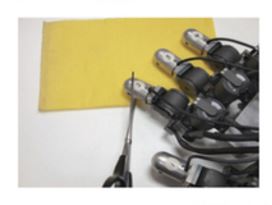
Is human-to-robot empathy possible? That is, can we feel empathy toward humanoid robots? Researchers from Toyohashi University of Technology and Kyoto University believe we can. Empathy is the ability to understand and share the feelings of another.
Humans are genetically programmed to feel empathy toward their fellow human beings and console them in distress.
As robots become increasingly more popular and common in our everyday lives, we need to understand our interaction with robots in social situations.
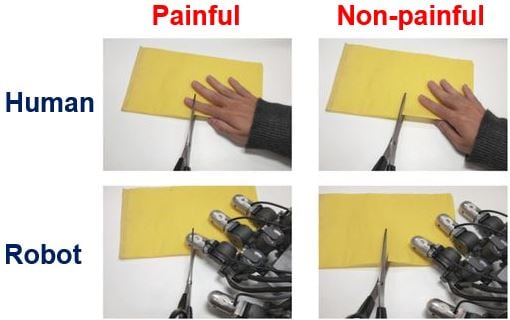 A cut finger. An example of stimuli used in the experiment. (Image: Scientific Reports)
Many humans appear to feel empathy toward their cars – they call them names, feel sad when they look dirty and unkempt, and talk about them with pride (or concern when there is something wrong with the engine).
Human behavior with robots in empathic situations
So, how does the human brain respond to robots in empathic situations. This is what a team of researchers tried to find out. They published their findings in the journal Scientific Reports.
Researchers from Kyoto University and Toyohashi University of Technology, both in Japan, have found the first neurophysiological evidence of our ability to empathize with robots in perceived pain.
Associate Professor Michiteru Kitazaki and colleagues say that the empathy we can feel toward robots is different from what we feel toward other humans.
The team performed electroencephalography (EEG) in fifteen healthy adult volunteers who looked at photographs of either a human or robotic hand in painful and non-painful situations, including a finger being cut by a knife.
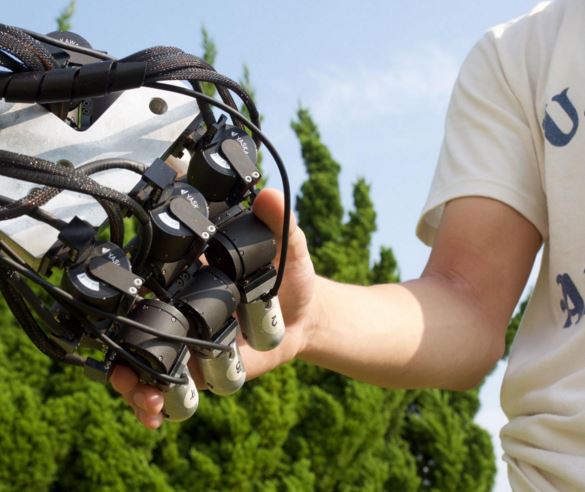 A human and a robot in a social situation. As we interact more with humanoid robots, will our feelings for them grow? (Image: Eurekalert)
We can feel empathy toward human-like robots
Event-related brain potential for empathy toward robots that look like humans in perceived pain were fairly similar to those for empathy toward other humans in pain.
However, the beginning of the top-down process (from general to specific) of empathy was weaker in empathy toward humanoid robots than toward real human beings.
Prof. Kitazaki said:
“The ascending phase of P3 (350-500 ms after the stimulus presentation) showed a positive shift in the observer for a human in pain in comparison with the no-pain condition, but not for a robot in perceived pain.”
“Then, the difference between empathy toward humans and robots disappeared in the descending phase of P3 (500-650 ms). The positive shift of P3 is considered as reflecting the top-down process of empathy. Its beginning phase seems related to the process of perspective taking, as was shown in a previous study.”
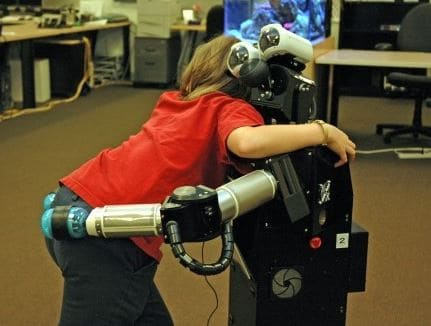 Children perceive robots as emotional, moral beings. Will robots eventually replace cats and dogs in our homes? (Image: phys.org)
The researchers said their results indicate that humans empathize with humanoid robots in a similar way as we do with other human beings.
The researchers said:
“However, the beginning of the top-down process of empathy is weaker for empathy toward robots than toward humans. It may be caused by humans’ inability in taking a robot’s perspective.”
We are unlikely to take the perspective of robots because their body and mind (if one exists) are quite different from ours.
 Imagine a humanoid-robot that is intelligent, a great companion, fun, and 100% loyal. Could humans fall in love with them?
In an Abstract in the journal, the authors concluded:
“These results suggest that we empathize with humanoid robots in late top-down processing similarly to human others. However, the beginning of the top-down process of empathy is weaker for robots than for humans.”
Prof. Kitazaki and colleagues are now trying to manipulate humans’ perspective taking of robots in a new study. They hope the results of their study will contribute toward the development of human-friendly robots for whom we feel sympathy and with whom we feel comfortable.
Citation: “Measuring empathy for human and robot hand pain using electroencephalography,” Suzuki, Y., Ikeda, A., Itakura, S. and Kitazaki, M. Scientific Reports, 5:15924. 2nd, November, 2015. DOI: 10.1038/srep15924.
