
health_insurance_thumbnail

IMF predicts global economic growth of 3.6% in 2017 and 3.7% in 2018

Written by Joseph Nordqvist

Published: 02:36, October 11, 2017

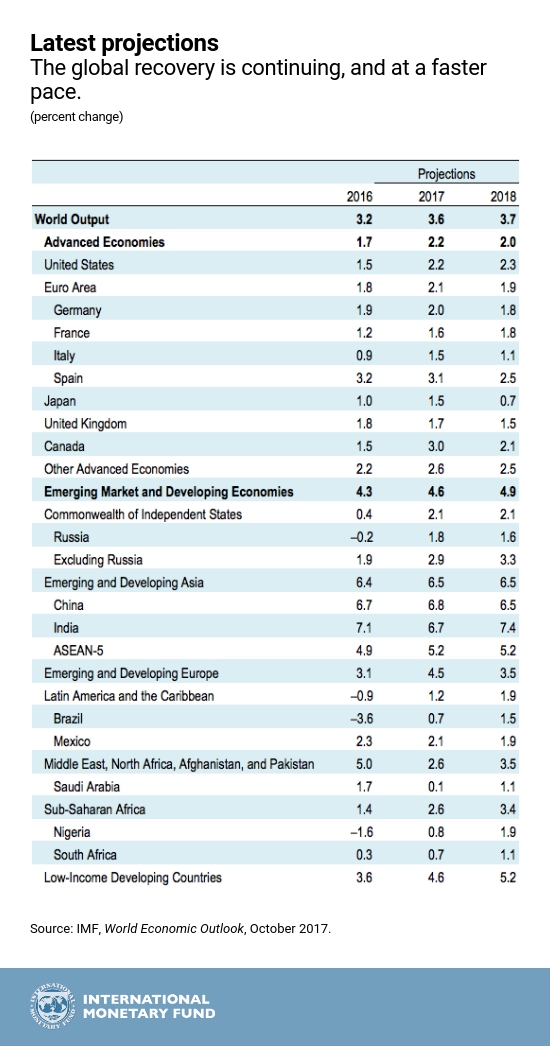
The International Monetary Fund revised its growth forecast for the global economy in October. It now predicts growth of 3.6% this year and 3.7% in 2018 – 0.1% higher than its previous forecasts, and well above 2016’s global growth rate of 3.2%.

The IMF said that most of the 2017 upgrade “owes to brighter prospects for the advanced economies, whereas for 2018’s positive revision, emerging market and developing economies play a relatively bigger role.”

The global economy is experiencing a “welcome cyclical upturn after disappointing growth over the past few years,” the IMF said in its report.

Broad-based upward revisions in the euro area, Japan, emerging Asia, emerging Europe, and Russia more than offset downward revisions for the United States and the United Kingdom.

UK growth forecast same as in its July report

The IMF continues to expect UK economic growth to slow from 1.8% in 2016 to 1.7% this year and to 1.5% next year.

The IMF forecasts weaker growth in consumer spending due to the decline in the value of the pound and subsequent impact on real incomes.

US downward revision

The IMF forecasts US economic growth of 2.2% this year and 2.3% in 2018, down from April when the IMF predicted 2.3% growth in 2017 and 2.5% in 2018.

“The downward revision relative to April forecasts reflects a major correction in U.S. fiscal policy assumptions,” the IMF wrote in its World Economic Outlook report.

Chart of countries and their predicted growth rates
ENG_WEO_table_11_Oct_3-1

Joseph Nordqvist Avatar

Share this:

Other News

Shopify data suggests AI search is giving niche products a new route to customers

Aug 5, 2026

Customer data is moving deeper into pricing decisions

Aug 5, 2026

Texas pauses data-center grid connection approvals as power queue reaches 474 gigawatts

Aug 4, 2026

Japan tests whether carbon pulled from seawater can fuel planes

Aug 4, 2026

Expressive robots engage people more, but their mistakes carry a higher social cost

Aug 4, 2026

Employees reported a better work experience after hybrid work was introduced

Aug 4, 2026

Tomato gene helps plants recover after drought in controlled tests

Aug 4, 2026

New process could reduce the need to purify factory carbon dioxide before reuse

Aug 4, 2026

More novel drugs gained revenue faster in the U.S. after 2013

Aug 3, 2026

Why the right decade matters: new research could help advertisers use nostalgia more effectively

Aug 3, 2026

Could flexible working unlock a new generation of women leaders in family businesses?

Aug 3, 2026

Can waste become the world’s next fire-resistant building material?

Aug 3, 2026

Public R&D spending can boost the economy before the money is even spent, study finds

Aug 2, 2026

Boehringer Ingelheim’s Mexico City expansion targets 5 billion tablets a year

Aug 2, 2026

Why more accurate AI forecasts don’t always make better investment decisions

Aug 1, 2026

The AI boom is inheriting the geography of America’s old energy economy

Jul 31, 2026

Brands scale AI investment as consumers place greater value on reliability, survey finds

Jul 30, 2026

Customers may praise products they helped create even when they fail

Jul 30, 2026

Study links Uber and Lyft to higher local GDP, but overall job effects remain unclear

Jul 30, 2026

Why some industrial parks create thousands of jobs while others create almost none

Jul 29, 2026