
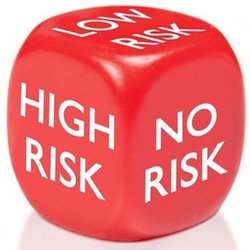
A team of researchers has found that investor risk tolerance is driven much more by the fear of losing money than spending habits. As the American economic rebound gradually kicks in, millions of investors are still apprehensive about investing in stocks and shares.
Investor risk tolerance refers to people’s willingness to take risks – it is a key factor when we decide whether to invest in the stock market, and how much. Not to be confused with Risk Capacity, which is the amount of risk you must take in order to reach financial goals.
Professor Michael Guillemette, from the University of Missouri College of Human Environmental Sciences, and Professor David Nanigian, from the American College, examined what causes risk tolerance.
The study, titled “What Determines Risk Tolerance?” was published in the Journal of Financial Planning (Michael A. Guillemette Ph.D. and David Nanigian Ph.D.).
Loss aversion determines investor risk tolerance
They found that loss aversion – the fear of losing money – is the main factor that explains investor risk tolerance.
Prof. Guillemette said:
“Traditionally, it was believed that spending habits were the main driver of risk tolerance, meaning that the more variation an investor was willing to accept in their spending, the higher their risk tolerance for investments. Our study found that no such relation exists between risk tolerance and spending habits. Rather, loss aversion is a much more accurate indicator of risk tolerance.”
“The more averse, or fearful, to losing money an investor is, the lower their tolerance seems to be for taking risks in the stock market. Consumer sentiment also appears to help explain investors’ risk tolerance, though not nearly as much as loss aversion.”
Three potential drivers studied
For the study, the authors gathered and analyzed data from a risk tolerance survey taken between 2003 and 2010. They concentrated on three potential drivers of risk tolerance:
- changes in consumer sentiment levels,
- alterations in investor spending habits,
- loss aversion.
It is important for risk assessment instruments to gauge loss aversion, especially during periods of poorly performing stock markets, Guillemette says. For financial planners who have to create long-term investment plans, knowing how much people are willing to risk when markets are doing badly is helpful, he added.
Best to gauge reactions during a ‘hot state’
Guillemette explained:
“Financial planners probably acquire more accurate information on client risk preferences when risk tolerance is assessed in a hot state when stock prices are falling, compared to a cold state, when stock prices are rising. Now that we know loss aversion is a key factor that drives risk tolerance, it is important for investors to take steps to reduce their loss averse tendencies.”
“This includes viewing investment returns infrequently, as investors allocate a greater percentage of their portfolio to stocks if they view their returns on an annual, as opposed to monthly, basis.”
It might help reduce loss aversion if investors are encouraged to view their portfolios in a holistic manner, the researchers suggest.
