
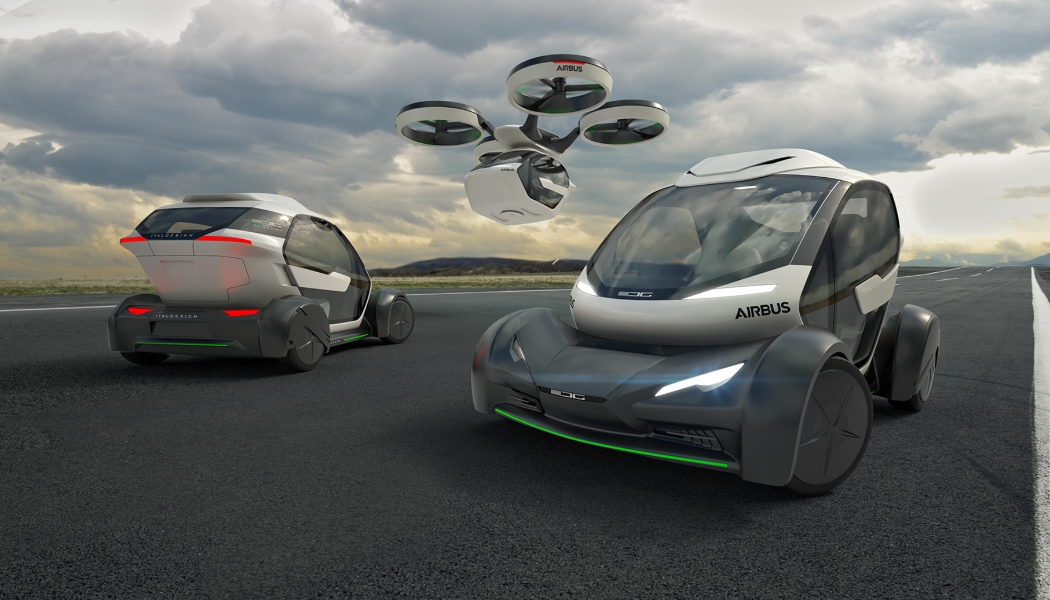
In a bid to relieve traffic congestion – a growing, intractable problem for megacities – Italdesign and Airbus have joined forces to propose a solution based on a self-driving, self-piloting car-drone.
The two companies unveiled “Pop.Up” – their futuristic urban mobility concept – at the 87th Geneva International Motor Show, which finishes on March 19th.
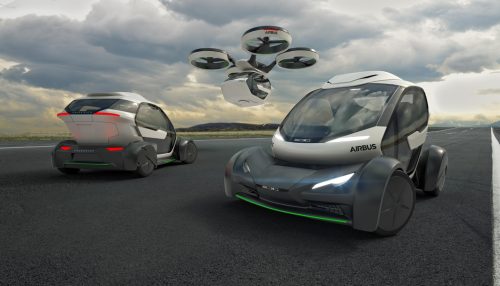 The idea of Pop.Up is that passengers stay in the capsule throughout the journey, during which it switches between self-driving ground and self-piloting air modes by attaching to the appropriate module. Credit: Italdesign
The innovative urban mobility concept brings together the partners’ respective areas of engineering expertise: ground and air transport.
Traffic congestion big problem for megacities
Traffic congestion is already a problem for megacities. For example, Airbus note that traffic analysts have calculated that people living in Los Angeles spend about 104 hours a year stuck in traffic that travels at under 65 percent of the free-flow speed.
Also, research suggests that by 2030, there will be more than 5 billion people worldwide living in 41 megacities – defined as cities with more than 10 million inhabitants.
More than a car-drone
Pop.Up is more than a car-drone. Physically, the “modular, fully electric, zero emission concept vehicle” comprises three elements: a passenger “capsule”, a ground module, and an air module.
However, how the elements work together as a system in the context of a city transport scheme also forms a significant part of the design.
The idea is that passengers remain in the capsule throughout their journey. The capsule switches between ground and air mode by attaching to the appropriate module. There are also plans to allow the capsule to integrate into other types of transportation.
Passengers plan and book a trip via an app that automatically suggests the best mode of transport, taking into account the route, traffic congestion, costs, ride-sharing demands, and the passengers’ preferences.
Seamless switching from ground to air mode and vice versa
If the car-drone is in ground mode and the road becomes congested, the system summons an air module that attaches on top of the capsule, removes it from the ground module, and takes off vertically.
The car-drone then becomes a self-piloted air vehicle that is no longer bound by traffic conditions on the road.
When the journey is complete, the passengers exit the capsule and the car-drone – whether in air or ground mode – returns to a dedicated charge station where it awaits its next fare.
‘Ground transportation moving to the next level’
At the unveiling of Pop.Up in Geneva, Mathias Thomsen, General Manager for Urban Air Mobility at Airbus, said:
“Successfully designing and implementing solutions that will work both in the air and on the ground requires a joint reflection on the part of both aerospace and automotive sectors, alongside collaboration with local government bodies for infrastructure and regulatory frameworks.”
Jörg Astalosch, CEO of Italdesign says, “if you want to design the urban vehicle of the future, the traditional car cannot alone be the solution for megacities, you also have to think about sustainable and intelligent infrastructure, apps, integration, power systems, urban planning, social aspects, and so on.”
“In 10 years, ground transportation will move to the next level,” he concludes, “It will be shared, connected, autonomous, multimodal, and, most importantly, make use of the third dimension.”
Video demonstration of Pop.Up
The following video from the Airbus Group describes the idea of Pop.Up, a “modular system for multi-modal transportation that makes full use of both ground and airspace.”
