

Japan building world’s fastest supercomputer, 130-petaflops using under 3MW power

Written by Joseph Nordqvist

Published: 20:32, November 27, 2016

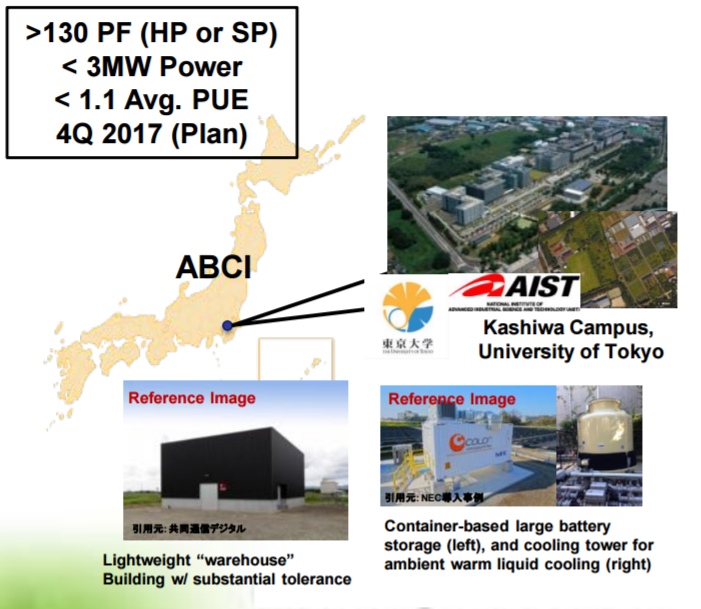
Japan is building the world’s fastest supercomputer capable of making 130 quadrillion calculations per second (otherwise known as petaflops).

The 130-petaflops supercomputer will be built at Japan’s ‎National Institute of Advanced Industrial Science and Technology (AIST).

The computer will outperform the current most powerful computer, China’s Sunway Taihulight – capable of 93 petaflops.
abci_supercomputer_location
Source: AIST Information Technology Research Institute

Satoshi Sekiguchi, a director general at AIST, told Reuters: “As far as we know, there is nothing out there that is as fast,”

Not only will the Japanese supercomputer be incredibly fast, it will also be super-efficient – the team is aiming for a power consumption of under 3 megawatts. To put things in perspective, the Sunway Taihulight uses 15.3 megawatts of power.

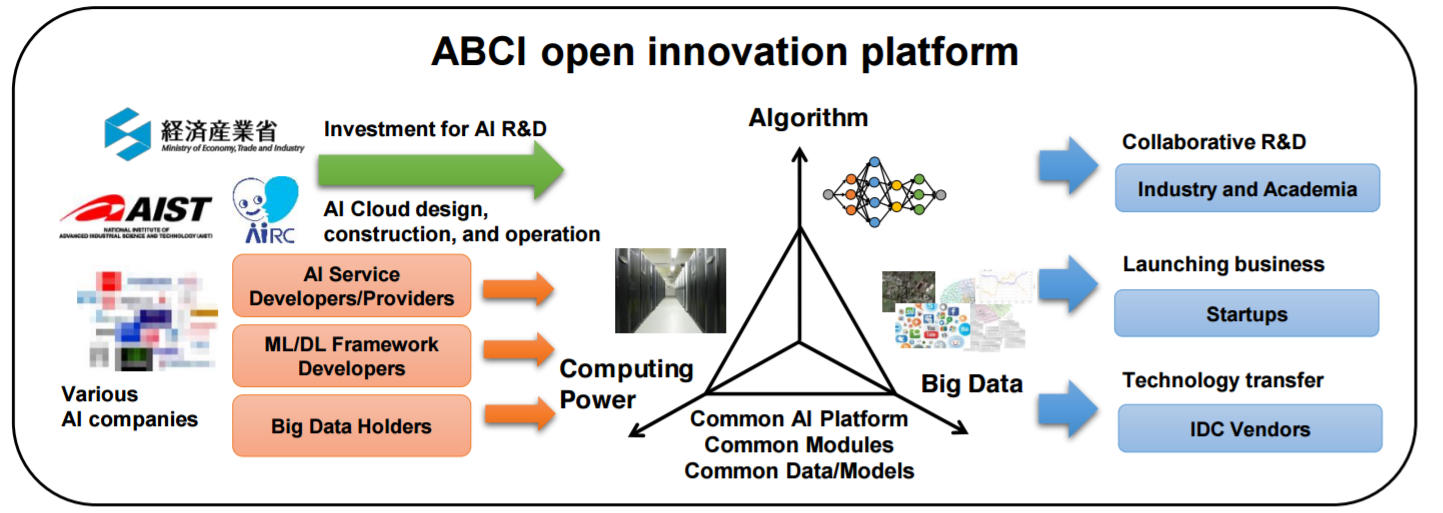
The Japanese Ministry of Economy, Trade and Industry will invest 19.5 billion yen ($173 million USD) on the project, which is being called “AI Bridging Cloud Infrastructure,” or ABCI.

As the name of the project suggests, the computer will be used for ultra-fast calculations to accelerate advances in artificial intelligence, such as deep learning technology – the speed of the calculations it makes allows it to more closely mirror our brains’ neural pathways.
abci_supercomputer_japan_platform
Source: AIST Information Technology Research Institute

Deep learning technology is used in the research community and in industry to help solve big data problems such as computer vision, speech recognition, and natural language processing.

The computer will be made available for a fee to Japanese companies – many of which currently outsource data crunching to firms abroad.

Bidding has already opened and will close on December 8.


Joseph Nordqvist Avatar

Other News

Alibaba updates Qwen3.8 Max as Chinese AI rivals target workplace tools

Sep 3, 2026

Uber and Wayve begin supervised autonomous rides in London

Sep 3, 2026

Dutch central bank raises London share of gold reserves to 32.1%

Sep 3, 2026

Europe’s housing squeeze is becoming a labor market problem

Sep 3, 2026

Vertiv agrees $1.45 billion deal to expand onsite power for AI data centers

Sep 2, 2026

Advanced-economy bond yields are lifting borrowing costs for developing countries

Sep 2, 2026

‘Buy Now, Pay Later’ may lift prices for shoppers who pay upfront, model finds

Sep 1, 2026

Fast delivery can shield nearby sellers from competition

Sep 1, 2026

World Bank says domestic reforms could unlock more trade within Africa

Sep 1, 2026

GoPro agrees Starman merger as action-camera maker looks to AI infrastructure

Sep 1, 2026

UK opens first challenges under £100 million AI procurement scheme

Aug 31, 2026

SLB to buy Kelvion in $4.1 billion deal as it expands into data center cooling

Aug 31, 2026

EU online sellers declared €38.8 billion in VAT through one-stop systems in 2025

Aug 31, 2026

IMF says stablecoins could cut payment costs but weaken monetary control

Aug 30, 2026

Middle East energy shock drives renewables push and fossil-fuel safeguards

Aug 30, 2026

Build-A-Bear cuts outlook as retail sales fall and wholesale growth slows

Aug 30, 2026

HP raises outlook as PC revenue climbs 18% despite lower unit volume

Aug 29, 2026

OECD growth edges up to 0.5% as G7 economies slow

Aug 29, 2026

G20 trade accelerates as imports and services strengthen in second quarter

Aug 29, 2026

Free electricity may help grids use excess wind and solar power

Aug 28, 2026