
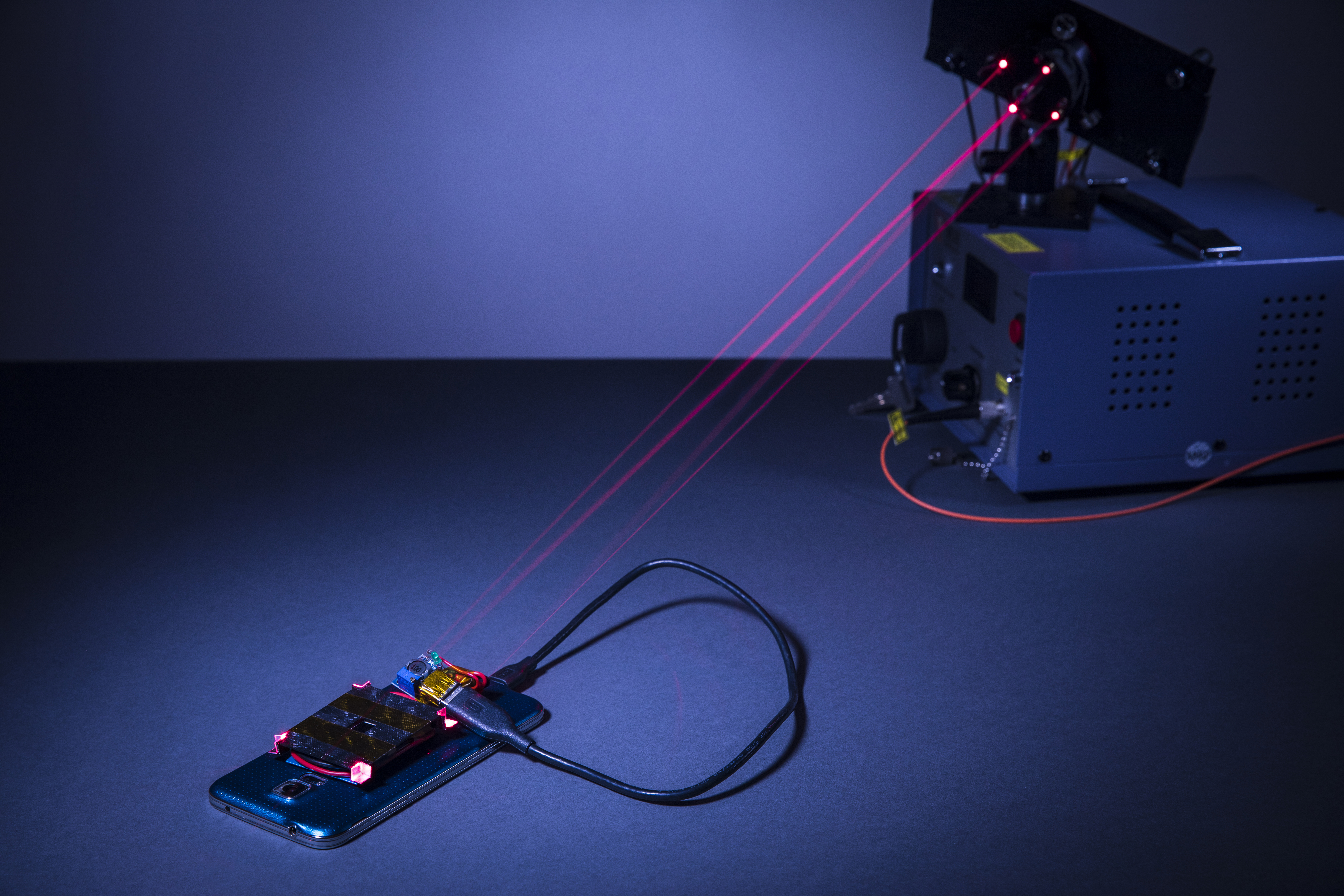
Engineers have developed a safe laser method that allows wireless charging of smartphones and other mobile devices over a short distance, such as from one side of a room to the other.
The team, which hails from University of Washington in Seattle in the United States, says that the wireless charging system can charge a smartphone in around the same time as it takes using a standard USB connection.
 The guard beams that surround the charging laser beam rapidly switch it off if someone moves into their path. The beams are normally invisible, but shown here in red so you can see them. Image: Mark Stone/University of Washington
You can read about the system in a paper that was recently published in the Proceedings of the Association for Computing Machinery on Interactive, Mobile, Wearable and Ubiquitous Technologies.
Technical and safety challenges
As well as the technical challenge of delivering a minimum of 1 watt of power across a room without using bulky equipment, safety was a prime consideration in the design of the wireless charging system.
The engineers achieved this by surrounding the main high-power laser beam that delivers the charge with harmless “guard beams” that shut off the main beam if a person crosses their path.
In addition to the main beam shut-off safety mechanism, the system also includes a heatsink that stops the smartphone over-heating.
“These features,” explains Arka Majumdar, an assistant professor of physics and electrical engineering and co-leader of the study team, “give our wireless charging system the robust safety standards needed to apply it to a variety of commercial and home settings.”
Potential to increase range
The smartphone receives the charge from the laser beam into a power cell that is mounted on the back of the phone.
Tests of the wireless charging system showed that it could deliver more than 2 watts of power to an area of 15 square inches over distances of up to 14 feet, or 4.3 meters, from the laser emitter.
Furthermore, the tests showed that the guard beams can detect and shut off the main charging beam extremely fast – before “a human moving at a maximum speed of 44 [meters per second] can even enter the high-power laser beam area.”
The team also believes that it is possible to increase the radius of the charging beam so that it can deliver power to an area of up to 100 square centimeters that is up to 12 meters, or 40 feet, away.
These increases mean that the device could be placed anywhere on a larger charging surface – such as a tabletop or counter – to receive the charging beam.
By programming the smartphone to signal its location, the team can ensure that the laser emitter can detect when you place it on the charging surface.
The researchers believe that their wireless charging system will also be able to charge other devices, such as tablets, cameras, and perhaps even desktop computers.
