

A significant proportion of Americans rarely involve lawyers or courts when addressing life’s problems, many of which are also legal issues, a recent study has found. The idea that we all seek an expert when having to deal with a legal problem appears to be a myth.
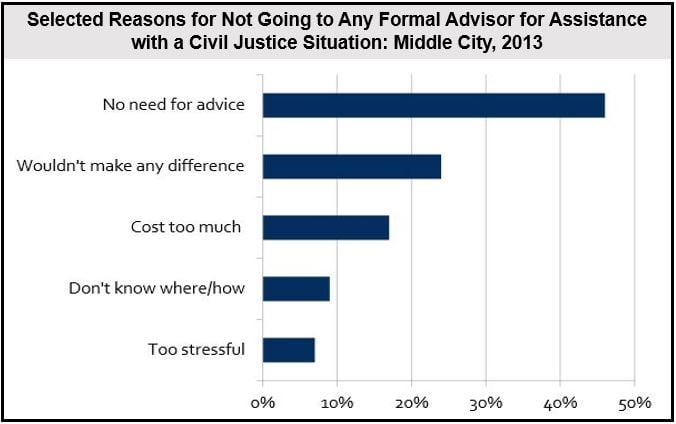
Contrary to popular assumptions, most of these people are not shunning legal experts because of the costs involved, said University of Illinois professor Rebecca Sandefur at the annual meeting of the American Bar Association in Boston.
The study is titled “Accessing Justice in the Contemporary USA.”
Professor Sandefur said:
“The main reason people don’t get assistance is not that they think it’s too expensive. It’s that they think about these problems in a way that channels them away from attorneys, and often channels them away from anybody helping them outside their immediate social network.”
Sandefur’s study included 688 randomly-selected adults from a middle-sized Midwestern city who were interviewed in 2013. It was partly funded by the Services Study for the American Bar Foundation and the National Science Foundation.
(Source: “Accessing Justice in the Contemporary USA.”)
Two-thirds of people in civil justice situations
Sixty-six percent of participants said they had experienced at least one civil justice situation during the preceding 18 months. The average number of situations reported among those people was 3.3.
Of those claiming to have experienced a justice situation:
- 46% dealt with it in their own,
- 16% sought help/advice from friends or family,
- 16% did nothing about it.
- Just 22% sought help from a 3rd party, which may have included the courts or legal experts, as well as government agencies/officials, clergy or social workers.
Negative consequences
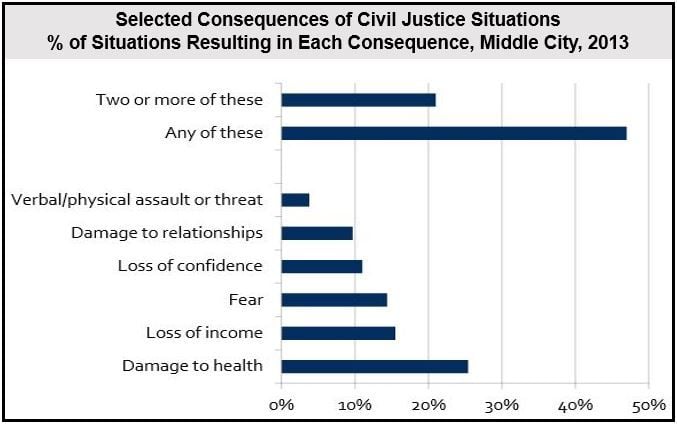
Professor Sandefur also found that 47% of people in those situations went on to experience negative consequences, regardless of how or whether they were resolved. Over one third of those with negative consequences said there was a damaging impact on their physical or mental health.
(Source: “Accessing Justice in the Contemporary USA.”)
Prof. Sandefur said:
“I anticipated people would report that these situations caused them to lose money or to experience fear or a loss of confidence, but seeing such wide-ranging impacts on health for so many people, for such a range of problems, was quite surprising.”
Most problems related to a person’s livelihood
Below is a breakdown of the most common situations reported (percentage of people responding), in each case respondents reported at least one situation:
- 25% involving debt,
- 24% involving their jobs, such as a disciplinary procedure, termination or wages,
- 22% involving insurance,
- 21% involving money, such as disputed bills or mismanagement of pension funds,
- 18% involving rental housing, including evictions or problems with housing conditions,
- 16% had problems with government benefits.
Other situations involved negligent care by dentists or doctors, relationship breakdowns, personal injury, and children’s education.
The interviewees were also asked about problems with access to health care, consumer purchases, and neighborhood & community issues. Prof. Sandefur says those findings will be included in her future reports.
Prof. Sandefur emphasized she was not necessarily making a case for more involvement by legal experts. Several services and programs have been developed, especially in other nations and some US courts, that provide adequate advice without the need for lawyers, she added.
Many would have been better off with help
Prof. Sandefur said:
“In many cases, there are inexpensive interventions possible that would prevent a lot of hardship and expense later on. Oftentimes people handle these things on their own and it’s disastrous, not only for them but for their entire families. They have different lives than they would have, if they’d had a little bit of help.”
A high number of problems are being resolved without the system knowing about it. The system has no idea how many issues are being resolved fairly, or even lawfully. “And that seems like a problem to me, if you believe in something like the rule of law,” Sandefur said.
