
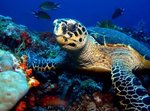
Up to one quarter of all well-known marine species are today threatened with extinction, scientists at the University of Sheffield in England have warned. This is the same figure as for land-based plants and animals, they say.
The number of species facing extinction in our seas is growing, and academics are not taking the problem as seriously as the threat to plants and animals that live on land, they say.
The destruction of habitats like coral reefs, overfishing, climate change and pollution are harming our seas, the scientists wrote in the academic journal Current Biology.
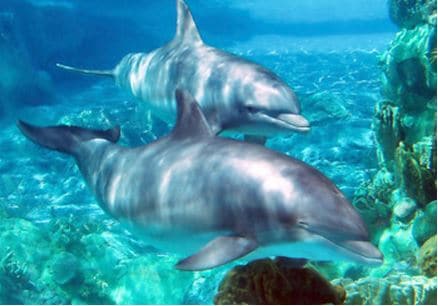
Academics need to take the threat to marine life more seriously, the authors say. (Image: University of Sheffield)
Study leader, Dr. Thomas Webb, from the University’s Department of Animal and Plant Species, said:
“Until now, there has been a general assumption that, despite pressures on marine environments like pollution and overfishing, marine species are unlikely to be threatened with extinction.”
“We have shown that, on the face of it, there are indeed far fewer marine species of conservation concern; but much of this can be explained by the fact the conservation status of fewer marine species has been formally assessed.”
Three-quarters of the major groups of marine animals and plants have not been assessed and checked against the International Union for the Conservation of Nature’s (IUCN’s) list of criteria.
Dr Webb added:
“When we concentrate on those groups of animals and plants which are best known, and where estimates of extinction risk are likely to be most reliable, the difference between marine and non-marine species disappears.”
“Instead, in these groups around one in every four or five species is estimated to be at a heightened risk of extinction, whether they live on land or in the sea. We ought to be more concerned about marine species.”
The study, which was funded by the Royal Society, forms part of a wider programme of study which challenges the traditional belief that marine life is fundamentally different from terrestrial life, and thus should be researched separately.
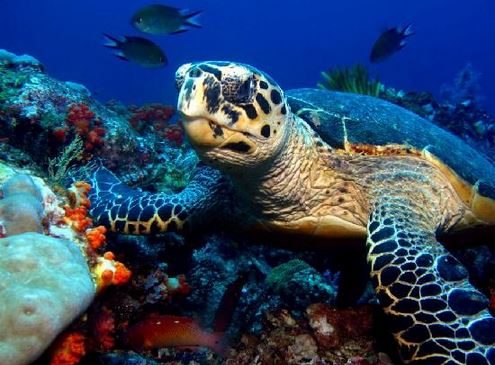
Our oceans cover over three-quarters of the surface of our planet. They are teeming with life.
Dr Webb said:
“This is not to say that there are no important differences, but rather that assumptions need to be tested in order to make sensible decisions about managing the marine environment.”
Ocean temperatures in the summer of 2014 were the warmest on record. Several studies have indicated that climate change is already wreaking havoc on marine life.
Bleaching of corals, such those in the Great Barrier Reef, is severely weakening the species.
When most of us think about life on Earth in danger of extinction, we picture polar bears and other land-based creatures, and not the billions of marine animals and plants beneath ocean waters. This distorted perception of life on our planet needs to change.
Dr. Webb and colleagues hope their study will persuade scientists across the globe to start taking marine life more seriously when considering threatened species.
Marine life going the same way as land-based life
Researchers at the University of California, Santa Barbara, said that ocean life faces a colossal threat from human activity. They say the way we are plundering the oceans with shrimp farms, satellite-guided giant-scale sea-fishing, and seafloor mining threatens to destroy much of its wildlife in the same way so many land animals and plants became extinct.
While the extinction of life in the oceans is just a fraction compared to what occurred on land over the past five centuries, this is about to change dramatically, the scientists warned.
Douglas McCauley, from the Department of Ecology, Evolution, and Marine Biology at UC Santa Barbara, said the same patterns that led to the collapse of wildlife populations on land are starting to occur in the oceans.
