
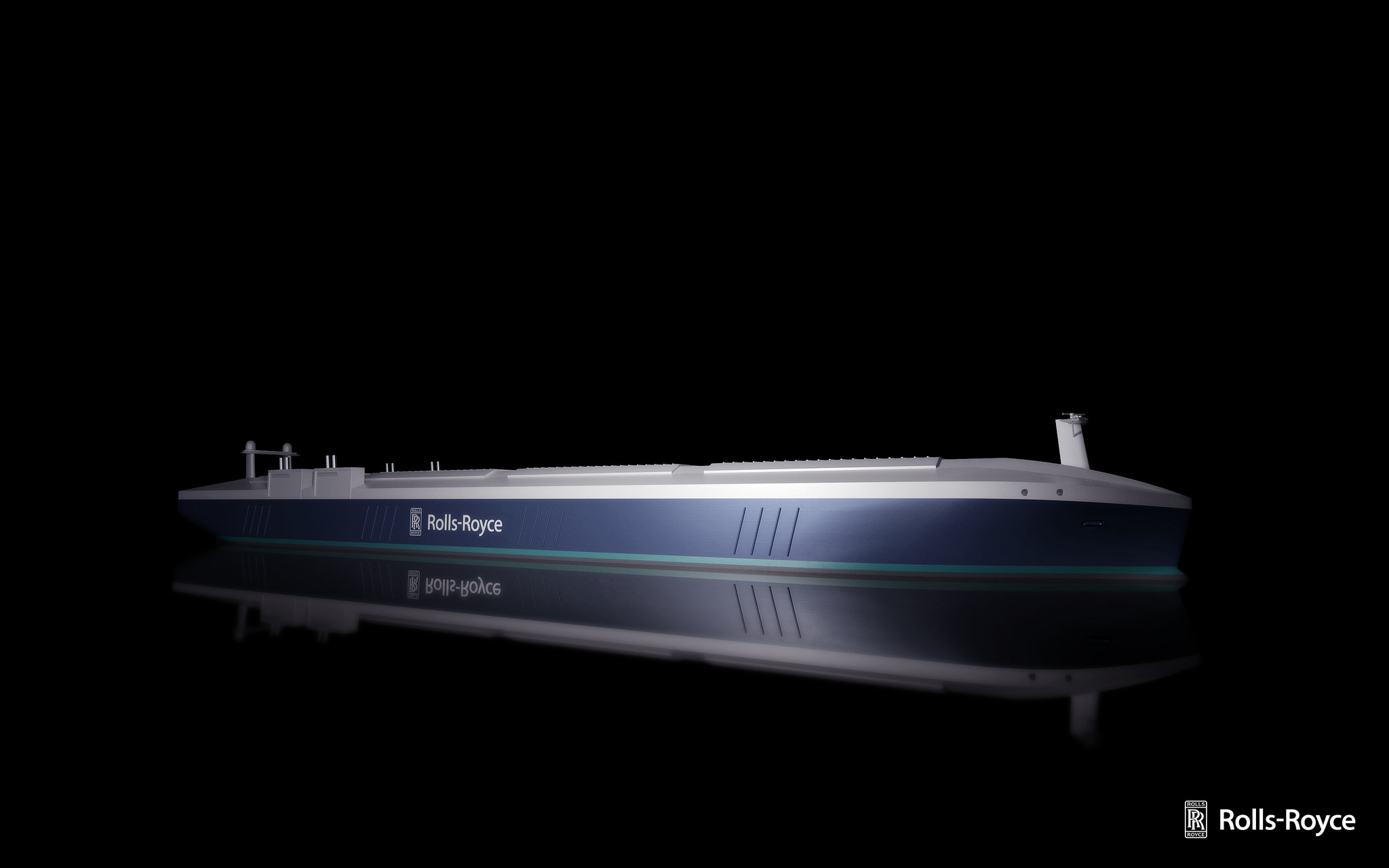
The technology revolution taking place on land with the advent of driverless vehicles also looks set to transform sea transport. In the near future, we are likely to see some large vessels – whether remotely piloted or fully autonomous ships – navigating oceans with nobody on board.
So predicts Oskar Levander, vice president of Innovation, Engineering and Technology at Rolls Royce in an article published in IEEE Spectrum.
He says he and his colleagues at Rolls Royce – the power systems provider, not the motor car marque – “expect fully autonomous oceangoing cargo ships to be routinely plying the world’s seas in 10 or 15 years’ time.”
 With no need to cater for human crews, autonomous ships can be lighter and sleeker, made to hold more cargo, run more efficiently, and be harder for pirates to board. Image: Rolls Royce
Future of remote control and autonomous shipping
Increasingly intelligent and connected digital systems that bring together computing, electronic sensors, and telecommunications are driving innovation of remote control and autonomous cars, trains, planes, drones, and helicopters – and now – ships.
To this end, Rolls Royce is leading a joint industry project in Finland called the Advanced Autonomous Waterborne Applications Initiative (AAWA), details of which were published last year in a white paper.
Other projects are also coming together. MUNIN, a German-led European Commission co-funded project is investigating not only the technical and economic feasibility of operating autonomous ships on open-sea voyages, but is also assessing the legal implications.
China has also launched a research and development project that is looking at ways to use autonomous ships for commercial and military purposes.
And, in Norway, the international ship-certification organization DNV GL is looking at the feasibility of using uncrewed battery-powered ships to carry freight along the long Norwegian coastline.
DNV GL recently signed an agreement with Singapore to promote research and development of intelligent shipping systems – including autonomous ships and drones for maritime purposes.
‘Human error biggest cause of marine accidents’
The technologies needed to make remote and autonomous ships already exist, says Levander. In his article, he outlines some of the advantages and drivers that are making the shipping industry take a serious look at robotic ships.
The main drivers are safety, efficiency, and cost. According to a 2012 safety and shipping report by the insurance company Allianz, 75-96 percent of marine accidents result from human error – often due to fatigue.
Levander says the risk of accidents would be reduced in remote control and autonomous ships – as would the risk of injury and death to crew members, and the consequent danger to the vessel.
If autonomous ships do not have to cater for a human crew, then they can be designed to hold more cargo and run more efficiently.
An unmanned vessel has no need of accommodation quarters, ventilation, heating, sewage systems, or a deck house. The ship can be made lighter, sleeker, and with lower wind resistance. This reduces fuel consumption, cuts construction and operating costs.
Lower risk of piracy
Autonomous ships can also be designed to reduce the risk of other threats – for example piracy.
The ship can be made difficult to board once it is on the high seas. The controls can be made inaccessible, the vessel’s computers can be programmed to immobilize it and make it cruise in a circle, so it is easier for naval authorities to find it.
Also, the absence of a crew could make such vessels less attractive to pirates who see the holding of hostages to ransom as a lucrative part of their activity.
Scarcity of skills
Ship owners and operators are finding it more and more difficult to secure crews with the maritime skills needed to operate and maintain the increasingly complex and sophisticated systems on board.
Also, fewer people with such abilities are attracted to the seafaring life that involves spending long periods away from home.
Perhaps the prospect of operating remote control and autonomous ships from land-based posts might encourage more talent into the industry.
All these benefits and advantages are currently only theoretical, but Levander and his colleagues, and other teams around the world working on similar projects, are keen push the boat out and put them to the test.
Many of them will be presenting and attending the Autonomous Ship Technology Symposium 2017 in Amsterdam on 6-8 June.
The conference will be covering: the development and testing of autonomous ships and associated maritime technology; the legal challenges and implications; the potential cost benefits; safety and security issues; and how to develop a universal set of rules.
