
Over the past fifty years, British people have been travelling further, but less frequently, according to a new study published in the journal Significance.
Since 1965, the total number of trips individuals have made has remained fairly stable, as has the amount of time people spend travelling (about one hour each day).
In 2014, people on average made 921 trips per person annually, compared to about 945 trips in 1965. Trips rates overall increased until the mid-1990s, and have since declined to reach a similar level to 1965.
However, we are now travelling 71% further annually compared to half a century ago. For a similar number of journeys and time spent travelling, Brits travel much further than in 1965. This change over the past five decades is mainly due to shifts in mode use.
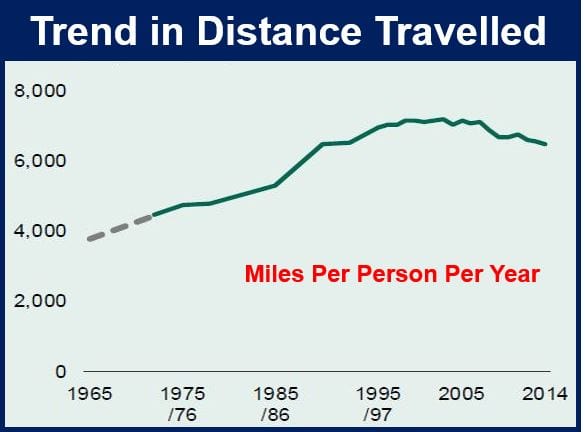 Distances travelled per-person-per-year increased significantly until the mid-1990s. (Source: National Travel Survey)
Over the past five decades, the number of stages made by car, both as a passenger and driver, has increased, while stages made by bicycle and bus have declined.
These findings are based on information sourced from the National Travel Survey, which is currently celebrating its 50th anniversary.
A new article published in Significance describes these and other travel trends over the past 50 years, pointing out that investment in transport on the explosion in car usage have widened employment and leisure opportunities, especially for older people and women.
While distances travelled by women and older age groups lengthened considerably, the mileage of young men has declined slightly. Men under the age of 30 travelled furthest in 1965, while older men are doing more mileage today.
There are considerably more cars in British households today compared to fifty years ago. While just 42% of households had at least one car in 1965, about 76% do so today. Only 29% of British adults had a driving licence fifty years ago, compared to 73% today. Five percent of households had at least two cars in 1965, versus 32% today.
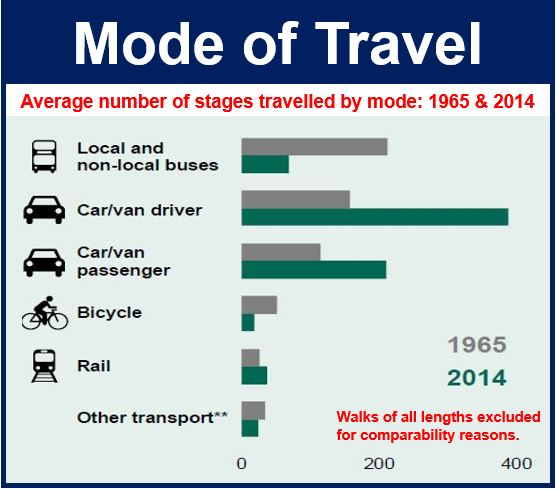 Interesting to see that while bus usage has declined, more people now travel by train. (Source: National Travel Survey)
Brian Tarran, editor of Significance, said:
“The National Travel Survey offers a fascinating look at how one aspect of our society has changed over time, but these insights can also play a crucial role in transport policy development.”
“With World Statistics Day less than a month away, this article makes a strong case for the importance of data sources like the National Travel Survey and the impact they can have on the lives of millions of people.”
