
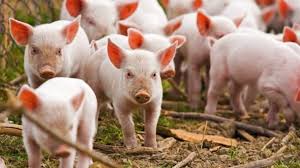
piglets

Pork prices may drop as farms rebound from virus and stocks surge

Written by Joseph Nordqvist

Published: 00:01, October 12, 2014

Last year millions of baby pigs died due to a virus which increased the price of pork. However, high temperatures over the recent summer and the improvement of biosecurity management has reduced the number of piglet virus incidents.

With farmers establishing new health protocol, along with warmer weather and sunshine, the number of incidents of the virus has dramatically fallen – the virus does not spread as much in warmer temperatures.

Entire litters of baby pigs were dying because of the porcine epidemic diarrhea virus, subsequently decreasing pork supplied and increasing the price of pork. According to the USDA, the price of pork was $4.20 per pound in the week of Aug. 14 – 11 percent higher than the year before, at $3.76 per pound.

According to a U.S. Department of Agriculture report, supplies are now up significantly, with a total of 5.46 million new baby pigs born between June and August in Iowa, America’s number one producer. This represents the highest quarterly total in more than 20 years – with a record 10.7 pigs surviving per litter.

With the cost of feed decreasing along with the virus being maintained, pork producers in the US can expect to profit around $60 per animal – an all time high. The average profit per animal over the past two decades has only been $10.50.

The U.S. Department of Agriculture has said that producers are increasing their stock by thousands, in what appears to be an attempt to take advantage of the rise.

A surge of stock increases should push down the profit per animal down to around $30 in 2015.

Purdue University economic professor, Chris Hurt, said it takes almost half a year for a pig to reach market weight. Therefore, the increased supply could mean a slight drop in consumer prices this winter and a more noticeable drop in spring.

Joseph Nordqvist Avatar

Other News

A missed opportunity can make managers keep weak projects alive

Sep 19, 2026

Surgical robots are gaining autonomy, but surgeons still run the operating room

Sep 18, 2026

Catalonia’s Plan B asks how an economy can meet needs without relying on growth

Sep 18, 2026

Bank of Japan raises policy rates to 1.25%. What higher borrowing costs mean

Sep 18, 2026

UK retail sales rise 0.5% in August as online stores recover

Sep 18, 2026

Mistras agrees $866 million sale to H.I.G. Capital

Sep 18, 2026

US industrial output stalls in August as manufacturing slips

Sep 18, 2026

Japan’s household financial assets hit a record ¥2,519 trillion. What that measures

Sep 17, 2026

Canada welcomes EU associate-member proposal, but terms are undefined

Sep 17, 2026

Softcat agrees $1.05B GDT acquisition to expand US data-centre services

Sep 17, 2026

Bank Rate held at 3.75% in the UK as energy prices sharpen inflation risk

Sep 17, 2026

East African Community trade reaches $52.3bn as exports drive surplus

Sep 16, 2026

Canada says its investment summit mobilised nearly C$500bn. What does that actually mean?

Sep 16, 2026

May Mobility agrees $1.4B SPAC deal, bets on asset-light robotaxi model

Sep 16, 2026

Fed raises rates to 3.75% to 4.00% as inflation remains elevated

Sep 16, 2026

IBM-backed Anderon finalizes up to $1B US quantum foundry award

Sep 16, 2026

WTO puts the cost of trade fragmentation at up to 10% of global GDP

Sep 15, 2026

Salesforce launches Koa, a CRM reasoning model built on Nvidia’s Nemotron

Sep 15, 2026

Could humanoid AI companions ever replace human partners?

Sep 15, 2026

IEA forecasts record global coal demand after gas prices climb

Sep 15, 2026