
Employers should reward their workers with higher wages now that oil prices have fallen and companies are making more money, British Prime Minister David Cameron said. The benefits of lower costs should be passed on to employees, he added.
According to the Office for National Statistics, earnings in the service and manufacturing sectors are at record levels as businesses benefit from cheaper oil. Private non-financial firms’ profitability was 12% in Q3 2014 compared to 11.6% in the previous quarter. The net rate of return of manufacturing companies was 10.9% in Q3 2014 versus 9.9% in Q2 2014, the highest since Q1 2002. Service companies’ net rate of return, at 16.8%, was the highest rate since Q1 1997.
Mr. Cameron also called on companies to pay their employees at least a living wage, which is calculated at £7.85 per hour (£9.15 an hour in London). The National Minimum Wage stands at £6.50 an hour.
Global crude oil prices have plummeted by more than 60% since peaking in June 2014, mainly due to an explosion in shale oil production in North American, slower demand from emerging economies (especially China), and OPEC deciding not to reduce production.
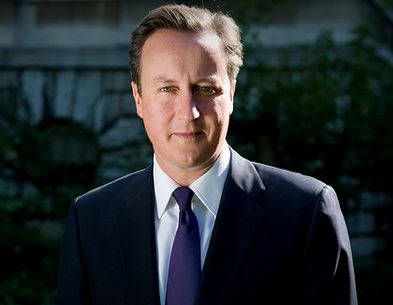
Mr. Cameron believes companies are now in a position to raise wages. (Image: UK.GOV)
Mr. Cameron, who spoke from the White House during a two-day visit to the United States, said:
“Obviously I want to see companies’ success passed through in terms of wage increases. It has to be done in a way that’s affordable, and in a way that companies can continue to grow, we need to see productivity increase.”
“Companies that can afford to pay the living wage should. It’s good and helps to reduce the welfare bill. Falling oil prices is going to benefit a lot of businesses and a lot of countries and we want to see those benefits passed through in all the ways they can be.”
Cheaper oil has handed the Conservatives a political gift just months before a national election by blunting Labour’s attack over a “cost of living crisis” in the UK. Prices of petrol (gasoline), food and several other everyday items have fallen, partly due to the crude oil price crash.
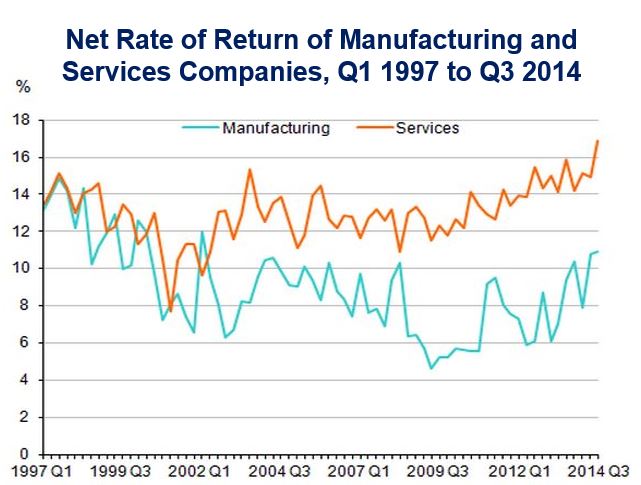
Source: “Manufacturing and Service Companies, Q3 2014,” Office for National Statistics.
Whether the feel-good factor will arrive rapidly enough to help the Tories in their re-election efforts remains to be seen. The Conservatives (the party in power) are still narrowly behind Labour, according to most opinion polls.
Reuters news agency quoted an anonymous source close to Mr. Cameron and his party who said “But there’s uncertainty about whether the votes will feed through as fast as the price cuts are feeding through. The election is not that far off now.”
There is concern among the political parties positioning for votes that North Sea oil companies will cut jobs dramatically in Scotland. However, the Tories are unlikely to be too alarmed as they would have very few votes to lose in Scotland. Chancellor George Osborne said he is considering lowering taxes for North Sea oil firms.
A Labour Party spokesman said in an interview with the BBC that the Conservative-Liberal Democrat coalition was the first government since the 1920s to leave its citizens financially worse off at the end of its parliament than at the beginning.
For nearly five years, wages have failed to keep up with inflation.
Mr. Cameron added, in response to Labour’s claims of workers’ dwindling purchasing power:
“I want to see people earn money for a good standard of living. We are seeing that happening. The figures showed recently if you have been in work for a year on average people have seen a pay increase of 4%.”
