
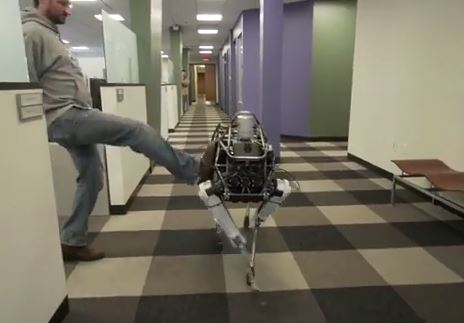
A robot dog, that scientists at Boston Dynamics call “Spot”, is a four-legged machine that never seems to fall down. It can run, walk, tackle awkward hills with ease, and even goes up steps with uncanny smooth elegance.
The engineers at the Google-owned robotics design company showed how spot copes with being kicked (see video below). Its legs sprawl ever so slightly, but it does not appear to lose its balance, and in less than a second is walking normally again.
Spot walks up hills, even rocky ones, and goes up stairs as well as we can. A sensor on top of its head helps it navigate tough and uneven terrain. Its legs are hydraulically activated, while energy is sourced from an electric battery.
According to the scientists, Spot, who weighs 160 pounds (72.5 kg) can run pretty fast.
Spot is a smaller version of robot “BigDog” that Boston Dynamics showed off last year.
Spot has military ambitions
Boston Dynamics plans to have Spot working in the army as a scout or packhorse in difficult terrain. So, relatively speaking, a gentle kick from research engineers is nothing compared to what it may have to face one day.
There is concern within the scientific community about the potential of artificial intelligence (AI) as well as the risk it could pose to human life in one day. Stephen Hawking recently warned about the eventual dangers of AI.
In an interview with the BBC in December 2014, Prof. Hawking said:
“The development of full artificial intelligence could spell the end of the human race.”
While basic forms of AI developed so far have proven to be helpful, Prof. Hawkins is worried about the consequences of creating something one day that is either as or more intelligent than humans.
“It would take off on its own, and re-design itself at an ever increasing rate. Humans, who are limited by slow biological evolution, couldn’t compete, and would be superseded,” he said.
Boston Dynamics also created “Atlas”, a human-like robot that can do some pretty nifty things, including frightening karate moves.
About Boston Dynamics
Based in Waltham, Massachusetts, Boston Dynamics is wholly owned by Google Inc.
It started off as a spin-off from MIT (Massachusetts Institute of Technology), where Marc Raibert and colleagues first developed robots that moved about and ran like animals at the National Academy of Engineering.
The company was founded in 1992, and according to the company “their (the founders’) ground-breaking work continues to inspire much of our work. We pride ourselves in building machines that are both innovative and actually work.”
