
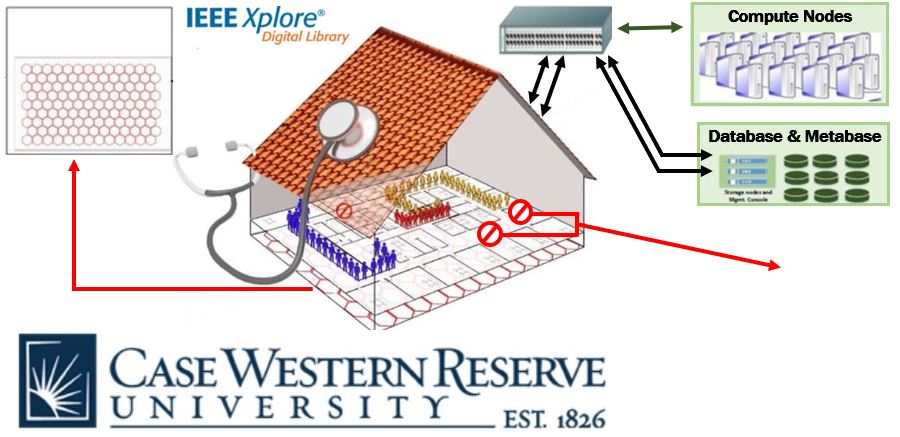
For the past couple of decades, homes have been getting steadily smarter. The next generation of smart homes may offer what researchers are calling an ‘Internet of Ears.’
Smart homes today feature appliances, security cameras, and entertainment systems. They also feature heating and cooling systems that are interconnected and online. Online, in this context, means connected to the Internet.
We refer to the technology of interconnecting devices, such as home appliances, vehicles, etc. as the ‘Internet of Things’ or ‘IoT.’ The technology of interconnecting government, industrial, or commercial buildings is also part of the IoT. Someday, even entire communities will be interconnected.
Smart homes with a new suite of sensors
Some scientists have been working on a new suite of sensors. This technology would read the sounds, vibrations, gait, and other movements associated with humans and animals in a building. They would also sense subtle shifts in the ambient electrical field.
Smart homes of tomorrow will be buildings that adjust to people’s activity with just a few, small sensors hidden in the walls. There might also be sensors under the floor. There would be no need for invasive cameras. This technology, say Ming-Chun Huang and Soumyajit Mandal, is still maybe a decade or so away.
Huang is an assistant professor in electrical engineering and computer science. Mandal is the T. and A. Schroeder Assistant Professor of Electrical Engineering and Computer Science. They are both from Case Western Reserve University in Cleveland, Ohio, USA.
Smart homes that ‘listen’
Prof. Huang said:
“We are trying to make a building that is able to ‘listen’ to the humans inside. We are using principles similar to those of the human ear, where vibrations are picked up and our algorithms decipher them to determine your specific movements. That’s why we call it the ‘Internet of Ears.'”
Prof. Huang is leading the research related to motion tracking and human gait. Prof. Mandal is focusing on vibration sensing and changes in the existing electrical field. Specifically, changes that humans and even pets cause.
Prof. Mandal said:
“There is actually a constant 60 Hz electrical field all around us, and because people are somewhat conductive, they short out the field just a little.”
”So, by measuring the disturbance in that field, we are able to determine their presence, or even their breathing, even when there are no vibrations associated with sound.”
Publication of their work
The scientists published details of their work in at the IEEE Sensors Conference in New Delhi, India (article citation below). IEEE stands for the Institute of Electrical and Electronics Engineers.
Early in 2019, a longer version will appear in the journal IEEE Transactions on Instrumentation and Measurement.
The scientists have tested their technology in the Electrical Engineering Department’s conference rooms on campus. They have also tested it in the Smart Living Lab at Ohio Living Breckenridge Village. The Smart Living Lab is a senior-living community.
Prof. Mandal said they used as few as four small sensors under the floor and in the walls of a room. Regarding privacy concerns, he said the system wouldn’t identify individual people. However, he could calibrate it to recognize the different gaits of individuals.
Smart homes – energy savings and building safety
The scientists expect the system could provide several benefits.
Prof. Huang said:
“The first advantage will be energy efficiency for buildings, especially in lighting and heating, as the systems adjust to how humans are moving from one room to another, allocating energy more efficiently.”
The system would also be able to track and measure a building’s safety and structural integrity base on human occupancy. This could be critical in, for example, a hurricane or earthquake, Prof. Huang explained.
Prof. Huang added:
“This hasn’t really been explored as far as we’ve seen, but we know that humans create a dynamic load on buildings, especially in older buildings.”
“In collaboration with our colleague YeongAe Heo in the Civil Engineering department, we are trying to predict if there is going to be structural damage because of the increased weight or load based on the number of people on the floor or how they are distributed on that floor.”
Citation
“An ‘Internet of Ears’ for crowd-aware smart buildings based on sparse sensor networks,” Xinyao Tang, Ming-Chun Huang, and Soumyajit Mandal. DOI: 10.1109/ICSENS.2017.8234263}. Conference: 2017 IEEE SENSORS.
