
Getting land to develop is a big problem for SME house builders in the United Kingdom. New research shows two-thirds of them cite it as a main constraint on their ability to build new homes.
Every year, the Federation of Master Builders (FMB) carries out a survey of house builders. For two years running (2015 and 2016), it shows that lack of available and viable land is the biggest barrier to small and medium sized (SME) house builders delivering more new homes.
 SME house builders face several barriers to building new homes, with land availability, planning system, lack of construction skills, and access to finance among the top reasons they gave in a survey.
Half of respondents to the 2016 survey say they see the planning system and access to finance as major constraints preventing them building new homes, while 40 percent say the crisis in construction skills is now a major impediment.
The vast majority (95 percent) of builders in the survey said the amount of information they are required to give to the planning system has either increased or not changed at all, following proposed reforms to reduce it.
 The table lists the constraints on ability of SME house builders to build new homes.
Each cell is percentage of respondents who mentioned that constraint in that survey year (2012-2016).
On a more positive note, a high proportion of SME house building firms are saying Brexit – the referendum vote to leave the EU – does not seem to have dampened consumer demand for new homes.
Too much focus on large sites
The main problem with the planning system is the delays to the planning process, say SME house builders, who blame it on under-resourced local authority planning departments.
Brian Berry, FMB’s chief executive, says:
“The current focus on large sites is squeezing out smaller developers, which is reducing competition in the housing market at a time when we need more, not less, choice.”
He suggests councils need to find ways to allocate and grant planning permission for small sites.
In the 1980s, around two-thirds of homes were built by smaller builders – today that figure is less than a quarter.
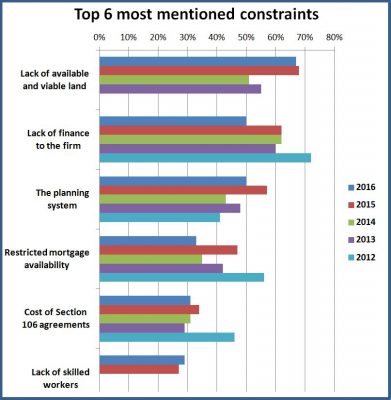 The bar chart shows the six most common constraints on ability of SME house builders to build new homes. Each bar is percentage of respondents who mentioned that constraint in that survey year (2012-2016).
Limited supply of small sites
Berry says the “limited supply of opportunities for small scale development,” is given as a major reason by smaller builders.
For example, he describes is as “absurd” that the planning system processes a planning application for three homes in the same way as it treats one for 300 homes.
He says SME house builders have yet to see any change on the ground from the government’s drive to reduce red tape and increase the number of homes being built.
Berry urges the government to press ahead with reform so there is renewed focus on small sites in the planning process – including a presumption of favouring the small-scale over the large-scale development.
“Planning departments also need to be adequately resourced so that they have the capacity to engage more closely with SME house builders and ensure planning applications are processed through the system as speedily and efficiently as they can be,” he notes.
Stalled sites
While access to finance remains a commonly-cited barrier for SME house builders, fewer firms are mentioning it. The survey finds that assessment and lending conditions for developing residential sites appear to be improving.
A measure that the FMB uses to assess impact of restricted access to finance is the number of stalled sites.
This year, the survey shows that over a third (35 percent) of SME house builders said sites they were interested in had stalled for finance reasons.
This compares with 52 percent last year – the first time the figure has fallen since 2013, the year the survey started asking about stalled sites.
