

Sony profit warning number three was issued on Thursday, its third warning in just six months, as the company booked a further ¥30 billion in costs from leaving its loss-making PC business.
The Japanese electronics and entertainment giant, which employs 146,300 people worldwide, reduced its annual operating profit estimate by almost 70% to ¥26 billion, a nearly 90% fall compared to one year ago, even though revenue is expected to be slightly higher at ¥7.8 trillion.
A profit warning was announced in October 2013, and then another one in February, when the company said it was selling off its loss-making PC division and laying off 5,000 workers.
Sony wrote in its Revision of Consolidated Forecast today:
“The forecast for consolidated results for the fiscal year ended March 31, 2014, as announced on February 6, 2014, was based on assumed foreign currency exchange rates for the fourth quarter (from January 1, 2014 to March 31, 2014) of approximately 104 yen to one US dollar, and approlimately 140 yen to one euro. The average rates for the fourth quarter were 102.8 yen to one US dollar and 140.9 yen to one euro.”
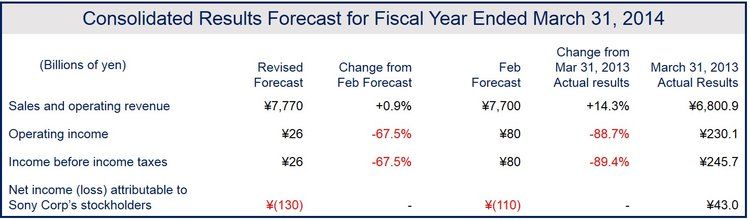
(Source: Sony Corporation)
PC division fared worse than expected
In Thursday’s profit warning, Sony reported worse-than-expected sales in its PC division, which would incur an additional ¥30 billion in costs during the 12-month period up to the end of March 2014 to exit the business.
The company said the additional charges, which also included additional costs from its overseas DVD and CD business, would increase its net loss to ¥130 billion for the 12-month period ending March 31st 2014.
So far, there have been three downgraded forecasts from Sony for the year ending March 31st, 2014:
- October 2013: a ¥30 billion profit.
- February 2014: a ¥110 billion loss.
- May 1st, 2014: a ¥130 billion loss.
Bad news for Kazuo Hirai
This latest profit warning is another obstacle for Kazuo Hirai, who became the President and CEO of Sony on April 1, 2012, replacing Sir Howard Stringer.
Hirai embarked on a major restructuring of the company, an initiative he named “One Sony” aimed at reviving the company from years of losses and bureaucratic management structure. Stringer had found this extremely difficult to achieve. It was said that the difference in cultures and native languages between Stringer and Sony’s Japanese divisions and subsidiaries made it impossible for him to push through major changes.
Hirai said the company’s electronics business should focus on imaging technology, gaming and mobile technology. He also announced a plan to reduce the major losses from the company’s TV business.
Sony selling off departments
Recently, Sony has been divesting or reducing several departments and holdings in order to raise profits:
- Its Vaio PC division was sold in January to a new corporation owned by Japan Industrial Partners.
- It spun its TV division into its own corporation to make it more streamlined.
- At the end of February the company announced the closing down of 20 stores.
- In April Sony announced that it planned to sell 9.5 million shares in the gaming company Square Enix in a deal that would raise $48 million.
One year ago there was optimism when Sony reported its first 12-month net profit in five years. That optimism has vanished as far as investors are concerned, despite the company’s assurance today that there was no significant change in its total restructuring cost.
Sony will report full-year results in May. While PlayStation 4 has won sales, demand for its TVs, cameras and stereos continue to fall, and its smartphone and appliance sales face ever-growing competition from Apple, Samsung and other mobile phone makers.
In an interview with Bloomberg, Daniel Ernst, an analyst with Hudson Square Research, New York, said “The figures underscore just how much electronics continue to drag down other parts of the business that perform much better, including entertainment, games and finance. It will probably continue to fuel arguments (for a spin-off of the television or consumer electronics businesses).”
Sony’s rival Panasonic reported ¥120.4 billion ($1.2 billion) profits for the year ending March 31, 2014.
