

While protecting us from sunburn and reducing skin cancer risk, sunscreen is also deadly for coral reefs across the world, according to a new study published in the academic journal Archives of Environmental Contamination and Toxicology.
The scientists, from the US and Israel, found that a common UV-filtering compound – oxybenzone – currently exists in high concentrations in the waters around the more popular coral reefs in the Caribbean and Hawaii.
Co-author Dr. Omri Bronstein, of Tel Aviv University’s Department of Zoology, said:
“The chemical, oxybenzone (benzophenone-3), is found in more than 3,500 sunscreen products worldwide. It pollutes coral reefs via swimmers who wear sunscreen or wastewater discharges from municipal sewage outfalls and coastal septic systems.”
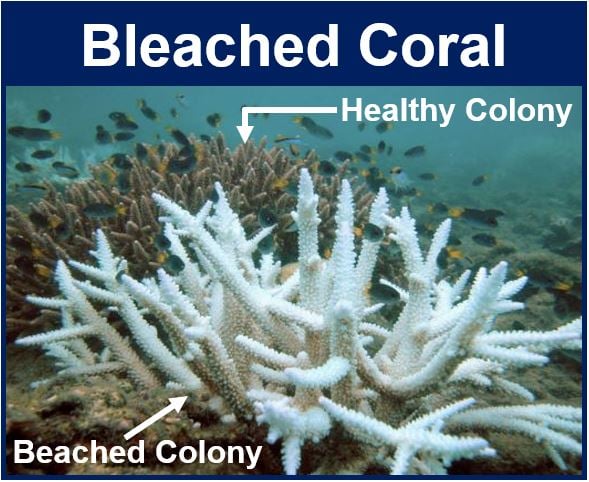 Bleached Acropora coral (foreground) and normal colony (background). High oxybensone concentrations can cause coral bleaching. (Image: Wikipedia)
Oxybenzone damages DNA
Oxybenzone not only kills the coral, it also causes DNA damage in adults and deforms coral DNA when the marine invertebrate is in the larva stage, which severely undermines its chances of developing properly.
An individual who spends the day at the beach uses typically between two to four ounces of sunblock if re-applied every couple of hours after swimming, toweling off, or sweating. If you multiply this by the number of swimmers in the water, there can be a serious risk of environmental damage.
Where eco-tourists congregate in largest numbers, oxybenzone concentrations in the reefs were found to be the highest.
Coral reefs have environmental and economic value
Co-author, Associate Professor John Fauth, a diving enthusiast who works at UCF (University of Central Florida) Biology, said:
“Coral reefs are the world’s most productive marine ecosystems and support commercial and recreational fisheries and tourism. In addition, reefs protect coastlines from storm surge. Worldwide, the total value of coral reefs is tremendous. And they are in danger.”
The study was led by Dr. Craig Downs, Executive Director of the non-profit scientific organization Haereticus Environmental Laboratory. Dr. Downs and colleagues gathered samples in Eilat (Israel), the US Virgin Islands and Hawaii, diving into the water themselves. During their dives they wore no personal hygiene products.
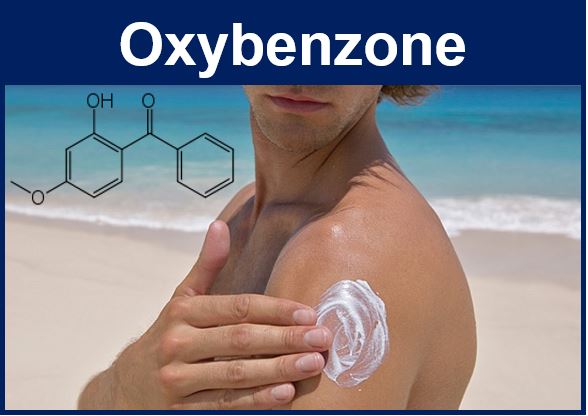 Oxybenzone (benzophenone-3) is found in more than 3,500 sunscreen products worldwide.
Dr. Downs said:
“The use of oxybenzone-containing products needs to be seriously deliberated in islands and areas where coral reef conservation is a critical issue. We have lost at least 80 percent of the coral reefs in the Caribbean.”
“Any small effort to reduce oxybenzone pollution could mean that a coral reef survives a long, hot summer, or that a degraded area recovers. Everyone wants to build coral nurseries for reef restoration, but this will achieve little if the factors that originally killed off the reef remain or intensify in the environment.”
The team exposed cells of adult corals and coral larvae to increasing levels of oxybenzone in laboratory experiments.
They discovered that oxybenzone deforms coral larvae by trapping them within their own skeleton, making it impossible for them to float with currents and disperse.
Oxybenzone causes coral bleaching
Coral bleaching was also caused by oxybenzone. Bleaching is the main cause of coral deaths globally. When corals lose or expel the algae that normally exist inside them, they bleach. Algae is a vital source of nutrition.
Dr. Downs and colleagues also detected more DNA damage in coral larvae exposed to increasing oxybenzone concentrations.
Seven coral species died when exposed to oxybenzone concentrations similar to those measured in ocean water samples. Three coral species tested are currently listed as threatened under the US Endangered Species Act.
In an Abstract in the journal, the authors concluded:
“Oxybenzone poses a hazard to coral reef conservation and threatens the resiliency of coral reefs to climate change.”
The research team included scientists from the University of Central Florida, the Haereticus Environmental Laboratory, the University of Hawaii, the National Aquarium in Baltimore, the U.S. National Oceanic and Atmospheric Administration, Tel Aviv University, and Ben-Gurion University of the Negev.
Prof. Fauth has the following advice for divers:
“Wear rash guards or scuba wetsuits and skip all the hygienic products when you go diving. If we could do it for a week at a time, people can certainly forgo it for a few hours to help protect these reefs for our children and their children to see.”
Citation: “Toxicopathological Effects of the Sunscreen UV Filter, Oxybenzone (Benzophenone-3), on Coral Planulae and Cultured Primary Cells and Its Environmental Contamination in Hawaii and the U.S. Virgin Islands,” C. A. Downs, Esti Kramarsky-Winter, Roee Segal, John Fauth, Sean Knutson, Omri Bronstein, Frederic R. Ciner, Rina Jeger, Yona Lichtenfeld, Cheryl M. Woodley, Paul Pennington, Kelli Cadenas, Ariel Kushmaro, and Yossi Loya. Archives of Environmental Contamination and Toxicology. 20 Oct 2015. DOI: 10.1007/s00244-015-0227-7.
