

SuperSTEM 3, the most powerful electron microscope in the world, that can pinpoint the position of single atoms, has been installed at the Engineering and Physical Sciences Research Council’s (EPSRC’s) SuperSTEM facility at the Daresbury laboratory complex near Warrington, Cheshire, England.
Scientists say SuperSTEM 3, which cost £3.7 million, is 100 times more powerful than any other device currently available at British universities. It can examine objects with one-millionth of the diameter of human hair.
There are just three of these super electron microscopes in the world, one at the SuperSTEM Daresbury facility and the other two in the United States, where they were made.
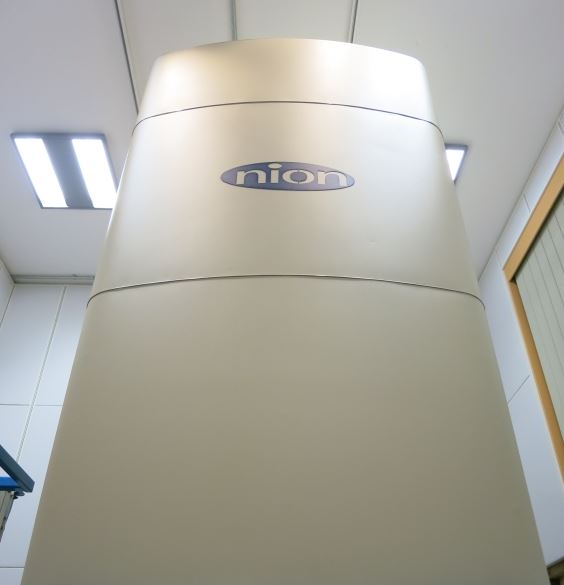
The SuperSTEM 3 is the world’s most powerful electron microscope. (Photo: SuperSTEM Daresbury)
SuperSTEM 3 has an energy resolution of 10 millielectron volts or meVs (1 millielectron volt = 1.60217656 × 10⁻²² joules).
It will support several additional capabilities compared to other electron microscopes, including “the localised mapping of band gaps in semiconducting materials and device structures, the study of plasmonic materials and architectures for optical engineering, solar capture and molecular detection and will importantly enable the detection of the presence and atomic location of light elements, which is otherwise extremely difficult,” says SuperSTEM.
Scientists say it will allow them to identify atoms more closely and precisely, and also observe the bonds between atoms more effectively, which will help when examining hard-to-study materials such as graphene.
Greg Clark, Minister of State for Universities, Science & Cities, said:
“From developing new materials for space travel to creating a better, cheaper treatment for anaemia, this new super-powerful microscope lets UK scientists examine how materials behave at a level a million times smaller than a human hair.”
“This exciting research will help lead to breakthroughs that will benefit not only our health but the environment too.”
Professor Philip Nelson, EPSRC’s Chief Executive said:
“This EPSRC investment in state-of-the-art equipment is an investment in UK science and engineering. It will give scientists access to a tool that can delve into the heart of materials, discoveries made using this microscope will aid research and lead to innovations that benefit society and our economy. The EPSRC SuperSTEM facility at Daresbury has already delivered us new knowledge and applications and this new equipment will continue that pedigree.”
About the Superstem Daresbury facility

SuperSTEM is the EPSRC National Facility for Aberration Corrected STEM.
SuperSTEM Daresbury is run by the Universities of Glasgow, Liverpool, Leeds, Oxford and Manchester.
It also has collaboration agreements with the Universities of Sheffield, Cambridge, York and Warwick.
The facility revolves around its central hub, a purpose-designed building housing three state-of-the-art aberration corrected STEM instruments on the STFC (Science and Technology Facilities Council) Daresbury Campus.
The SuperSTEM project started in 1997 when Professor Mick Brown, Emeritus Fellow, Natural Sciences (Physical), Robinson College, University of Cambridge, presented a paper at the EMAG conference in Cambridge entitled “A Synchrotron in a Microscope”. He urged the British microscopy community to pool resources to exploit the emerging technology of spherical aberration correction.
