
In a world first, researchers have successfully demonstrated a rechargeable proton battery that promises to offer cheap energy storage that is easy on the environment.
The team, based at RMIT University in Melbourne, Australia, believes that the breakthrough is a significant step toward meeting the world’s growing demand for energy storage in a more affordable and sustainable way than lithium batteries.
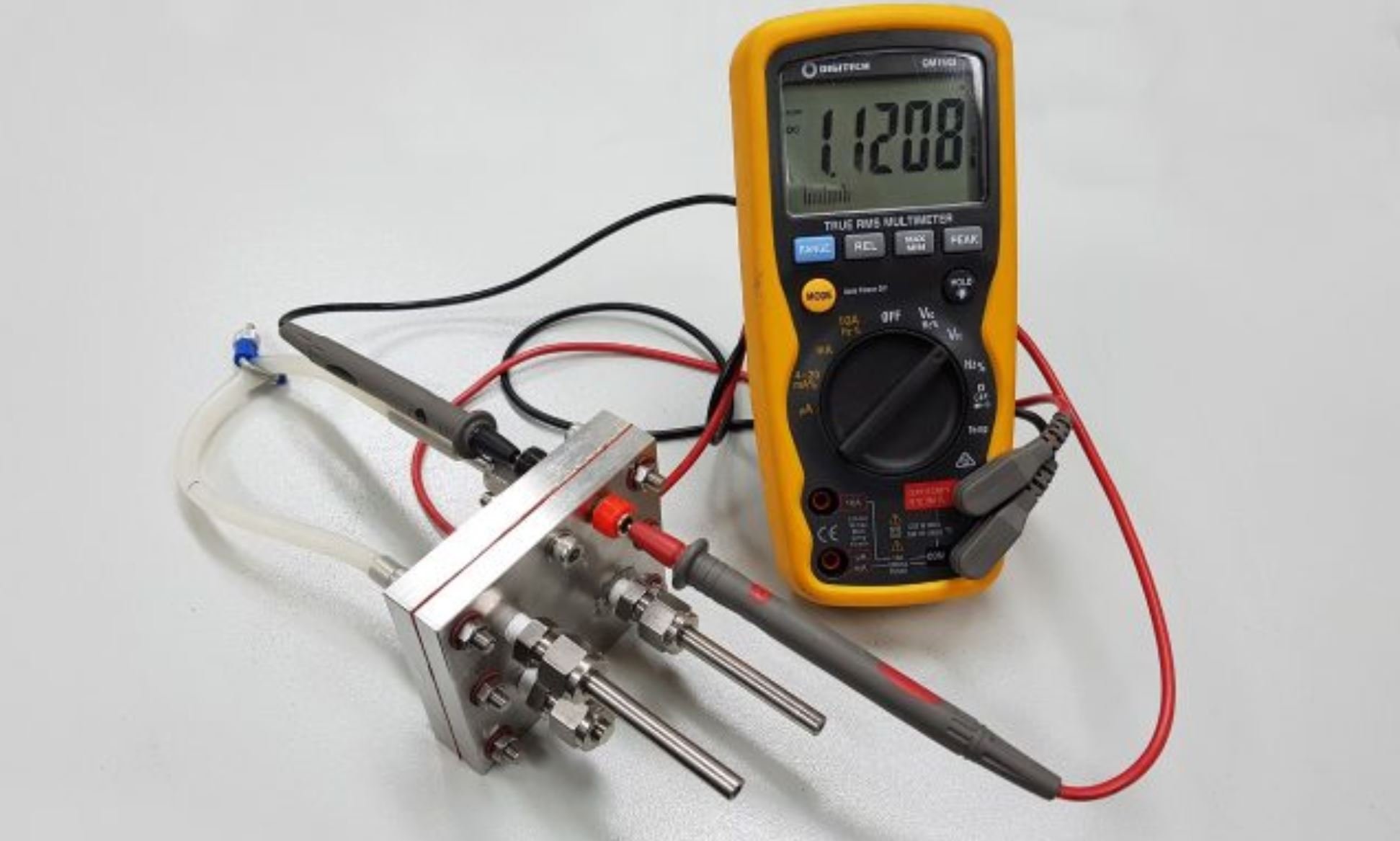
 The study is the first to show that the proton battery is technically feasible. Image: RMIT University
“Powering batteries with protons,” explains lead researcher John Andrews, an RMIT professor who has been researching sustainable energy for nearly 40 years, “has the potential to be more economical than using lithium ions, which are made from scare resources.”
The primary resource that is used in the proton battery is carbon, which, Prof. Andrews points out “is abundant and cheap compared to both metal hydrogen-storage alloys, and the lithium needed for rechargeable lithium ion batteries.”
Wide variety of applications
He and his team believe that with further development, their prototype proton battery could store more energy than today’s lithium ion batteries and they look forward to it being used in a variety of applications.
One application that they foresee it being used for is to store electricity generated by domestic photovoltaic solar panels, thus rivalling Tesla’s lithium-ion-based “power wall.”
Another application, which is feasible with some changes and scaling up, is that the proton battery could also be used to power electric vehicles and even provide medium-scale electricity storage for power grids in a similar way to Tesla’s giant lithium battery in South Australia.
The main features of the proton battery are a carbon electrode that stores “hydrogen in atomic form, rather than as molecular gaseous hydrogen in an external cylinder,” and a reversible, proton-exchange membrane (PEM) fuel cell.
The process is emissions-free because the carbon does not burn and generate carbon dioxide, as it does when fossil fuels are used to generate power.
Hybrid between hydrogen fuel cell and battery
The team describes the proton battery as a “hybrid between a hydrogen fuel cell and battery-based system” that combines the advantages of both.
To charge the battery, you just plug it into a power supply. This releases protons from water molecules in the reversible fuel cell, which then bond with the carbon electrode.
To use the battery, the reverse happens. The protons are released from the carbon electrode, pass through the fuel cell and combine with air to make water and release energy.
“It’s the carbon electrode plus protons from water that give the proton battery its environmental, energy, and potential economic edge, Prof. Andrews explains.
‘Competitive with lithium ion batteries’
In a paper that is published in the International Journal of Hydrogen Energy, the researchers report how they evaluated the proton battery’s feasibility.
There, they describe how their small prototype system – whose active surface area is smaller than a 20 cent piece – has the capacity to store energy as efficiently as the lithium ion batteries you can buy today.
Prof. Andrews says that they will now concentrate on improving the battery’s performance and energy density. This might be done by using materials such as graphene which are only one atom thick.
He and his colleagues hope, in this way, to produce a proton battery that is “truly competitive with lithium ion batteries,” he adds.
