
Rumours are rife in the UK that the country may start EU divorce proceedings – Brexit – very soon. Much of the British and American media this weekend report on claims that Prime Minister Theresa May is gearing up to invoke Article 50 during the first quarter of next year.
Article 50 is a very basic 5-point plan should any nation wish to leave the EU. The moment an EU member state invokes Article 50, negotiations concerning the separation begin.
Some experts say the negotiations will take about two years to complete, while others predict at least five years.
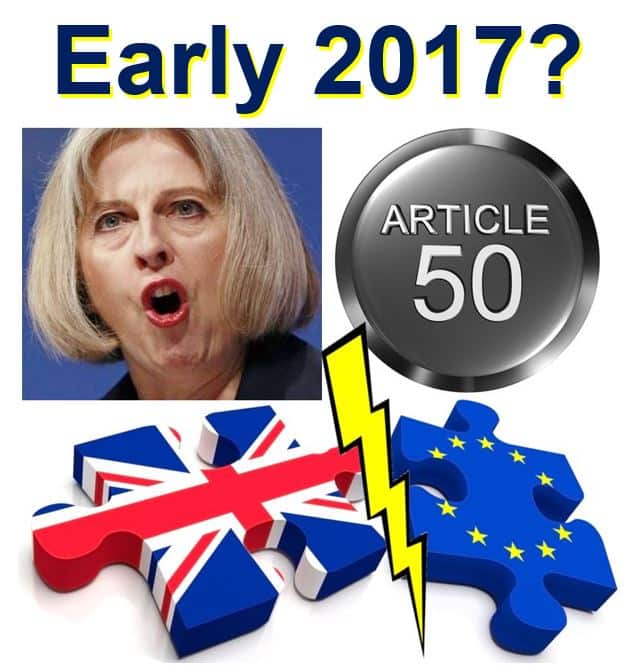 Betting odds are all pointing to early 2017, when Theresa May will invoke Brexit Article 50, and start the UK-EU divorce proceedings.
The pound sterling, which never fares well when speculators fear Brexit is looming, fell by as much as 1% – its largest decline in two weeks, as unnamed officials claimed that the Prime Minister wants to invoke Article 50 before German and French elections next year.
Brexit proceedings in Q1 2017?
France holds its first round of presidential elections in April 2017, while German parliamentary elections are set to be held in September 2017.
A Bloomberg report cites officials in London saying that Mrs. May is under increasing pressure from several quarters to invoke Article 50 soon.
Given the better-than-expected economic statistics over the past couple of weeks, many economists are starting to wonder whether the economic effects of Brexit had been exxagerated.
UKIP former leader Nigel Farage said that if the Prime Minister drags her feet on her referendum commitments she will come under growing pressure from his party and more than half the country’s electorate.
 Pressure on Mrs. May – from the electorate, (top right) Nigel Farage, (top left) Boris Johnson and hundreds of MPs – to invoke Article 50 will steadily grow.
German and French leaders will not be keen to have more economic uncertainty in the weeks leading up to their elections next year. Mrs. May is likely to take this into account, as she needs to get on well with them in order to secure a trade deal with the EU that her MPs (Members of Parliament) and voters are likely to embrace.
Does UK have a Brexit team?
If Mrs. May is aiming for the first quarter of 2017 to invoke Article 50, one wonders whether there is enough time to put together a decent and competent Brexit negotiating team . Negotiations will be tough and extremely complicated.
The British Civil Service has an excellent reputation globally as a body that can turn itself around rapidly, prepare ministers and get things up and running. If any public body is able to do this, it would be them.
The Government needs to find not only the right team, but also buildings, offices, even email addresses, etc.
The Government aims to have the Brexit negotiations team ready by the end of this year.
Experts estimate that it will take about two years to get a trade deal with the EU – that is, 24 months from the day Article 50 is invoked. Those two years will be fraught with uncertainty, rumours and volatility.
KPMG experts explore how the leave vote may impact talent management and current business models https://t.co/xiCR6yIwMy @kpmguk #Brexit
— Karen Briggs (@KarenBriggsUK) 19 August 2016
UK post-referendum economy surprises
The UK economy will probably expand at a faster rate than expected in 2016 and 2017, say economists as they adopt a much more optimistic view of things to come for the country following the Brexit vote on 23rd June.
George Osborne’s and others’ predictions of an economic meltdown have simply not happened. In fact, most economic statistics since the referendum point to a thriving economy.
Economists in the City of London now forecast GDP (gross domestic product) growth of 1.6% and 0.7% in 2016 and 2017 respectively, which is much more optimistic than July’s forecasts of 1.5% and 0.5% (respectively).
Even so, the latest more positive predictions still represent a slowdown, when compared to last year’s 2.2% growth. However, we are just at the threshold of post-referendum predictions. Panic has turned to mild optimism – who knows what economists will predict next month or towards the end of the year.
Barclays raised its July GDP growth forecast for 2016 from 1.1% to 1.5%, partly because of the better-than-expected second quarter GDP figures, which showed growth was speeding up in the months leading up to June’s referendum.
Citigroup and Commerzbank have also improved their GDP growth forecast for 2016 from 1.3% to 1.7% and 1.2% to 1.6% respectively.
These predictions come during a week of surprisingly positive news, which suggests that the economic consequences of the Brexit vote may be nowhere as severe as first feared.
Joblessness was down both during the weeks immediately before the vote and also after. Unemployment is now at an 11-year low – at 4.9%.
Consumer spending was up by 5.8% in July 2016 compared to July 2015 – an encouragement to companies that had shelved investment plans because of Brexit concerns.
The vast majority of companies in the UK sell to domestic customers. If consumer spending at home is growing strongly, companies will probably start putting their shelved investment plans back on the table.
Some economists remain gloomy, and believe it is still early days and that the downturn will eventually come. In an interview with the Daily Telegraph, Nomura’s Philip Rush said:
“This week’s numbers don’t affect my view. Asking prices for houses are getting marked down without many new listings, and as this filters into the headline numbers, this should feed consumer caution and my forecast recession.”
Video – Rally to invoke Article 50
Street demonstrations urging the Prime Minister to invoke Article 50 like this one on August 17th will become larger and more frequent.
