
English money

The UK’s top 100 directors’ earnings up 21%

Written by Joseph Nordqvist

Published: 03:39, October 13, 2014

The directors of the UK’s top 100 publicly listed companies earn 120 times the average that their employees earn, according to a recent report by Incomes Data Services (IDS).

The earnings of directors of FTSE 100 companies saw their total earnings increase by 21% at the median over the last year.

The average annual salary in the UK currently stands at £27,000. The IDS reports that a director now earns £2.43 million a year.

The rate of executive pay growth is faster than the growth of average pay. Fourteen years ago, in 2000, directors only earned 27 times more.

What has mainly driven the pay increase are share awards (to incentivise long-term performance) and bonuses, which rose by 44% and 12% respectively.

The median bonus for the directors of the FTSE 100 companies was £1,018,000, while the median value of vested long-term incentive plan (LTIP) was £1,993,500.

Basic salaries were £822,300, an increase of 2.5%, which is over three times the size of average wage growth.

Steve Tatton, editor of the IDS report, said:

“FTSE 100 directors have seen their total earnings jump sharply in the last year, fueled by a rise in the value of share based awards. Bonus payments have also recovered strongly following a downturn last year.”

“The pattern of pay growth highlights the complex make up of directors’ remuneration. Salary rises may be modest but this can be more than made up for by the receipt of incentive payments. When such incentives pay out, they can pay out substantial sums, giving a significant boost to directors’ earnings.”

Indexed median earnings movements of FTSE 350 Chief Executives versus all full-time employees 2000 to 2014:
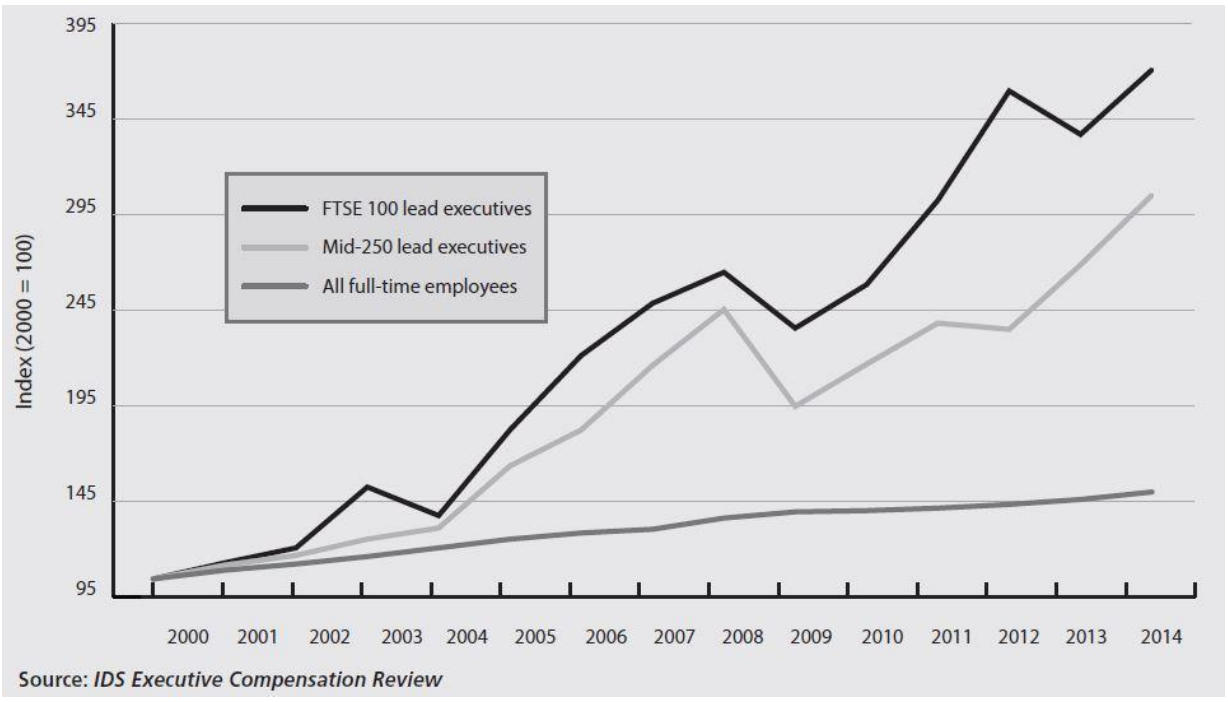
Indexed median earnings movements of FTSE Executives

Reference: “FTSE 100 Directors’ Total Earnings Jump By 21% in a Year”, Steve Tatton, IDS Executive Compensation Review”

Joseph Nordqvist Avatar

Other News

Safety reminders reduce unsafe choices in a clinical AI study

Oct 10, 2026

VEIR raises $110 million for superconducting data-center power systems

Oct 10, 2026

EU prepares €52.5 million in calls to help research reach the market

Oct 10, 2026

France secures EU approval for €40.5 million in fuel-cost loan schemes

Oct 10, 2026

EU selects 46 new projects for critical mineral supplies

Oct 10, 2026

Why a port disruption can reach factories far inland

Oct 10, 2026

Sorghum could diversify Europe’s feed crops as the climate warms

Oct 10, 2026

X-ray snapshots reveal how an enzyme builds penicillin’s rings

Oct 9, 2026

Thyssenkrupp opens Pune engineering center focused on vehicle software

Oct 9, 2026

Malaysia plans RM2,000 minimum wage with relief for smaller firms

Oct 9, 2026

Airtel Money’s London flotation puts its payments business in focus

Oct 9, 2026

More US families face heavy debt payments despite rising wealth

Oct 9, 2026

Can bikes and scooters make everyday city travel cheaper?

Oct 8, 2026

Workplace wearables: the safety promise and the privacy risk

Oct 8, 2026

International experience can help business leaders, but the fit matters

Oct 8, 2026

Housing costs and family plans: owners and renters face different pressures

Oct 8, 2026

Women in male-dominated finance workplaces report less comfort admitting mistakes

Oct 8, 2026

Second Nature Brands brings Voortman onto shared SAP platform

Oct 8, 2026

Why cloud bills can grow faster than companies expect

Oct 7, 2026

Why empty offices affect more than landlords

Oct 6, 2026